From cohort to lifelong friends: diversity and depth in the MAAI
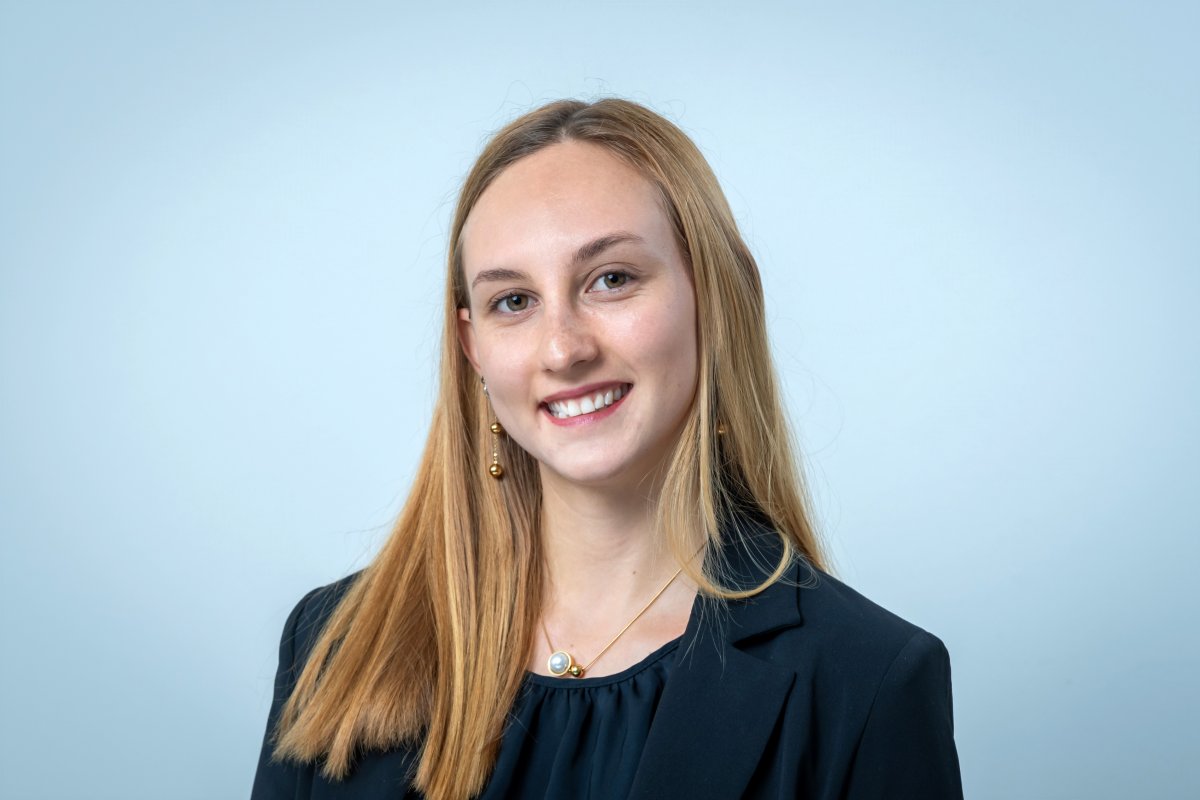
For Victoria Landazuri, Master in Analytics and Artificial Intelligence (MAAI), Class of 2027, being in a male-dominated field is a chance to offer essential perspective. In this blog, she explains how “diverse teams just build better products” and why it is vital to give women a seat at the AI, data, and decision-making table.
Finding a real community: Victoria’s story
Victoria also shares insights on her international background, and how it creates a wonderful synergy with a MAAI cohort where nearly 80% of students come from outside Germany.
Finally, she shares her MAAI highlights so far and explains how she juggles a full-time master’s degree with a job as a working student (and now an internship) at Bosch.
Hi Victoria, please introduce yourself
Hi! I'm Victoria, originally from Quito, Ecuador, where I grew up in a big loud family that I miss every day. I did my undergrad in Economics and Management in Italy and then a double degree in International Finance in Germany, which took me out of my shell and made me a very sociable introvert, and that turns out to be a surprisingly useful skill in international business school.
I'm currently finishing my Master in Analytics and AI (MAAI) at ESMT Berlin. I’m also working as a student at Bosch, where I get to build things that actually get used, which is a rare and cool feeling. Outside of spreadsheets and Python scripts I do aerial silks, run, and spend most of my time reading for each of the book clubs I'm part of.
Why did you decide to join the Master in Analytics and Artificial Intelligence (MAAI) program at ESMT?
I wanted a program that took AI seriously as a business tool, not just a technical one. I come from a finance and controlling background, and I kept seeing how much of the work I was doing could be smarter and more meaningful with the right data skills.
ESMT's MAAI felt like the right bridge, rigorous enough to actually learn something but applied enough that I wouldn't spend two years lost in pure theory. Also, Berlin.
Prior to ESMT, you lived in Ecuador and then studied in Italy. What prompted the move to business school in Germany?
I studied in Italy and honestly it was an amazing experience, I got to learn the language, immerse myself in a completely new culture, and figure out who I was a little bit more. It was also Covid times, so the whole thing had a different, almost surreal feeling to it.
I was studying Economics and Management when a visiting German professor taught a corporate finance class that genuinely changed my trajectory. He saw something in me and offered me a spot in the selection process for a double degree program in Germany. I said yes without fully knowing what I was getting into and ended up in a small town near Stuttgart studying International Finance. That's where everything clicked. I did internships there at Bosch and HUGO BOSS, fell in love with the work culture, and realized this was where I wanted to build my career.
ESMT then felt like the natural next step, right in the capital, with a very international DNA, and focused exactly on the intersection of business and technology I was already moving toward.
You are part of a global MAAI class: 75% have an international background. What is it like to be part of such a diverse cohort?
“Every group project becomes a small UN negotiation, which is chaotic and also exactly how real business works.”
It's genuinely one of the best parts of the program. Because the class is small, you get to know everyone, not just "oh that's the person who always sits in the front row" but actually know them.
The diversity means every group project becomes a small UN negotiation, which is chaotic and also exactly how real business works. The vibe is just really warm, and you feel it from day one.
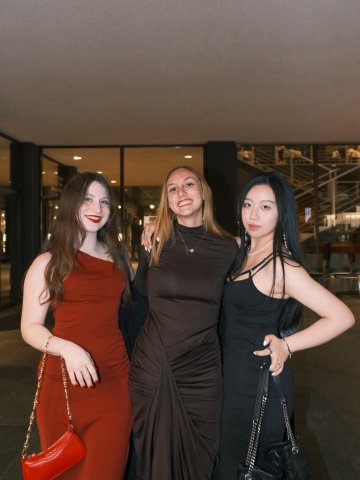


Stereotypically, the AI and Analytics field is seen as male-dominated. Do you think women can bring an interesting perspective to these data or AI topics?
“Practically speaking, diverse teams just build better products. When you're building tools that half the population will use, you probably want half the population involved in building them.”
Yes, and I think perspective is actually the key word. Data doesn't exist in a vacuum; it reflects decisions about what to measure, how to measure it, and whose reality it captures. Having women in the room when those decisions are made matters a lot.
I read Invisible Women by Caroline Criado Perez and AI Mirror by Shannon Vallor, and both books really opened my eyes to just how much the absence of women in this field has shaped the tools and systems we all use today, often in ways that are invisible until they're not.
And beyond the philosophical argument, practically speaking, diverse teams just build better products. When you're building tools that half the population will use, you probably want half the population involved in building them.
While completing your degree, you have been a working student for Bosch. How do you juggle your coursework with your job?
Carefully, and with a very good calendar. Honestly, the two reinforce each other more than they compete. When I'm studying something in class I often have a real context at Bosch to apply it to immediately, which helps it actually stick.
The harder part is energy management. There are weeks where you're finishing a case study late at night after a full day of work, and you really have to remind yourself why you signed up for this. But I genuinely love both, and that makes it a lot easier.
I've learned to plan everything that matters really well and then leave my social life completely unplanned, which sounds contradictory but is actually the only way to stay sane. Structure where it counts, flexibility everywhere else.
You are also completing your MAAI internship at Bosch. What are the advantages of interning with a company you are already familiar with?
I already knew the systems, the culture, the people, so from day one I could focus on doing actual work instead of spending three weeks reading onboarding documents. There's also a trust factor. When you've already delivered as a working student people give you more interesting problems to work on. The bar is higher but so is the opportunity.
During the internship, are you diving deeper into your working student role? Or are you exploring a new area?
Same team, different focus. As a working student, I was more on the reporting and finance side of things. For the internship I stayed in the same team but shifted toward digitalization, building tools, automating processes, developing an AI agent.
So, the context was familiar, but the work itself was a real step change. It was the right kind of challenge: unfamiliar enough to learn something new but grounded enough to actually deliver results.
Are you able to leverage any of the MAAI learnings in your Bosch role? Are there any skills seminars or classes that particularly stick with you?
“Engaging fully with the program also opened doors I didn't expect”
I have. The Ethics class was one I didn't expect to find so useful, and I mean that as a compliment. It sounds like a soft topic until you're the person deciding how an AI tool should handle data it wasn't explicitly trained on, and suddenly all those frameworks feel very real.
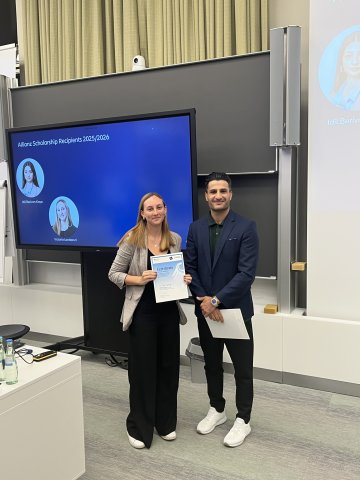
I also loved the Organizational Behavior class structure where the professor would send prep work, then lecture, then we'd apply everything in a project. That layered approach meant things actually stayed with me. SQL, mmls, causal inference, all of it shows up at work in some form. And engaging fully with the program also opened doors I didn't expect, like receiving the Deutschland Stipendium, which I'm really grateful for.

What is your advice for other master’s students who will apply for internships in the future? Are there any valuable extra skills, eg German language?
Start earlier than you think you need to. And – this is specific to German, but learn at least basic German. In Berlin you can get by without it in daily life and in many international teams it's not strictly required. But it is good to know a little and the team appreciates your willingness to learn.
Finally, I would say: be open to learning. In the interviews show what you know, but it is always important to show how willing you are to learn.
You have taken part in some in-demand extracurriculars, like the Munich Young Forum. What was that like, and did it add to your ESMT experience?
“I actually got to speak up and share my perspective during one of the sessions, which was terrifying and also exactly why I said yes to going.”
It was one of those experiences where you walk in slightly unsure of what to expect and walk out genuinely different.
The Munich Young Forum is a side event of the Munich Security Conference, hosted at Siemens HQ, and the theme this year was Living on the Edge which felt very appropriate for the state of the world right now. The conversations covered everything from space security to cybersecurity to the future of the European order.
What made it special wasn't just listening though. I actually got to speak up and share my perspective during one of the sessions, which was terrifying and also exactly why I said yes to going. I'm really grateful that ESMT creates that kind of access for students.
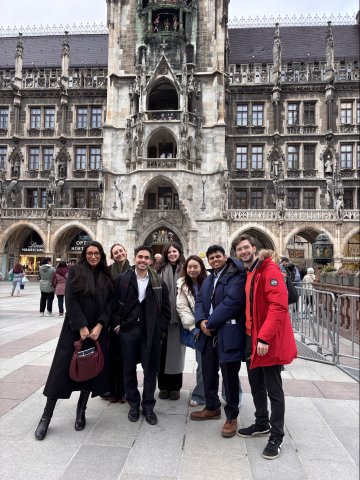


What are your favorite memories from the MAAI so far?
“I really appreciate ESMT's emphasis on attendance because it creates a warm environment where people are actually present and engaged.”
The Welcoming Week without a doubt. It's what made this feel like a real community from the start, not just within the MAAI cohort but across programs, which you don't always expect.
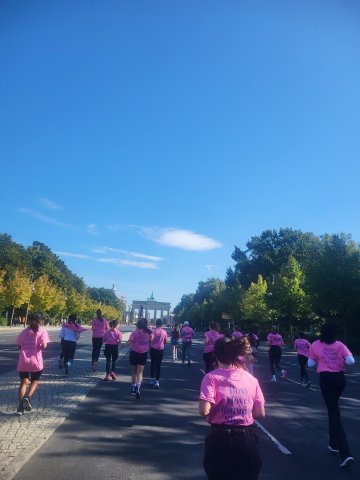
The Secret Santa at Christmas I organized with my cohort was genuinely fun and one of those evenings where you realize how comfortable you've gotten with people in such a short time. I appreciate the opportunity to be part of the Women in Leadership Club and be in events such as the run for Breast Cancer Awareness. And then all the spontaneous things that came after, going to the opera together, Christmas market trips, traveling with friends you met just months before.
And honestly, just the small everyday moments too, sitting in class with people from completely different countries, participating, laughing, learning from each other.
I really appreciate ESMT's emphasis on attendance because it creates a warm environment where people are actually present and engaged. The people I've gotten to meet have given me some of my best memories from this first year.
If you would like to hear more insights from Victoria about life in the Master of Analytics and AI, or about her role at Bosch, you can follow her on LinkedIn.


Want to stay up to date with life at ESMT?
