Technology, scale, impact: inside a Deutsche Telekom internship
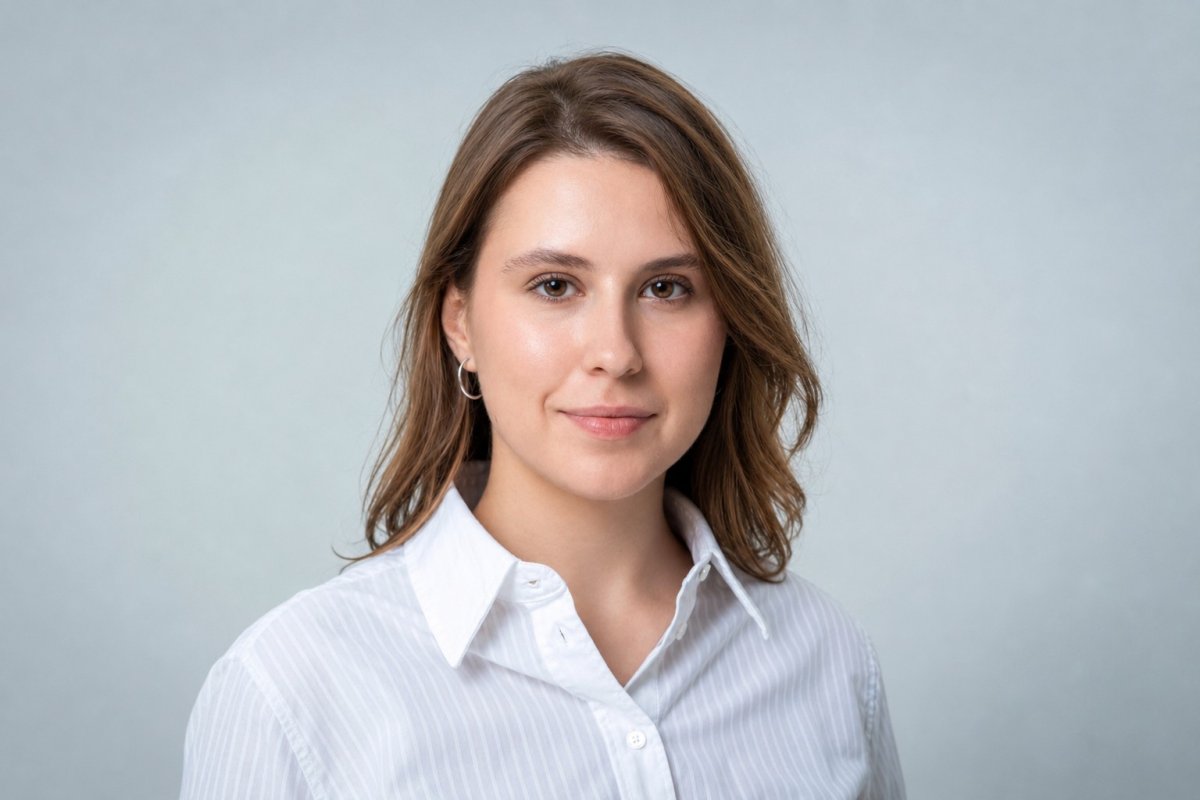
Master in Analytics and Artificial Intelligence student Alexandra Romanova, Class of 2027, thrives at the intersection of technology, international scale, and societal impact. This made her a natural fit for the Master in Analytics and Artificial Intelligence (MAAI) program at ESMT – and for an internship with Deutsche Telekom, one of ESMT’s founding partners.
Why staying curious opens doors: Alexandra’s story
In this blog, Alexandra explains how being curious has led to an international path that has taken her from the UN’s International Atomic Energy Agency in Vienna, to the MAAI program at ESMT in Berlin, and now to an exclusive internship as a Leadership Excellence Intern at Deutsche Telekom.
She also shares some of her favorite things about the MAAI program: from the ongoing value of an international, diverse cohort, to the leadership applications of AI, to the lifelong friendships made along the way.
Hi Alexandra, please introduce yourself
Hi! I'm Alexandra, but most people call me Sasha. I'm currently doing the Master in Analytics and Artificial Intelligence at ESMT Berlin.
I did my undergraduate studies in Business and Economics in Vienna, and before ESMT I got to work in quite different worlds – an internship at the International Atomic Energy Agency, part of the UN system, and earlier experience in the pharmaceutical industry. That mix of international, mission-driven environments really shaped the direction I wanted to take, and it's a thread I've kept pulling on ever since.
What drew you to the Master in Analytics and Artificial Intelligence (MAAI) program at ESMT?
I wanted a program that took the technical side of analytics and AI seriously but didn't treat it in isolation. I was interested in how these tools actually get used inside organizations, and in the questions around them, like ethics and responsible AI. ESMT had that balance. But honestly, the international character of the school was just as decisive for me. ESMT promised exactly that, and it delivered.
You completed your undergraduate studies in Austria, what then drew you to Germany?
Vienna set the tone in a way: it's a deeply international city, and the UN presence there was a big part of my early experience. So Berlin felt less like a leap and more like a natural next step. It's one of the most open, international cities in Europe, with a real pull in tech and innovation, and ESMT sits right in the middle of that, connected to where the field is actually moving, without asking me to give up the international atmosphere I valued in Austria.
More than three-quarters of your MAAI cohort have an international background. What is it like to be part of such a global class?
“You stop assuming your own perspective is the obvious one, which is exactly the mindset the AI field needs.”
It's genuinely my favorite part of the program. An international setting is something I actively look for. It's where I feel most at home and, frankly, most challenged in a good way.
You're constantly around people who approach the same problem from a completely different angle because of where they come from and how they think. You stop assuming your own perspective is the obvious one, which is exactly the mindset the AI field needs.
The AI and Analytics field can be diverse – but also male dominated. Do you think women can bring a unique perspective to these data or AI topics?
“To me that's not a diversity checkbox, it's just better engineering. Teams that see more of the world build AI that works for more of it.”
Here's how I see it. AI doesn't fall from the sky. It's built by people, trained on data we choose, and optimized toward outcomes we decide matter. It inherits whatever world view is standing behind it.
So, when a field is dominated by one type of person, the technology quietly starts assuming the world looks like them – and at AI's scale, that assumption gets multiplied across millions of decisions.
That's the part I find genuinely interesting: the people in the room aren't just doing the work, they're defining what "normal" means for everyone the system touches. Women are one of the voices that keep that definition honest, and so is anyone who brings a different starting point. To me that's not a diversity checkbox, it's just better engineering. Teams that see more of the world build AI that works for more of it.
You are currently completing your MAAI internship as a Leadership Excellence Intern at Deutsche Telekom. How did you secure this opportunity?
I went into it very intentionally. I knew I was interested in IT broadly and tele-communications in particular, an industry sitting right at the intersection of technology, scale, and real societal impact, which is what motivates me.
So Deutsche Telekom was a deliberate target, not a coincidence. I studied the company properly before applying – its strategy, its priorities, the way it talks about leadership and transformation – and I tried to be as structured as possible throughout: how I prepared, how I mapped my experience to the role, how I answered the interview questions. I went in honest about wanting to learn, and I think that, plus the preparation, came through.

You are one of the students who managed to land an exclusive ESMT internship with one of our founding companies. What is that like and how is it going?
It's a privilege to be here at Deutsche Telekom. I'll be honest here: a lot of people like to say everything's amazing and that they arrived already knowing it all. I'd rather be real. My background is primarily in business and finance, so HR and leadership development is a new branch for me – I came in genuinely curious to learn it, and to see where the analytics and AI knowledge I've gained at ESMT could fit in.
That's part of why I'm so grateful to DT. They brought me straight into the projects they're working on around leadership development and T-Style, Deutsche Telekom's own leadership culture and the shared principles they expect from their leaders. I've gotten to contribute to real work: shaping program content, helping organize team offsites, seeing how much thought goes into something that looks effortless from the outside.
My colleagues at DT have been genuinely supportive, which makes the learning curve a pleasure rather than a pressure.
Are you able to rely on any MAAI learnings in your internship? Are there any skills seminars or classes that are sticking with you?
“The most useful thing the program gave me isn't a single tool, but a way of structuring problems”
Definitely. The most useful thing the program gave me isn't a single tool, but a way of structuring problems – breaking something ambiguous into parts you can actually analyze. The operations and analytics courses trained that muscle, and I use it constantly.
The AI side stuck with me too, especially how universal it is – once you think that way, you spot places to apply it everywhere, including leadership development, where it can make processes simpler and more optimal.
What is your advice for other master’s students who will apply for internships in the future? Are there any must-have skills, eg German language skills?
“Go in wanting to learn rather than to perform; people can tell the difference.”
Be structured and specific! Don't apply broadly and hope. Pick the places you actually care about, study them genuinely, and be able to say why that company and that role. Go in wanting to learn rather than to perform; people can tell the difference.
On language: at ESMT and in international companies like Deutsche Telekom you can absolutely work in English, so not being fluent in German shouldn't stop anyone. That said, even a little goes a long way here – practically, and as a signal you're invested in being in Germany. I'd treat it as a real plus, not a barrier.
Beyond the classroom, do you take part in any student clubs or ESMT activities? What does this add to your experience?
I follow the Tech and Innovation Club. I also never skip the office visits ESMT organizes; the one to Deutsche Bank was a highlight. But honestly, the life of the program happens just as much in the informal moments – the group work that turns into friendship, the conversations after class, the social side of Berlin we discovered together. That's what made the cohort feel like a community rather than a class list.
What are your favorite memories from the MAAI so far?
Without questions, they're all tied to people. The friendships I've made here are what I'll carry with me longest. And the teachers too: the ones who were generous with their time and pushed me to think differently. When I look back, it's never going to be about the coursework. It's the people I was lucky enough to go through it all with.
Thank you, Alexandra!
If you would like to hear more about Alexandra’s international learning journey, and see more insights about the MAAI at ESMT Berlin, you can follow her on LinkedIn.


Discover more ESMT stories
