#OneInOneMillion: ESMT Berlin joins a milestone Erasmus+ celebration
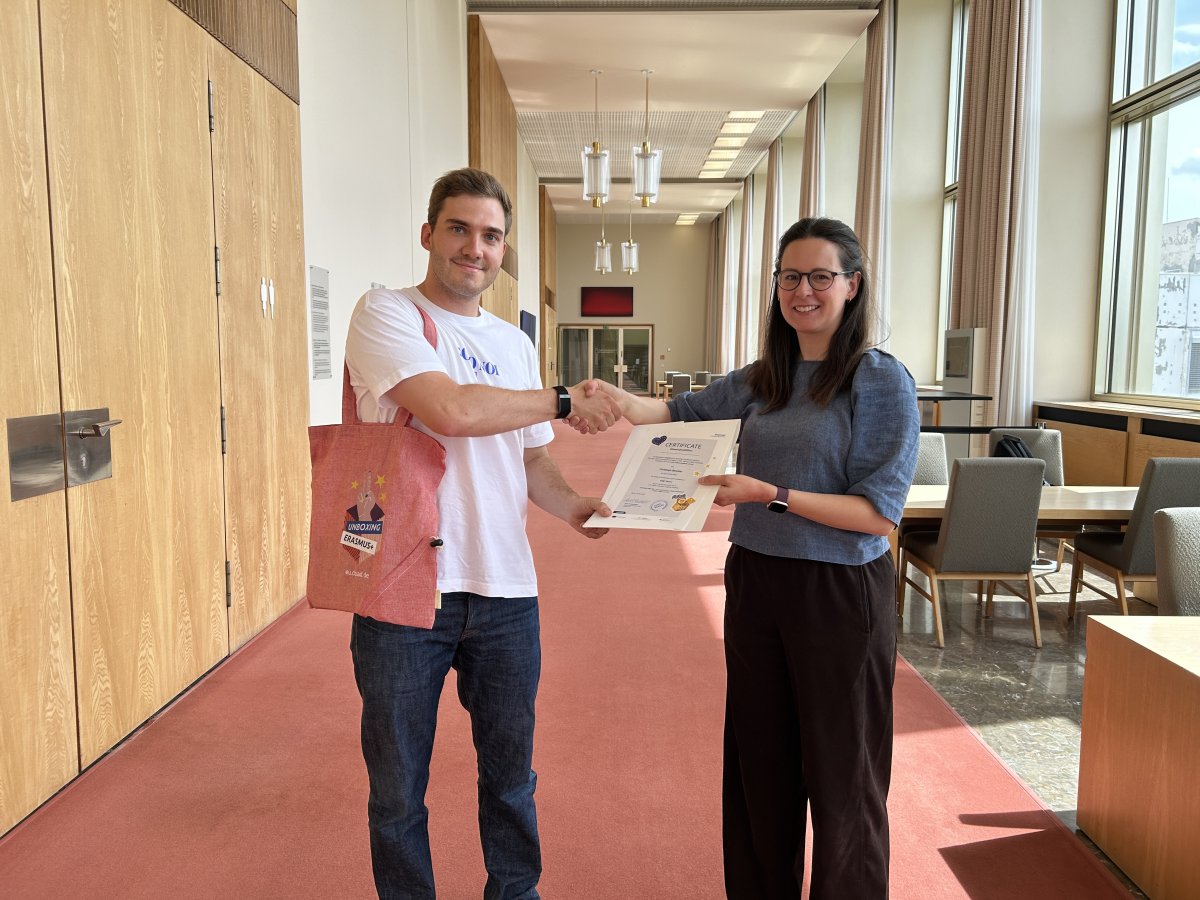
Since the launch of Erasmus in 1987, German higher education institutions have enabled one million mobilities abroad. To celebrate this major milestone, the German National Agency for Erasmus+ (NA DAAD) is running a nationwide campaign called #OneInOneMillion – and ESMT Berlin is taking part.
Our representative for the #OneInOneMillion celebration is Christoph Beickler, a Master in Analytics and Artificial Intelligence (MAAI) student, Class of 2026, who completed a student exchange semester at Università Bocconi.
Anna Frankowska, the Head of International Office at ESMT Berlin, said "We were very impressed with how Christoph handled the workload, given the high level of technical subjects. We also appreciated his proactive communication and persistence in seeing his experience through. This is a brilliant trait for an exchange student, and an ESMT representative."
Ciao, Bocconi: Christoph’s story
In this blog, Christoph explains what it is like to study in Milan, and why he thinks exchange programs are such a valuable part of the student experience. He also takes us inside his favorite moments at ESMT, including his internship where he was able to get hands on with the real-world applications of AI.
Hi Christoph, please introduce yourself
Hi, my name is Christoph and I am originally from Munich, Germany. I am currently in my final semester of the Master in Analytics and Artificial Intelligence (MAAI) program at ESMT, writing my master's thesis.
Last winter semester I had the opportunity to study abroad at Bocconi University in Milan, and after graduation I will be joining SIXT as an AI/ML professional.
Why did you decide to join the Master in Analytics and Artificial Intelligence (MAAI) program at ESMT?
When I decided to pursue a degree in the field of Data Science and AI, I was torn between a technical university and a business school. I ultimately chose a business school because I wanted to learn how to apply technical methods in practice, rather than studying them purely in theory.
Out of all the programs I looked at, the MAAI at ESMT stood out the most. It felt very current and relevant, and the exchange semester options also played a big role in my decision.
Your MAAI classmates come from all around the world. What is it like to be part of such a diverse cohort?
I think the diversity of our cohort is one of the best things about the program. We have so many different nationalities represented in our class, and I feel really lucky that we ended up with such a great group of people. I made some very good friends here, and that is something I will take with me long after graduation.
You are the ESMT representative for the #OneInOneMillion Erasmus+ campaign. Congratulations! How does this feel?
Honestly, I am not really someone who receives awards that often, so it was a bit unexpected. But I am genuinely happy about it, mainly because it gives me the chance to represent ESMT and talk about my experience abroad. I hope it encourages other students to do the same.

Why do you think Erasmus exchange trips are such a valuable part of the student experience?
“You get to experience a new culture, meet people from all over the world, and build friendships that you would never have made otherwise.”
I think the value of an Erasmus exchange goes beyond just the academic side. You get to experience a new culture, meet people from all over the world, and build friendships that you would never have made otherwise.
On top of that, in my case I had a lot of freedom in choosing my courses at Bocconi, which allowed me to really tailor the semester to my own interests.
Can you tell us about your Erasmus exchange trip to SDA Bocconi? How long was the exchange and how did it go?
I really enjoyed my time at Bocconi. The exchange ran from September to the end of January, so about five months in total. I have to say, though, academically it was quite challenging. I had chosen very technical courses, and especially one programming course was really tough. A lot of students actually failed it, which was something I was not used to from ESMT. But I found the courses very interesting and it pushed me a lot.
And of course it was not all just studying. I also had a great social life in Milan, made some really good friends, including one guy from Milan I met through playing Padel, and became friends with Ben from the Master in Global Management (MGM) program, who I had only ever seen around campus at ESMT before.
Did you have to apply to Bocconi to take part? How did the ESMT International Office help support the exchange?
“ESMT described every step clearly and we had great support from Verena at the International Office, who was always there to help.”
The application process was actually very straightforward. ESMT described every step clearly and we had great support from Verena at the International Office, who was always there to help. After getting accepted, I could then choose my courses directly from Bocconi's course catalog
Why did you choose to study in Italy? What are the differences between studying in Berlin and studying in Milan?
“The academic culture at Bocconi is quite intense and competitive, whereas ESMT has a more collaborative atmosphere.”
Bocconi was actually my second choice, but honestly any of the universities in my top five would have made me happy. What drew me specifically to Italy and Milan was the food, and of course the reputation of Bocconi, which also has a very strong technical department.
As for the differences between Berlin and Milan, studying in Milan felt quite different. The academic culture at Bocconi is quite intense and competitive, whereas ESMT has a more collaborative atmosphere.
Why do you think it is important for future business leaders to gain global experiences?
I think the two biggest reasons are the network and the academic experience. You meet people from all over the world that you would never have crossed paths with otherwise, and those connections can be really valuable later in your career.
But also academically, I personally learned a lot during my time abroad. You get exposed to different ways of teaching and thinking, which broadens your perspective in a way that staying at one university simply cannot.
You have done other interesting things during your MAAI, like an internship where you helped build an AI chatbot. Can you tell us a bit about that?
Yes, I did an internship at a small Berlin-based startup where I built a coaching chatbot. The foundation was a GPT model that was customized to fit the specific needs of the company. What I really appreciated was that the founder gave me a lot of freedom to work independently, which I think would not have been possible in a large corporate environment.
I had a five-figure budget in Azure credits and was able to gain real production experience, rather than just working on Data Science projects in isolation. I think that is extremely valuable, because understanding how to integrate AI and bring it into production is something that goes far beyond building a chatbot.
With graduation day approaching fast, what are your favorite memories from the MAAI?
“What I will remember most is the atmosphere in class, we had a really great group of people and it always felt very open and collaborative.”
It is hard to pick just one thing. I think what I will remember most is the atmosphere in class, we had a really great group of people and it always felt very open and collaborative. Then there were the table tennis breaks, which became a bit of a ritual for us. And of course the great friends I made along the way.
Thank you, Christoph!
You can follow more of Christoph’s career progress and next steps on LinkedIn.


Learn more about ESMT life
