Hope in Romania: An online MBA alum’s humanitarian motivation
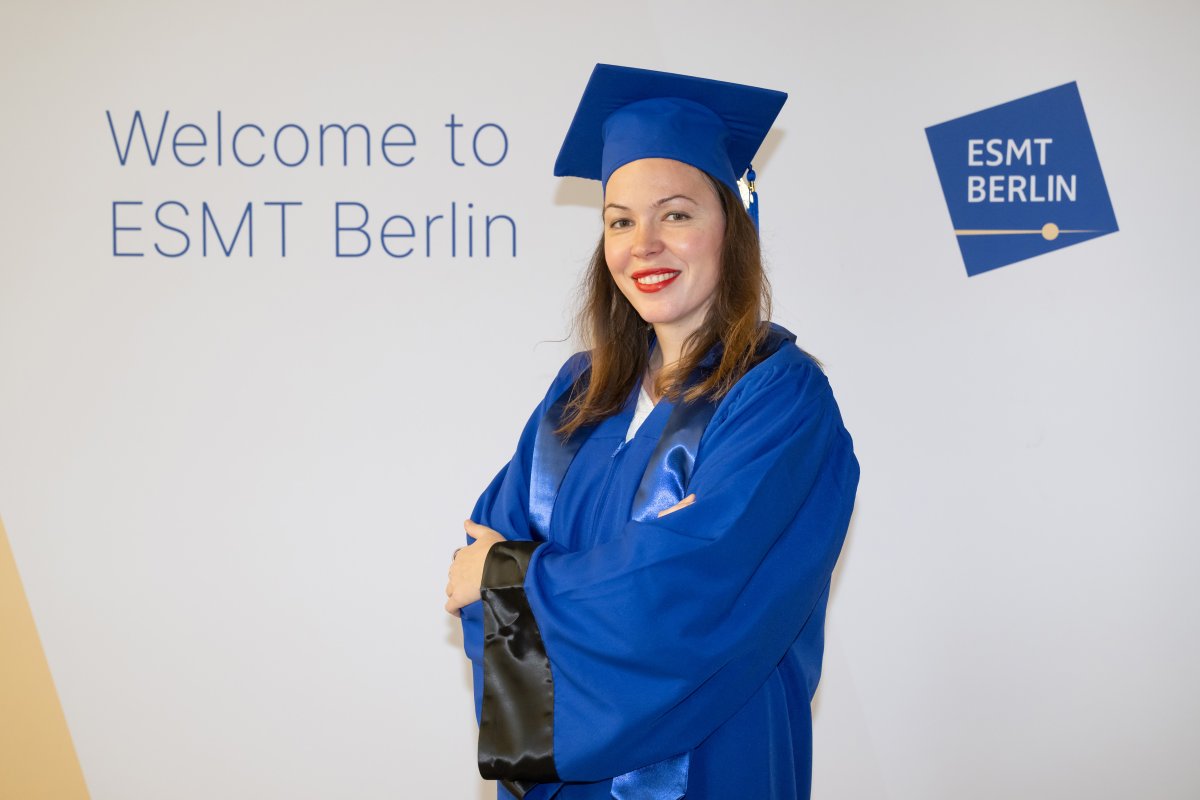
For Cătălina Costache, Global Online MBA Class 2025, joining ESMT was “an extraordinary opportunity:” for growth, learning, networking, and, above all, for strengthening her mission to help Romanian children born with congenital heart defects lead happier, healthier lives.
A transformational experience: Cătălina’s MBA story
In this blog, Cătălina explains how what you learn in the Global Online MBA program can help those in the humanitarian sector make an even more powerful impact. She also shares how the online format of the program made it possible for her to juggle MBA studies with her full-time role as the Executive Director of Polisano Foundation, a Romanian NGO.
Additionally, Cătălina explains how her cohort managed to forge ongoing bonds, despite being separated by oceans and continents, and how those ties remain active even after graduation.
Hi Cătălina, could you please introduce yourself?
My name is Cătălina Costache, and for the past 11 years I have been the Executive Director of Polisano Foundation, a non-profit organization in Romania dedicated to helping children born with congenital heart defects access life-saving surgeries.
By training, I am an economist with a master's degree and a PhD in finance and management. After more than a decade working in the financial sector in France, I returned to Sibiu, Romania and redirected my career entirely toward humanitarian work. My deepest motivation is to improve access to healthy lives for Romanian children. I am also the President of the Association of French Citizens in Sibiu.
Congratulations on completing your Global Online MBA! Why did you decide to join an online MBA program?
“I knew it could only benefit the organization I lead. So, I said yes, and I gave it everything.”
Honestly, it started with a mix of curiosity and a little bit of "let's just see what happens." The opportunity came through Allianz Tiriac, the principal sponsor of our foundation, who believed in us and put forward the recommendation. I had real doubts about whether I would even be admitted to such a prestigious school – I did not take it for granted at all. But once I was accepted, the weight of that commitment became very real to me.
At the same time, I was deeply convinced this was an extraordinary opportunity – for learning, for personal growth, and for connecting with remarkable people from all over the world. I knew it could only benefit the organization I lead. So, I said yes, and I gave it everything.
What was it like to study online? What were the online learning tools like?
Online was unquestionably the right format for me – in person simply would not have been possible. I am also a mother of two boys, including a teenager, and I am not, by nature, a very structured person. So, the flexibility was essential.
The online format came with real advantages: the accessibility of course materials, instant connection with professors and classmates across time zones, the ability to organize my own schedule. I genuinely appreciated the variety of learning formats – videos, live classes, team projects – and I found the online platform surprisingly intuitive, which was a relief since I am more of a humanist than a tech person.
But there were challenges too. I had to find ways to keep the foundation running, sometimes in what I would describe as "cruise mode" – or honestly, survival mode – during the most intense periods. And there were many evenings when, after putting the children to bed, I sat back down at the laptop for what felt like a second full workday. The personal motivation required for that, night after night, was something I had to consciously cultivate.
Were you able to network with your cohort online? Did you get to meet each other in person?
“Some of those connections have continued well beyond the program – and I smile every time I see that the WhatsApp groups we created for our study groups are still active”
Very much so, and this was one of the most enriching dimensions of the experience. My cohort was wonderfully diverse – colleagues joining from Africa who sometimes lost connection due to power outages, others logging in from airports between flights for multinationals, some adjusting to call times that fell at unusual hours. That diversity taught me a great deal about multiculturalism in practice, something I rarely got to experience at the foundation, given how small our team is.
We met in person at the Berlin Experience Week, at an elective I chose in Berlin, and of course at graduation. Some of those connections have continued well beyond the program – and I smile every time I see that the WhatsApp groups we created for our study groups are still active, with messages still coming in long after we graduated.
Were you able to visit the ESMT campus at all during the program? What was that like?
Yes, during Berlin Experience Week and at graduation. What struck me most was how tradition and innovation are woven together – both in the architecture and in the spirit of the place. There is something quite special about learning in a space that carries history while looking firmly toward the future.

You are the Executive Director of Fundatia Polisano in Romania. What does Fundatia Polisano do, and what does your role involve?
Polisano Foundation is a Romanian non-profit organization with a very clear and urgent mission: to ensure that children born with congenital heart defects can access the surgeries that will save their lives. Congenital heart disease is the most common birth defect globally, and in Romania, many families face enormous barriers – financial, geographic, and systemic – to getting their children the care they need.
As Executive Director, I oversee every dimension of the organization: fundraising and donor relations, partnerships with international medical teams who come to Romania to perform these surgeries, communication and the development of new initiatives. Over the years, we have expanded beyond surgeries to include prevention campaigns and community programs, always with children's heart health at the center.
You work in the humanitarian and NGO space. How does an MBA help in this sector?
“An MBA teaches you to think systematically about problems that can feel overwhelming when you are in the middle of them.”
When I first started the program, I genuinely wondered whether it would be relevant to a small non-profit. I was wrong. There was not a single course in which we were not challenged to apply the concepts and frameworks to our own organizations – and I discovered that everything translated, even if at a smaller scale. Agile Leadership, Logistics, Strategy – all of it. It was sometimes counterintuitive at first, but the principles hold regardless of sector or size.
An MBA teaches you to think systematically about problems that can feel overwhelming when you are in the middle of them. In the humanitarian field, where resources are always limited and the stakes are always high, that kind of structured thinking is not a luxury – it is essential.
Have any teachings or learnings from the MBA particularly stuck with you?
The concept that has stayed with me most deeply is the Blue Ocean mindset – the courage to innovate rather than compete, to create something new rather than replicate what already exists.
In the humanitarian field, innovation does not necessarily mean technological progress – that is often outside our control. But it can mean the courage to be first. A few months after graduating, we launched the first jump rope championship for children in Romania, under the banner of heart health prevention. And we have just opened the first charitable art gallery in Romania, in the historic center of Sibiu – the Heartfully Gallery – where all funds raised go directly toward heart surgeries for children.
The idea of bringing good into the community through art had already begun to take shape while I was still an ESMT student. We are even hosting an exhibition as part of the Sibiu International Theatre Festival, one of the top three theatre festivals in the world.
I am deeply grateful for the people who inspired me and who allowed us to bring Romanian charity to an innovative new level – for the benefit of children.

What was it like to balance the demands of an Executive Director role with the demands of MBA studies? Do you have any time management tips?
It required a kind of iron discipline that does not come naturally to me at all. I knew that whatever I did not complete today would be doubled tomorrow – and that awareness became its own motivator.
My family's support was invaluable. My partner, who is a graphic designer, helped me with layouts and visual work, including for my final project. I also learned to ask for help more readily – and within my study groups, I became more intentional about taking on the tasks where I could genuinely contribute, so we could work more efficiently together. We shared a lot with each other: textbooks, time management resources, tips and strategies.
As for balance – it was fragile. I often felt I was juggling too many things at once. In the end, I had to give myself permission to be kinder to myself, to let go of the pressure to finish first in my cohort, as I might have pushed for in previous academic contexts. That was its own kind of learning.
You had some support from Allianz during your Global Online MBA. How did this make it possible for you to succeed?
Allianz Tiriac has been the principal sponsor of Polisano Foundation for nine years. They know our work deeply, they trust us, and their recommendation for this opportunity came very naturally from that relationship. Their support made the program financially accessible to me – but more than that, it was a signal of belief. Knowing that an organization of that caliber sees value in investing in your growth is empowering. It added another layer of responsibility, in the best sense of the word.
What is your favorite memory from your time at ESMT?
A boat cruise along the Spree river in Berlin, in the summer, with my Berlin Experience Week cohort. It was one of those moments where you look around and think: these are remarkable people from all corners of the world, and we have somehow found each other here. That feeling of warmth and connection – after so many months of late-night study sessions on a screen – was something I will carry with me for a long time.
What tips would you give to someone considering applying to the Global Online MBA program? What is one thing you wish you had known before you started?
“It is a transformational experience – not just in terms of knowledge, but in terms of who you become.”
I would tell them this: it is a transformational experience – not just in terms of knowledge, but in terms of who you become. I am an idealist by nature, a dreamer, not particularly organized. And yet I discovered through this program that I can be deeply pragmatic when it matters, that I can set strict deadlines and meet them, that I can think in systems.
I also learned to dream bigger for my organization. Everything begins with a vision. The MBA gave me the confidence – and the tools – to Think Big, and to innovate in service of that vision.
So my advice is simple: apply. And go in ready to be surprised by yourself.
Thank you, Cătălina!
Cătălina Costache is the Executive Director of Polisano Foundation in Romania. If you feel inspired by her story and her work with the foundation, you can follow her on LinkedIn for further insights.


Want to read more from ESMT?
