Incredible experiences you didn’t plan for: a Part-time MBA while working full time
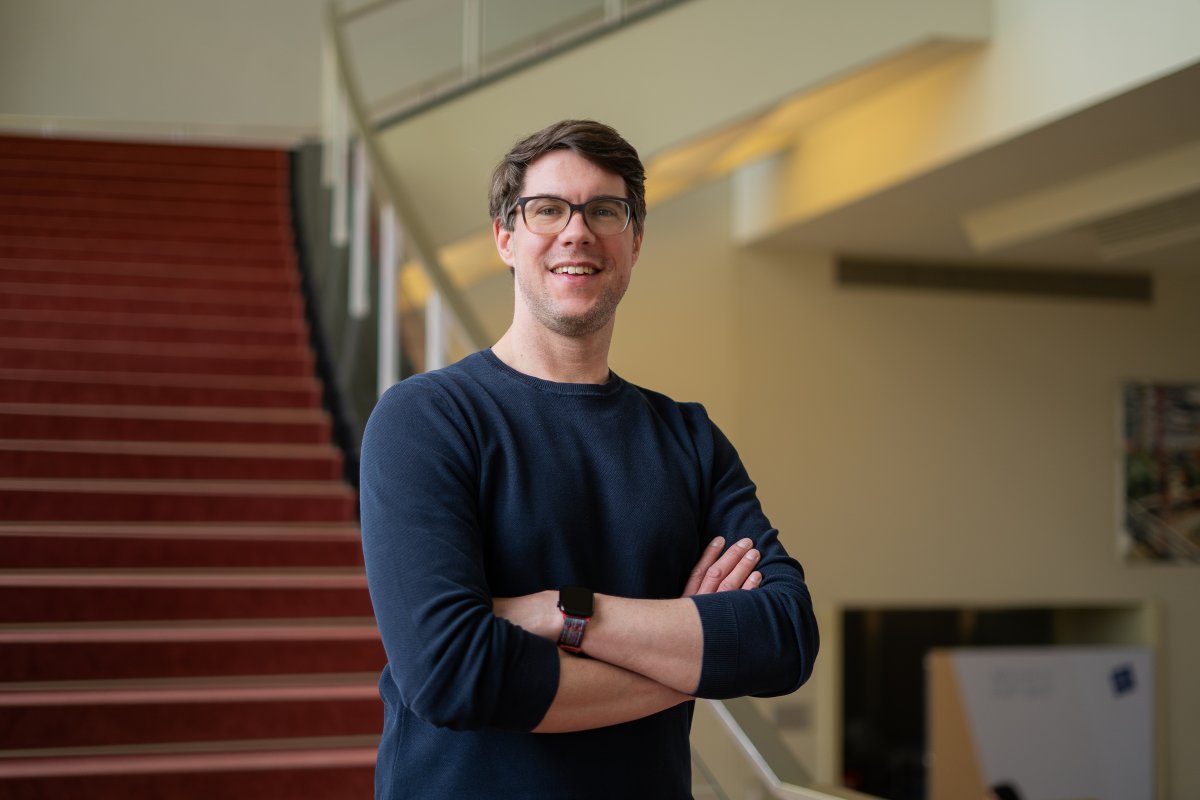
For Part-time MBA student Jan Zimmermann (Class of 2026), choosing to study for an MBA while working meant choosing a busy schedule. It also meant choosing a program that would reward this hard work. It meant a new network of peers, it meant international exposure, and, above all, it meant a “genuinely different way of operating.”
Making the most of the Part-time MBA: Jan’s story
Here, Jan reflects on some of his personal program highlights. He also shares how the program’s in-person residencies build incredibly strong cohort bonds and outlines how the part-time format lets those with busy careers apply their learning in real time.
And he explains how some of his favorite moments came from the things he didn’t expect – like being part of the #1-ranked part-time MBA team at the Gilead Pharma Case Competition, studying in Seoul, and co-founding the Healthcare Chapter of the ESMT Alumni network.
Hi Jan, please introduce yourself
Hi, I'm Jan. I've been with Shionogi for four and a half years, currently leading Customer Excellence & Operations at our DACH affiliate, where I focus on commercial operations. Shionogi is a Japanese specialty pharmaceutical company, and our work in this region centers on antimicrobial resistance (AMR), one of the most pressing challenges in global health today. I'm based in Berlin, and alongside my role I'm currently completing the Part-time MBA at ESMT.
Why did you decide to get your MBA at ESMT Berlin? What drew you to the Part-time MBA program in particular?
“The part-time format was non-negotiable for me because staying in my full-time role…meant I could test what I was learning in real situations from day one”
I'd reached a point in my career where I wanted to push beyond what my day-to-day role naturally exposes me to: broader strategic frameworks, sharper financial thinking, and a wider lens on how businesses are run beyond pharma. ESMT was the obvious fit. As Germany's leading business school, it offered the academic rigor and international cohort I was looking for.
The part-time format was non-negotiable for me because staying in my full-time role at Shionogi meant I could test what I was learning in real situations from day one, rather than stepping away from the work that was making the MBA worth doing in the first place.
What is it like to balance studying with working full time?
I won't pretend it's easy. The first stretch was particularly demanding. Going back to university while holding down a full-time job and being present for my family is a lot to take on at once. After the initial adjustment period, I found ways to balance everything, though obvious trade-offs still had to be made along the way. It only worked as well as it did because of the strong support from my family, and because I was able to bring learnings directly back into my job, with tangible benefits showing up from the very first week.
Do you think the Part-time MBA can be useful for those looking for career transitions or promotions?
Yes, absolutely. For both. The additional knowledge gained in the classroom, combined with the network you build along the way, supports both directions equally well.
I find it useful to think about this through a personal version of the Ansoff Matrix: career moves can be plotted along two axes: the function you do and the industry you do it in. A promotion is often "same function, same industry, but deeper"; a transition is moving along one or both axes into less familiar territory.
The part-time format, spread over 24 months, is what makes either route feasible, because it allows for a gradual, step-by-step shift rather than a single high-risk leap. That being said, it doesn't happen automatically. You still need to actively steer it and put in the work to translate the program into real outcomes.
Can you tell us more about your cohort? What is it like to spend time together in person after meeting each other online?
“It's no surprise that long-lasting relationships are built by going on this journey together. Having people from so many different backgrounds…is energizing, and it brings real diversity into every discussion.”
The residencies are a key part of the program: we come together for two weekends per quarter and spend a lot of time together, both in the classroom and outside of it over dinners and other social moments. It's no surprise that long-lasting relationships are built by going on this journey together. Having people from so many different backgrounds (both geographically as well as professionally) in the room is energizing, and it brings real diversity into every discussion. We spend most of our time online, so coming together in person is always a real pleasure.
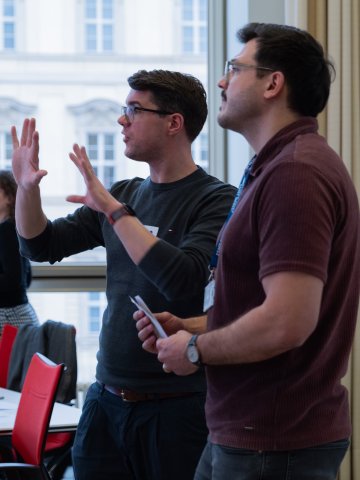

Images above: Jan and some of the Part-time MBA cohort, Class of 2026
How about beyond the classroom – are you a part of any student clubs or alumni chapters?
As a part-time student with a full-time job, I haven't yet joined any of the fantastic student clubs on offer. However, I've teamed up with an alumnus, Peter, to help formalize, structure, and develop the Healthcare Chapter of the ESMT Alumni network. This is an exciting initiative I'm really looking forward to building out further.
Can you tell us more about the ESMT Healthcare Alumni chapter?
Up until last year, ESMT alumni chapters were mostly organized geographically, with former students coming together based on proximity in cities and regions. Peter and I, both sharing a healthcare background, met at ESMT and decided to set up the Healthcare Chapter.
This chapter is open to all current students and alumni working in and around life sciences and healthcare. We've kicked things off with a series of virtual meetings featuring external speakers, and we're planning to further grow the network among alumni following this summer's Annual Alumni Meeting in Berlin.
Do you think more people in the healthcare space should consider an MBA?
Honestly, I think this goes beyond healthcare. Anyone who wants to broaden their profile and pick up new skills and perspectives should consider an MBA or a similar program.
Grant's resource-based view offers a useful lens here: sustainable advantage comes from a bundle of capabilities that are valuable, rare, and hard to imitate, not from any single skill in isolation. As AI continues to commoditize task-level work, individual technical skills are losing rarity fast. What stays defensible is the broader bundle: judgment, cross-functional fluency, leadership, and network. An MBA is one of the most direct ways to build exactly that bundle.
On the healthcare topic, your team took part in the Gilead Pharma Case Competition. What does that involve?
The Gilead Pharma Case Competition is a global business case challenge where MBA teams from leading universities tackle a real-world strategic problem in the pharmaceutical space. It tests strategic thinking under tight deadlines, the ability to synthesize complex industry data, and how well a team can land a clear recommendation in front of senior judges.
Together with my teammates Sarah Oftadeh, Alejandro Lewin, and Sarvesh Rao, we represented one of the ESMT Berlin teams in last year's edition.
Can you tell us more about the experience? How did your team place?
Looking back, the experience was every bit as demanding as it was memorable. We were genuinely relieved once we submitted our initial entry.
When we got the notice that we'd made it into the Final Round, we were stoked but again surprised by how much additional work it took to fine-tune our submission into a polished final presentation.
In the end, we finished Top 5 globally, #2 in Europe, and #1 among all part-time MBA teams – competing against more than 130 teams from 50 universities worldwide. Beyond the result, having the opportunity to do this together was amazing, and for the four of us it created a lasting memory. It also turned out to be a great learning experience that wasn't even part of my original plan when I started the MBA.

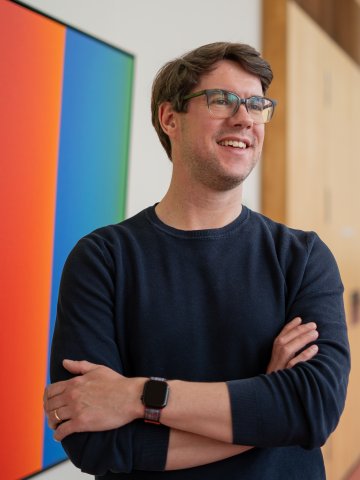

Images above: The Gilead Pharma Case Competition team ranked #1 of all part-time MBA teams - Jan Zimmermann, Sarah Oftadeh, Alejandro Lewin, and Sarvesh Rao
You did a GNAM week exchange at the Seoul National University Business School. What was that like?
“It's the kind of experience that I’ll carry with me for a long time as it’s hard to plan for and even harder to replicate outside a program like this.”
That theme (“incredible experiences I hadn't originally planned for”) extends to my GNAM week in Seoul.
Going into the MBA program, I knew the GNAM week was a core part of it and that we could choose from different universities around the world. I picked Korea both for the cultural experience and for the academic content, which centered on globalization and its challenges. Seoul turned out to be amazing, and it became another cornerstone of the program that I hadn't fully appreciated when I first signed up.
It's the kind of experience that I’ll carry with me for a long time as it’s hard to plan for and even harder to replicate outside a program like this.
Do you have any other favorite memories you would like to share?
There’s an obvious one: my very first week on campus, after months of anticipation following my acceptance into the program. Walking into ESMT for the first time as an actual student, meeting the cohort I'd only seen on screens, and finally feeling like the journey had begun is a memory that's hard to top.
More broadly, residency Thursdays are always something to look forward to: that buzz of everyone coming back to campus, catching up over coffee, and settling in for an intense weekend of learning together. I also genuinely love spending time in the Information Center, browsing the bookshelves and stumbling across hidden gems I'd never have picked up otherwise.
And then there's the less obvious one, away from the classroom: those moments at work when things that used to feel unclear suddenly click into place. Reading an organization through Schein's iceberg to understand why a change initiative is (not) landing, applying Grant's resource-based view to think about where real competitive advantage sits, or using Kotter's framework to sequence a transformation conversation.
These are the moments where the program stops being academic and becomes a genuinely different way of operating. Those moments don't make for dramatic stories, but they're some of the most rewarding memories of all.
Thank you, Jan!
If you are interested in hearing more from Jan – or if you would like to learn more about the ESMT Healthcare Alumni chapter – you can follow him on LinkedIn


Want to hear more student & alumni stories?
