Becoming an investment associate in Uganda: an MGM alum’s career path
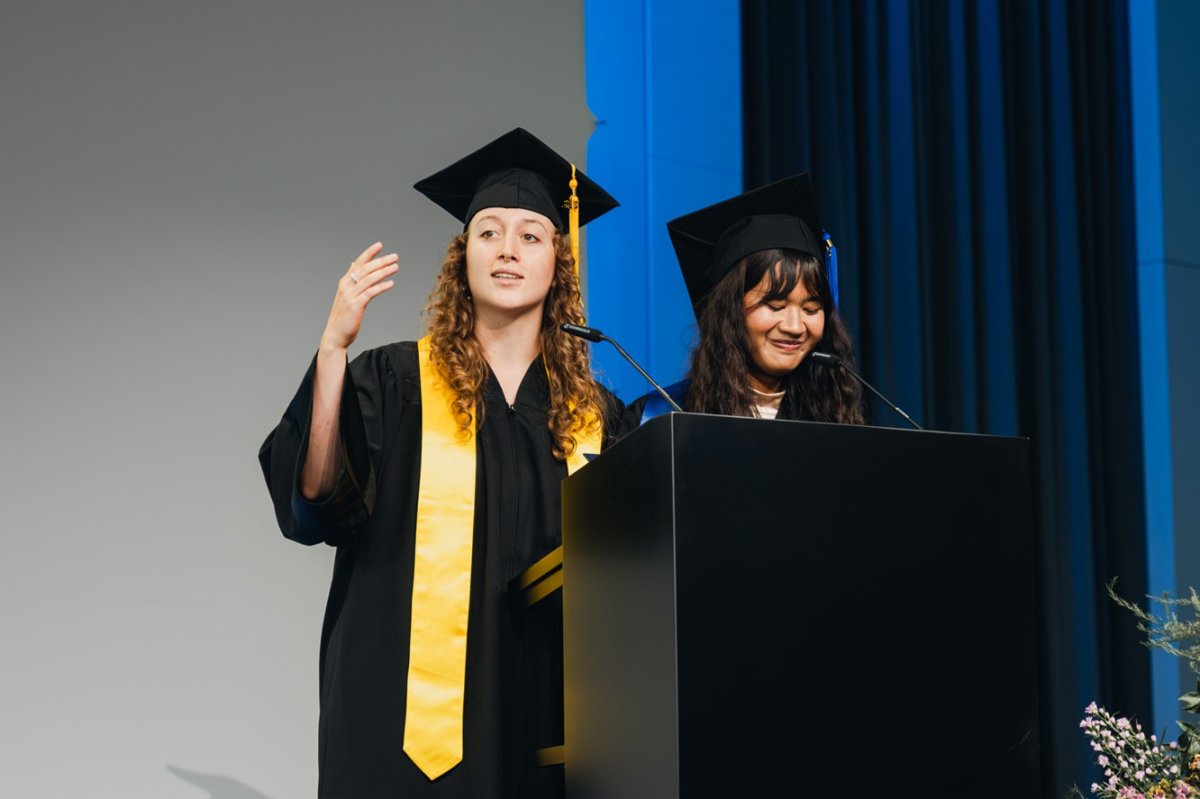
“I think the effort you put into making the experience as full as possible is what you get out of it in the end.”
This quote from Masters in Global Management alum Elise Most (Class of 2025), is the perfect way to sum up her time at ESMT Berlin.
During her two-year master’s program, Elise was a true changemaker. As a student club member she helped organize panels on topics like sustainability and tech. During her Social Impact Project, she traveled to India to consult for a shrimp-farming startup. And during her Responsible Leaders Fellowship she went to Uganda to consult for an organization that invests in small, growing businesses – a volunteer gig that has become a full-time job.
Making the most out of the Master’s in Global Management
Here, Elise shares her highlights, and her tips for anyone applying to ESMT.
Hi Elise, please introduce yourself
Hi, I’m Elise, a French-German ESMT graduate. I grew up in Luxembourg but left right after high school and have been traveling between different countries and continents ever since. Business and management have always been my main focus, so when I was looking for a master’s program in Europe, ESMT’s Master in Global Management quickly made my list.
What drew you to the Master in Global Management (MGM) program at ESMT?
“The MGM program really allowed me to explore whatever I wanted and supported me along the way”
While comparing Master’s in Management programs across Europe, I tried to focus on what I wanted to gain from the experience. And what I felt was the most important to me was “personal and professional development.”
I think we’ve reached a point in graduate education where many business schools across Europe offer similar class content and similar job outcomes. What made ESMT stand out to me was its emphasis on self-driven projects.
What I mean to say is that, at ESMT, you can shape your experience to suit your needs, regardless of the classes you take. If you want to lead clubs and extracurricular projects, ESMT will provide you with a budget and support. If you want to get global experience, you can participate in an international exchange, the Social Impact Project (SIP), the Responsible Leaders Fellowship (RLF), and others.
The MGM program really allowed me to explore whatever I wanted and supported me along the way.
Can you please tell us about some of the extracurriculars you took part in during your time at ESMT?
“I contributed to whatever I could help out on, and I did it in a way that made me feel like my contribution was valuable and that I learned something in return.”
As I mentioned previously, participating in clubs is an opportunity to apply the skills you learned in class to a more hands-on setting. I took full advantage of this opportunity by joining the Innovation and Technology Club, where I organized panels on technology and sustainability in business in 2024, and technology and music/sound in 2025.
I was also part of the Vali Venture Club, which focuses on entrepreneurship and business development. There, I provided market research, competitor analysis, and investor outreach materials for an edtech pre-seed startup.
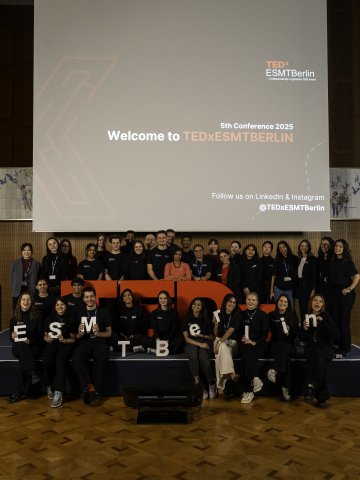
Finally, I volunteered as the sponsorship management co-lead for the 2025 TEDx ESMT Berlin conference, co-leading a team of four peers and raising €10,000. I contributed to whatever I could help out on, and I did it in a way that made me feel like my contribution was valuable and that I learned something in return.
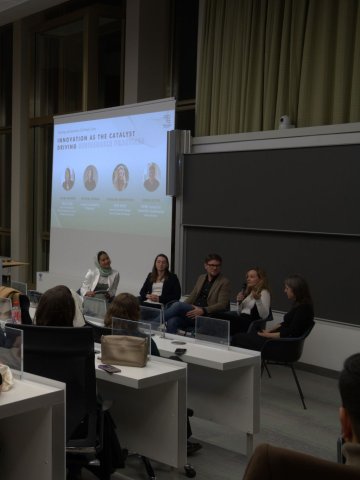
As part of the Innovation and Technology Club, you organized a panel on the topic Innovation as the Catalyst Driving Sustainable Practices. Can you tell us more about this?
The idea for this panel came from Klara Sirca, a Master in Analytics and Artificial Intelligence (MAAI) student, club president, and good friend of mine. She came up with the Innovation and Tech Club as an idea to bridge the distance between technology and business.
This panel series brought together professionals with a technical background and professionals with a business background, all working in sustainability, to discuss how different perspectives on a shared problem could lead to a common solution.
The main topics discussed at the event were the circular economy and product-service systems. Another topic was the financial feasibility of sustainability initiatives, touching on areas such as green chemistry, waste management, and sustainable travel. The main takeaway was that these serious problems don’t have straightforward solutions, but creating these platforms for idea contribution and exchange is a first step toward making tangible changes.
Some of Elise's student club highlights


You were one of the recipients of the Responsible Leaders Fellowship (RLF). Can you tell us more about the fellowship and the project you are working on?
So, the Responsible Leaders Fellowship program was started a few years ago by Nick Barniville. The main idea behind it is to encourage business graduates to give back to the community and the world before entering the workforce. ESMT pays your travel costs and covers some of your expenses for up to six months while you work at a nonprofit or social enterprise in a developing country.
As my time at ESMT was coming to an end, I felt that I still had the time and energy to move out of Europe and experience a different working environment and cultural setting. I looked through the list of RLF projects and found Relevant Ventures.
In short, Relevant in Uganda invests in small, growing businesses (SGBs) at better interest rates and more advantageous loan terms than banks and other local financial institutions. We provide something called "investment readiness" before disbursing the loan. We meet with the business owners, learn about their businesses and the communities in which they operate, and use the tight-knit Ugandan community culture to our advantage to de-risk the loans.

How has the RLF shaped your understanding of the importance of sustainability?
Before answering the question, I want to clarify that sustainability is not the main focus of my RLF. I work in finance, and the businesses we invest in range from chicken and cow farms to schools to soap manufacturers.
However, I can say that green energy and, more specifically, solar technology are definitely popular here. The climate in Uganda changes between a rainy season and a dry season approximately every three months. Although the country has a tropical climate, the dry season is very dry. Especially in the north, closer to South Sudan, the dry season tends to be longer, and farmers experience as little as three months of rain in an entire year. Consequently, the northern region offers significant potential for solar asset financing, such as solar irrigation and solar pumps.


Do you think that sustainability is an important topic for business in general?
A business’s primary objective should be, and is, to maximize profit. My experience working in finance has reinforced this perspective. For example, I wouldn’t ask a cassava farmer to spend more money on an electric tuk-tuk instead of a gas-powered one, even though the former would be better for the planet, because it would negatively impact his income.
Sustainability is an important topic for business, but to work financially, I think it needs to be integrated into business in two ways. First, it needs to be the better option in terms of time, money, and quality, and most sustainable assets aren’t there yet. Second, the government needs to incentivize it through a mix of subsidies and taxes, which is harder for some governments to implement than others.
On a more positive note, however, I think we are moving in the right direction globally.
What was your favorite memory from your time at ESMT?
“A year and a half ago, I didn’t know any of these guys, I had never been to India, and I had never consulted on a startup. I really felt lucky to have been given this opportunity.”
My favorite memory was from when I was working on the Social Impact Project in Kochi, India. We had just finished four weeks of intensive business development consulting for a shrimp farming startup.
The ESMT team: Son, Costa, Itay, and I, had decided to take a road trip through Kerala and Tamil Nadu. On the first day of our trip, we woke up at five am to walk through the tea plantations of Munnar and watch the sunrise. I realized how amazing and random it was. A year and a half ago, I didn’t know any of these guys, I had never been to India, and I had never consulted on a startup. I really felt lucky to have been given this opportunity.
Do you have any tips for someone thinking about applying to study at ESMT? How about any tips for someone interested in the RLF?
“The effort you put into making the experience as full as possible is what you get out of it in the end”
For someone applying to study at ESMT, I think the best place to start is by asking themselves, "What do I want to gain from this experience?" If you’re just looking for a diploma, there are other business schools that would make more sense for you. That's fine; I'm not judging. I think some people only want to earn a master's degree while continuing to work.
At ESMT, however, I think the effort you put into making the experience as full as possible is what you get out of it in the end. This brings me to the RLF. Of all my time at ESMT, the RLF is probably where I grew the most, both personally and professionally. It is as challenging as it is rewarding. I enjoyed my time there so much that I talked to my boss about staying longer and was hired full time.

Thank you Elise!
Elise Most is an Impact Investment Associate at Relevant in Kampala. If you are inspired by Elise’s story and interested in hearing more about her time in Uganda, you can follow her on LinkedIn.


Want to read more about ESMT career paths?
