French connections: building cohort bonds at the MBAT in Paris
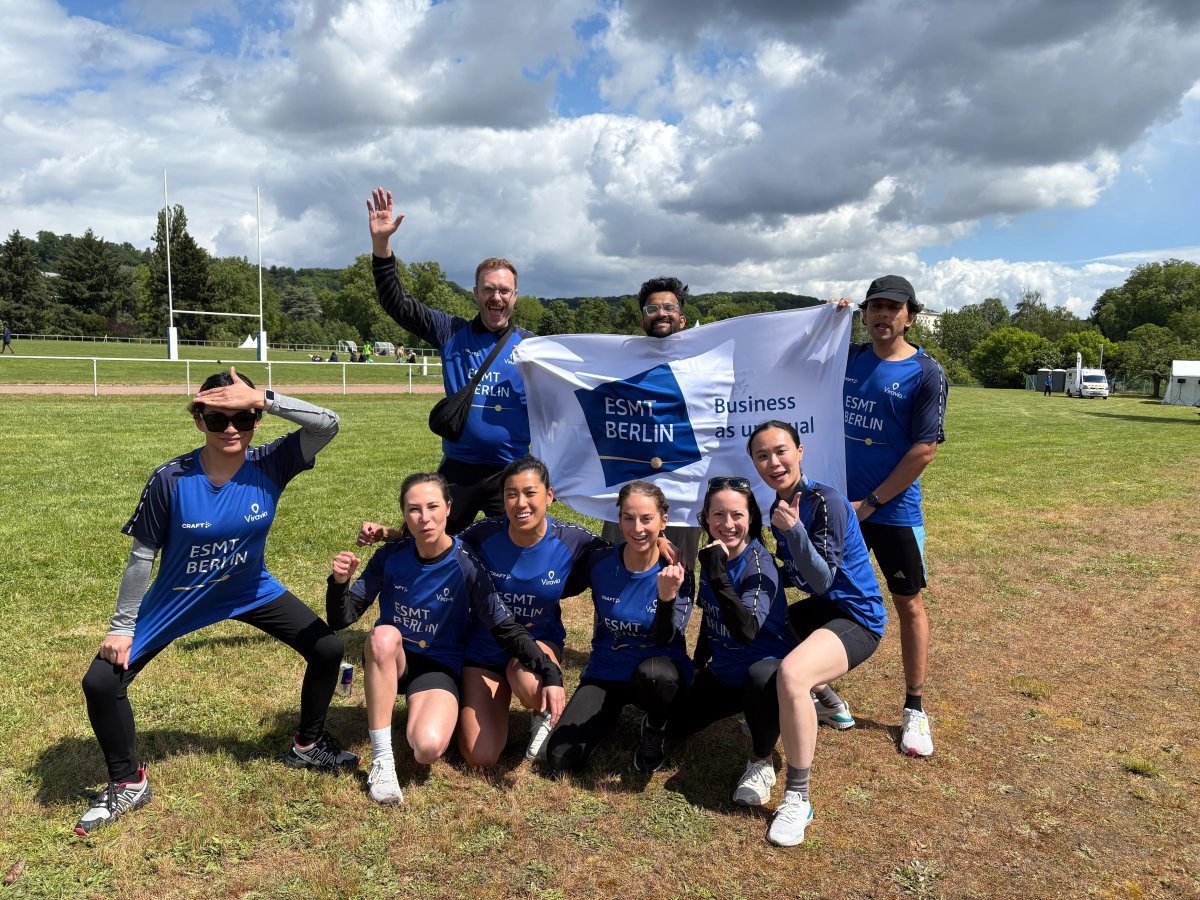
The MBA Tournament at HEC Paris (MBAT) is sometimes called the ‘MBA Olympics’. Over the course of a few days, thousands of MBA students from many different schools compete in a series of sports challenges. It’s a chance to shake off the classroom for a day or two, to grow your network, and most of all, to have fun. And, for Full-time MBA student Rhonda Li (Class of 2027), it became a place to create lasting friendships and memories.
Real space to contribute: Rhonda’s story
In this article, Rhonda explains what it is like to travel to the MBA Tournament as part of a small but supportive ESMT cohort, and how the experience builds unshakeable classmate bonds. She also outlines what drew her to Berlin from China, shares her top MBA moments so far, and tells us why the Full-time MBA rewards those who “show up fully.”
Hi Rhonda, please introduce yourself
I'm Rhonda, originally from China. Before the MBA, I spent over a decade in advertising as account service role, working with brands like Shell, PepsiCo, and Master Kong across Greater China. More recently, I made a deliberate pivot into AML compliance, working as a Case Manager at KPMG on a large-scale KYC remediation program for a major international bank.
Now I'm a Full-time MBA student at ESMT Berlin, which as it turns out, is exactly where both of those lives start to make sense together. Outside of all that, I love football, dancing, and any excuse to meet someone from somewhere I've never been.
What made you choose the Full-time MBA program at ESMT Berlin?
“The campus sits in the heart of the city, which means your learning and your life are happening in the same place – not in a bubble somewhere outside of it.“
Two reasons, honestly.
Career-wise, I want to build my next chapter in fintech and compliance – and Berlin is one of Europe's most active fintech hubs. ESMT is Germany's top-ranked business school with a genuinely international outlook and strong ties to exactly the industries I'm targeting. Once I mapped it out, it wasn't a hard decision.
On a more personal level, Berlin just felt right. It's one of the most welcoming cities in Europe for internationals, regardless of where you're from. The campus sits in the heart of the city, which means your learning and your life are happening in the same place – not in a bubble somewhere outside of it.
Were you already in Berlin or did you move here for the program? What drew you to Germany?
I moved here specifically for this. I'd spent almost my entire career in China – Berlin was a deliberate choice.
Part of it is career logic. I spent 13 years turning creative, intuition-driven work into measurable systems in advertising. Then I discovered at KPMG that the same thinking applies directly to compliance, building structured, scalable processes out of judgment-heavy workflows. Berlin sits right at the intersection of where I want to take that. The fintech ecosystem here is dense, the regulatory landscape is actively evolving, and AI and RegTech are reshaping how compliance work gets done. That creates real space to contribute, not just fit in.
But honestly, there is something simpler too: I wanted a city where I could show up as something new – not just the advertising person, but whoever comes next. Berlin gave me that.
91% of your classmates are from outside Germany. What is it like being part of such an international cohort?
“What surprises people is how much a diverse cohort reshapes the way you think, not just the way you network.”
It's genuinely unlike anything I've experienced before. We're 35 people from 22 nationalities, and because we're small, there's nowhere to hide. Every discussion goes deep, every perspective gets challenged.
What surprises people is how much a diverse cohort reshapes the way you think, not just the way you network. A few months in, I notice I approach problems differently. I ask more questions before I land on an answer. My thinking has expanded faster here than anywhere else I've been.
In a way, we've become a small laboratory for what international working environments actually feel like. When we eventually step into those environments professionally, none of us will be starting from zero.

Speaking of your cohort: many of you recently traveled to HEC Paris for MBAT. Can you tell us what this involves?
On paper, the MBA Tournament (MBAT) is a multi-day event hosted at HEC Paris: sports competitions during the day, individual and team events across different disciplines, and themed parties at night. It's where MBA students from top European schools come together to compete and connect. We were the only German school there, which gave the whole thing an extra edge.
But underneath the sports and the parties, MBAT is really about something else. It's the first time a cohort steps out into the world together as a group. Everything you've built inside the classroom – the trust, the shorthand, the way you show up for each other, suddenly gets tested in a completely different setting. And somehow, it holds.
What was it like to take part – especially as a relatively small MBA team?
“ I looked up and my entire cohort was there, cheering in the rain”
What struck me most was that nobody had to be told to show up for each other – everyone just did. People were cheering loudly for events they weren't competing in, preparing content for social media, making sure no one felt alone in an unfamiliar place. It happened organically, which made it mean more.
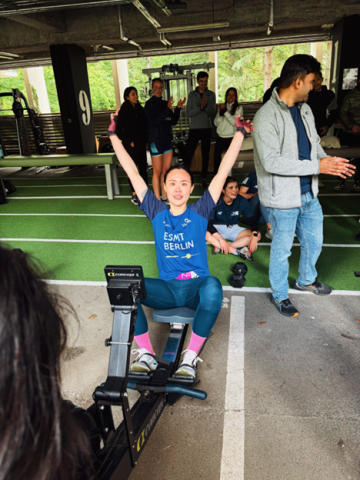
I competed in women's crossfit. Near the end, sit-ups and rowing, completely exhausted, and I was close to stopping. Then I looked up and my entire cohort was there, cheering in the rain. Some of them had just come off a brutal beach volleyball match. I didn't think about stopping after that. I just finished.
That moment probably captured everything about how our cohort works: support each other as usual.
What memories will you take away from the MBAT? Do you think it brought you all closer?
The image I keep coming back to is all of us shouting ESMT at competitions, between events, in the middle of parties, until we had no voices left. Most of us came back to Berlin hoarse.
We were already close before Paris. But MBAT added something, the kind of layer that only comes from navigating something slightly chaotic together, in a city none of us was familiar with, far from our usual routines.
The last night in Paris, we ended up at a cohort member's bar with no agenda, no schedule. Just everyone together, tired and happy, replaying the week. That's the memory I'll keep.


What have been your other favorite moments from the Full-time MBA so far?
Two very different ones come to mind.
The first is small but real: we never forget anyone's birthday. There's always a little ritual on the day, and I'm genuinely looking forward to my first birthday in Berlin because of it.
The second is harder to describe. In Professor Francis's Managerial Decision Making course, we spent most of a class on a case called Carter Racing, building decision trees and calculating whether to race. Engaging, almost exciting. Then Professor Francis revealed further context about the data. Without giving anything away, it shone a whole new light on the exercise.
All the confidence we'd brought to those calculations suddenly felt very small. I didn't expect a business course to affect me that way. That's probably what made it a favorite.
How about what’s next: which summer elective have you chosen and why?
I've signed up for the intensive German summer language school. It's the most direct investment I can make toward building a long-term career here – and honestly, the thing I most want to get right.
Alongside that, I'll be using the time to deepen my knowledge of EU compliance frameworks. It's an area where I know I have a gap, and the summer feels like the right moment to close it properly before the job search begins.
What advice would you give to someone considering an MBA at ESMT?
“Know that what you put in is what you get back, more directly than anywhere else I've been.”
Come with a real question: something you genuinely don't know the answer to yet. Not a polished career goal, but an actual problem you want to figure out. It doesn't have to be fully formed. But having a real question makes everything here work harder for you: the courses, the conversations, the connections.
And know that what you put in is what you get back, more directly than anywhere else I've been. This is a small cohort in a small school. There's no crowd to disappear into. The people who get the most out of it are the ones who show up fully: in class, in the group, in the city. If you're willing to do that, the return is real.
Thank you, Rhonda!
If you would like to hear more about what it’s like to do the Full-time MBA at ESMT Berlin, you can follow Rhonda on LinkedIn for more inspiring content.


Want to stay up to date with ESMT initiatives?
