
Academic articles
Practitioner articles
Working papers
Books
Book chapters
Case studies
Other publications
Subject(s)
Ethics and social responsibility; Human resources management/organizational behavior; Management sciences, decision sciences and quantitative methods
Keyword(s)
self-control, pro-social behavior, public good experiment, conditional cooperation
JEL Code(s)
D01, D03, D64, D70
Individuals in a social dilemma may experience a self-control conflict between urges to act selfishly and their better judgment to cooperate. Pairing a public goods game with a subtle framing technique, we test whether perception of self-control conflict strengthens the association between self-control and cooperation. Consistent with our hypothesis, cooperative behavior is positively associated with self-control for individuals in the treatment that raised the relative likelihood of perceiving conflict, but not associated with self-control in the treatment that lowered the likelihood. These results help advance our understanding of the role of self-control in social interaction.
View all ESMT Working Papers in the ESMT Working Paper Series here. ESMT Working Papers are also available via RePEc, EconStor, and the German National Library (DNB).
Pages
56
ISSN (Print)
1866–3494
Subject(s)
Human resources management/organizational behavior
Keyword(s)
leadership teams, personal characteristics, collapse section leadership styles, personal style, innovation
The case starts in 1973 when Pina Bausch stood at the turning point of her professional career: the transition from being a celebrated dancer to becoming a choreographer. Reflecting on what made Pina Bauschs career as a dancer exceptional, the case then elucidates Pina Bausch´s leadership and working style during her years as artistic director at the Tanztheater Wuppertal. Not only did Pina Bausch become famous for her artistic work and creative productivity, but also for her way of leading people and making them grow long-term. Her capability of leveraging the diversity of her dancers - the collective genius - made her choreographies inherently innovative and ground-breaking. Demanding highest performance, she created one of the most successful compagnies worldwide. She died 2009, leaving behind a dedicated and outstanding dance theater.
| buy now | buy now | buy now |
Subject(s)
Human resources management/organizational behavior
Secondary Title
Durch Coaching Führungsqualitäten entwickeln
Pages
203–212
ISBN
978-3039091256
Subject(s)
Ethics and social responsibility
Volume
6
Journal Pages
50–53
Subject(s)
Marketing
Keyword(s)
emotion, certainty, appraisal, affect regulation, indulgence, luxury consumption
Current theorizing suggests that the valence of an affective state alone cannot explain indulgent consumption but that this is contingent on whether indulging can improve a negative state or will not hurt a positive state. This research shows that when an emotion is associated with the appraisal of uncertainty (certainty), consumers infer that their affective state can (cannot) change. As a result, people in a negative affective state will indulge more when their affect is associated with uncertainty because indulging can help repair the negative state, but people in a positive affective state will indulge more when their affective state is associated with certainty because indulging will not hurt their positive state. Reconciling earlier research reporting apparently inconsistent results linking emotional valence, affect regulation, and indulgence, these findings suggest that the certainty appraisal of specific emotions is important in predicting indulgent consumption to regulate one’s affect. Implications are discussed.
View all ESMT Working Papers in the ESMT Working Paper Series here. ESMT Working Papers are also available via RePEc, EconStor, and the German National Library (DNB).
Pages
17
ISSN (Print)
1866–3494
Subject(s)
Economics, politics and business environment
Keyword(s)
competition policy, regional state aid, subsidies, anti-competitive effects
JEL Code(s)
H81, L4, O25, R58
The Regional Aid Guidelines foresee specific screens for an in-depth assessment of Large Investment Projects (LIPs): an in-depth assessment is initiated if the market share of the aid beneficiary is above 25% or the investment results in a capacity expansion above 5% in a declining market. It is currently being discussed within the broader State Aid Modernization package and also due to a recent court ruling on the case Propapier whether these market screens should stay as they are. Based on a dataset of all LIP cases notified under the 2006 Regional Aid Guidelines, we evaluate those market screens and find that the screens do have power to identify problematic cases – cases with a below average expected aid effectiveness and aid measures targeting specific industries. We also find, however, that the market screens are affected by a severe implementation problem and, hence, do not help to shorten phase I investigations. From a conceptual perspective, they are also not capable of identifying some of the potentially most problematic regional State aid cases. Policy options are discussed.
View all ESMT Working Papers in the ESMT Working Paper Series here. ESMT Working Papers are also available via RePEc, EconStor, and the German National Library (DNB).
Pages
25
ISSN (Print)
1866–3494
Subject(s)
Strategy and general management; Technology, R&D management
Keyword(s)
co-development, drivers and dangers of co-development, the KSF of co-development, the role of trust, balancing control and trust, managing relational quality
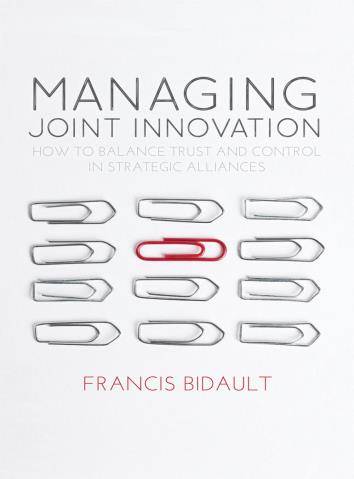
Joint innovation between different organizations or groups has become a common practice for the many companies confronted with major shifts in customers' demand and new technological possibilities. These co-development alliances, however, are typically unstable, and regularly result in drastic restructuring as the partners learn to work together and confront unexpected difficulties.
This new and innovative book takes a fresh look at the critical task of managing relationships and communication in co-development alliances. Good relational quality management will certainly not compensate for bad business strategies and poor execution of initiatives. But, at the same time, outstanding relationships will not survive when there is a lack of trust between partners and a desire for tighter control over one another.
Francis Bidault presents a new framework for understanding the dynamics of alliances and for managing the relationship between partners at all levels, with practical tools to help successfully develop joint innovation initiatives."
Pages
312
ISBN
9780230279971
Subject(s)
Economics, politics and business environment
Volume
3
Journal Pages
409–414
Subject(s)
Economics, politics and business environment
Keyword(s)
strategy, internationalization, Africa, uncertainty, finance, banking, politics, economics, South Sudan, Sudan, banking, globalization, emerging markets, crisis management
The case study documents the efforts of the equity investor African Development Corporation (ADC) and the African investment Loita Group to acquire shares in Nile Commercial Bank (NCB) of South Sudan in the summer of 2011. South Sudan had just become independent from northern Sudan in July 2011 after decades of civil war. It is one of the poorest countries in the world, but has vast reserves of commodities, mainly oil. On the one hand, NCB in 2011 was bloated with debt and managed badly. Certified data on the bank like P&L statements and balance sheets did not exist until summer 2011 and a due diligence has never been carried out. On the other hand, it is the most powerful banking brand in South Sudan and thus could yield high future profits by participating in the development of the economy and financing the exploration of the oil fields. The central bank, the Bank of South Sudan, has supported NCB since its founding in 2003, but was in 2011 looking for international debt- or equity investors to invest in NCB. The case focuses on ADC’s CEO, Dirk Harbecke, and his negotiations with the central bank. In summer 2011, ADC was an $80 million private equity fund, investing in banking and insurance services in sub-Saharan Africa. It is based in Mauritius. The case discusses whether or not ADC and Loita should invest in NCB when considering risk, return, and ethics as well as how a debt- or equity investment should be structured. The case can be taught in MBA, EMBA, and advanced management programs focusing on market expansion, global strategy, negotiation, and international finance.
| buy now | buy now | buy now |