Full-time MBA alumni careers: “my job is to build AI startups”
I wake up full of gratitude everyday: Punit’s story
For Full-time MBA (FTMBA) alum Punit Thakkar, the last two years have been transformational. Since moving to Berlin, Punit (Class of 2026) has completed his degree, been named a Poets & Quants Best and Brightest 2026 MBA, become a big part of a warm and welcoming ESMT community, and landed a role as the Head of AI Innovation & Venture Development at Fraunhofer Heinrich Hertz Institute, a frontier German applied research institute.
In this blog, Punit explains how he is making all of this happen. He takes us inside the Capstone Consulting Project that introduced him to Fraunhofer HHI, shares what it is like to be in a leadership position at the cutting edge of AI, and outlines how his Full-time MBA learnings are "crucial to all aspects” of his role.
He also shares his MBA insights and career advice for new or prospective ESMT students seeking to build a life in Berlin – and/or a career in AI.
Hi Punit, could you please introduce yourself?
Hello, I am Punit, here in Berlin for nearly two years now, and I am a poet and illustrator whose day job is to build AI startups out of the research at Fraunhofer HHI. Before coming to Berlin, I lived and worked across India and learned the basics of sales, marketing, asset and portfolio management.
Since we last spoke, you have earned your Full-time MBA. Congratulations! How does it feel to be a graduate?
Thank you! Yes, it has been a true milestone, and I feel super grateful for all the lessons learned and friendships nurtured along the way.
To be honest, it took quite some time for the feeling to sink in that I have graduated, because we had so many university events right after graduation – from the Nachbarschaftsfest, to the Annual Alumni Meeting, to the annual ESMT barbeque, to the ESMT Olympics – that I had some reason or other to just keep coming back to campus and see the familiar faces of classmates and friends in the ESMT staff.
I think it properly sunk in for me when I met a friend from the cohort after me and they asked me questions about how I chose electives last year for my second semester and I realized how fast time had moved. Suddenly the next cohort is almost halfway through their MBA journey, so I guess it is now time for me to accept that I have graduated!
You were also named one of Poets and Quants’ 2026 Best & Brightest MBAs. How did it feel when you heard the news?
I felt a sense of awe and wonder when I received that news. This recognition was a beautiful celebration of the entire journey of my MBA, and it made me feel like a true global citizen among peers who had also studied across the most hallowed MBA institutions in the world.

The last Full-time MBA project before graduation is called the Capstone Consulting Project. What does this project involve?
This project is the perfect opportunity for us as MBA students to put into practice all that we have learned throughout the 15-month program.
Organizations from across Germany and the world come to ESMT with a business case that they are currently solving internally. For our year we had a diverse mix of companies – from local Berlin-based businesses, to German government organizations, to global behemoths, to non-profits; and business cases from sales and marketing, to strategy, to startup innovation. We had a large platter of opportunities to choose from and work on.
We then spent the months of January, February, and March in teams of four to six students solving the business case along with the client under the guidance of a helpful mentor assigned to us by ESMT. At the end, drawing from our groundwork, market research, strategic analysis, and all the lessons learned throughout the project, we made a final presentation to the client, and also submitted a well-documented research report to ESMT, based on which our final grades were decided.
What company were you working with? Who was on your team and what support did you get from ESMT in finding and completing the project?
“Afterwards, each team was provided with a senior mentor who would support and guide us throughout the project journey. In our case, it was Dr. Ulrich Becker, a veteran of the banking and consulting industries.”
Along with my classmates Luisa Moreno, Vikrant Singh, Johanne Björklund Larsen, Gokul Kumaravelu, and Eduardo Rios, I worked on a project for Fraunhofer Heinrich Hertz Institute, one of Germany’s leading applied research institutes. The Career Development Center at ESMT brought Fraunhofer HHI and other companies to ESMT in November when they pitched us the main business case that they wanted us to work on. We students then submitted to ESMT our top three choices of the companies we wanted to work for. Most of us got assigned to one of our top two choices.
Then in December, we had a day-long session on how to successfully approach the consulting project. Afterwards, each team was provided with a senior mentor who would support and guide us throughout the project journey. In our case, it was Dr. Ulrich Becker, a veteran of the banking and consulting industries. His calm demeanor and discerning eye were crucial for the success of our project, especially during days when we found ourselves swimming in a sea of endless possibilities.
Lastly and most importantly, we received a suggested timeline and deadlines for the consulting project and its related submissions, which was extremely helpful in keeping us in check and on schedule.
Speaking broadly, what was your topic, and what was it like to present the findings?
“It was the Silicon Allee team who made the final presentation extra special for us, as they invited the scientists from the institute to come attend our presentation and provide feedback on it”
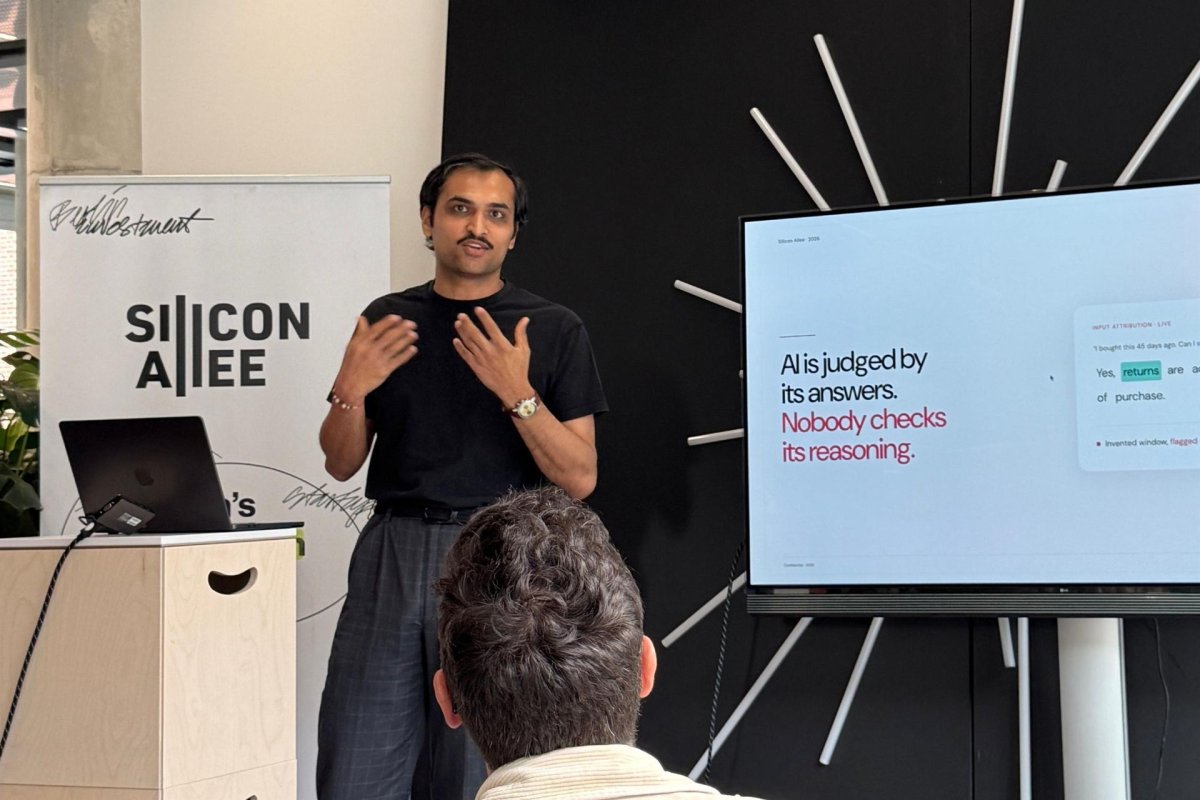
Fraunhofer HHI conducts pathbreaking research in AI, as well as other fields, and has a technology transfer office called Silicon Allee, which specializes in startup incubation and venture development. As part of its process, Silicon Allee identifies research topics with disruptive commercial potential and a growing level of technology readiness. These topics are referred to as CORE Topics. We were brought onboard to build a venture development playbook for one of their CORE topics: Trustworthy, Transparent, Safe, and Aligned AI.
Throughout the project, we received exceptional direction and freedom from the team at Silicon Allee, especially our managers Julius and Constantin, and also from Travis, the head of Silicon Allee.
We worked from the HHI office twice a week and had regular scheduled catchups with the Silicon Allee team, due to which we always had them aligned with the latest goings on of the project. As a result, on the day of the final presentation, it almost felt like a regular catchup where we were giving a status update.
It was the Silicon Allee team who made the final presentation extra special for us, as they invited the scientists from the institute to come attend our presentation and provide feedback on it, they graciously hosted our mentor Dr. Becker, and Travis also recorded our entire presentation and Q&A on his handycam, making us feel like total celebrities! Afterwards, as is German tradition, we went out for farewell drinks at a local Berlin Kneipe (local bar) with Julius and Constantin and reminisced about the experiences of the last three months together!



You stayed with Fraunhofer HHI as the Head of AI Innovation and Venture Development. What does this involve? What is it like to be in a leadership role?
“Being in a leadership role in such an environment is the most exciting and fulfilling professional experience of my life and I wake up full of gratitude everyday knowing that I get to work on these problems and opportunities with such incredible people.”
In my role at the department, I lead the commercialization of intellectual property and patents which we have built over the years in the fast-evolving field of AI. The primary means of doing so is incubating internal startup spin-offs, and evaluating+onboarding external startups scouted by Silicon Allee, who can leverage and license our technology.
In addition, I also support the process of sourcing and applying for government funding and grants for the department, through which we collaborate with research and industry partners from across the globe, and contribute our talent and IP to furthering the benefits that AI can provide to the world.
Our department has made ground-breaking inventions from techniques that make black-box AI models transparent and hallucination-free, to medical innovations like cancer detection models, to algorithms that enable better weather prediction – each invention either already changing the world or holding immense potential to do so.
The scientists who work here are literal geniuses in their fields who are driven by an exceptional urge to make the world a better place. Being in a leadership role in such an environment is the most exciting and fulfilling professional experience of my life and I wake up full of gratitude everyday knowing that I get to work on these problems and opportunities with such incredible people.
How are you leveraging what you learned at ESMT in your role? Are any particular seminars, topics, or other teachings staying with you?
“The lessons from the ESMT Full-time MBA are crucial to all aspects of my role. In this position, I am sometimes the sole business-focused person in a room full of scientists.”
The lessons from the ESMT Full-time MBA are crucial to all aspects of my role. In this position, I am sometimes the sole business-focused person in a room full of scientists. Their technological skills and vision need to be complemented by the right kind of ideas from the world of business, be it about innovation, finance, operations, or go-to-market.
I think of many lessons from ESMT but one that has been top of mind for me is the Operations and Supply Chains course by Professor Tamer Boyaci where we learned about the constraints on a supply chain in a factory and how that affects production. As I try to optimize our own startup factory inside the AI department at HHI I often think of the various constraints that apply on us, and how can I build internal processes that improve throughput and reduce waiting time to so that the startups face no bottlenecks in bringing their ideas to market.
What do you think is the most important thing someone can learn about AI in order to use it successfully at work?
There are two important points that come to my mind when thinking about using AI successfully at work.
The first is to become aware of the levels of capabilities that AI models and their harnesses are now able to achieve. The mechanical aspects of any given knowledge-worker job, be it creating documents, presentations, spreadsheets, writing code, etc., are more or less solved by AI products at this point in time.
The second is to not become overly dependent on AI for doing your job, mainly the thinking aspects of it. The Large Language Models (LLMs) that we use today are trained on massive amounts of human and synthetic data and then reinforced with feedback on specific problems and their ability to solve them. Thus, their ideas are often constrained in originality and uniqueness, and more often than not are just a blended average of what a representative set of humans could have thought up themselves.
If you want to do great work, then you are the one who needs to bring the original ideas based on your experience and unique worldview. That, in my opinion, is the best way to add value to the world today.
Is it important to understand concepts like AI ethics as well as AI deployment/strategy? Is this something you can explore at ESMT?
Yes, learning these concepts through educators like Professor Linus Dahlander and Professor Catalina Stefanescu-Cuntze was super valuable during the MBA. Especially working as a research assistant with Linus on developing a course “AI For Managers” for the Executive MBA was a great exercise for me to strengthen my core concepts and learning how exactly industry participants were putting AI to use in their own use cases.
This is often an underexplored aspect of the MBA at ESMT - you also get to contribute to the education of other cohorts on campus by taking up research assistant roles, expanding your own knowledge as a result!
Do you have any tips for a student hoping to turn their capstone project into a full-time role? How should they approach that conversation?
To start with, I would say that outcomes like this one are driven by so much luck and coincidence. Most of the factors that lead to a project like this converting to a full-time role are out of your control – factors like whether the company is even looking to hire full-time roles, whether the team you contribute to has the right kind of visibility throughout the management hierarchy, whether other people are under consideration for such a role, and so on.
Where one should focus are the factors within their control.
Some of them are:
- Thinking deeply about which company to make your top choice for the consulting project, especially whether you could see yourself in that kind of company doing that kind of work as an employee – such clarity of thought helps you commit to the project with the right burst of energy and focus.
- Being a strong team player within the project so the company can see your ability to work collaboratively and create impact – it is also the best way to learn how to cultivate trust and support in an authentic manner.
- Communicating openly about your broader career aspirations with the company – in my case since the project was with Silicon Allee which incubates startups, I would routinely talk with everyone I met about my own entrepreneurial ambitions and the products I was already building.
Finally, delivering results that meet or exceed expectations is crucial. Doing this is impossible without the support and bonding of a great team. I enjoyed working with Luisa, Vikrant, Johanne, Gokul, and Eduardo so much, and they also taught me to focus on the current moment and make the most of it rather than focusing on past mistakes or future uncertainties, and all of us created an environment which magnified our mutual bias for excellence. That was the biggest gift out of this project experience for me.
You have stayed in Berlin since graduation. Do you have any advice for others hoping to build a life here? What is your favorite part of the city?
“As long as you have an open mind and open heart, you are sure to find your people and your own little corner of this city.”
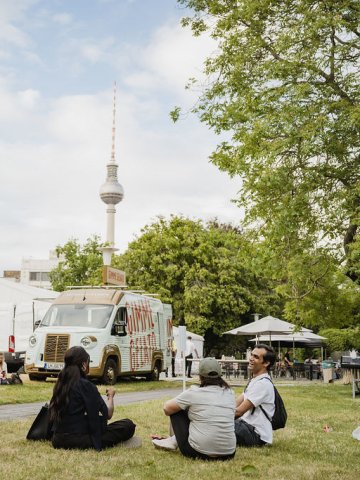
Berlin is a kaleidoscope full of colors and shapes like art, music, corporates, startups, government, and much more. There is room for everyone in this massive multicultural metropolis. As long as you have an open mind and open heart, you are sure to find your people and your own little corner of this city.
Especially at ESMT, where your cohort is so international and diverse, you will start your Berlin life with classmates going through the same experience of being new to the city, finding an apartment, finding a job, etc. at the same time as you. This creates a feeling of community like no other, and that feeling has been my favorite part of living in this city so far.
In terms of advice, I can highly recommend that one takes full advantage of the German language courses offered for free by ESMT - learning the language has an obvious benefit of opening up a larger part of the economy for you to participate in, but the more important benefit is the feeling of belonging and ability to communicate well with the majority of people in this country you are planning to call home.



If you could go back and give your pre-MBA-self one piece of advice, what would it be?
I would tell him to be even more confident in himself and to bet even harder on himself. I would tell him to trust that building the right process is more important than chasing outcomes. And finally, I would tell him to make even more special memories with his loved ones.
Thank you, Punit!
Punit Thakkar is the Head of AI Innovation and Venture Development at Fraunhofer Heinrich Hertz Institute. You can follow his professional journey through the world of frontier AI by following him on LinkedIn, and you can read his poetry by subscribing to his Substack.


Learn more about student & alumni life at ESMT
