"The conversation is the relationship."
Performance rarely collapses because a team lacks ambition. More often, it falters when tension goes unspoken.
During a training camp early in her rowing career, Tina Manker realized she had become “very impatient – very, very impatient” with a teammate whose pace and communication style differed from her own. No one named the issue. Still, “we could feel the tension growing. There was this unspoken thing between us.”
Eventually, her teammate addressed it directly: “I feel like you think everything’s my fault.”
At first, Manker brushed it aside. Later that evening, she sat with it. “What was even more confronting was that I had to admit that to myself,” she recalls. “This is actually not the person I want to be.”
The next day, she apologized.
“That conversation completely changed how we interacted for the rest of the season,” she says. “It saved the season.”
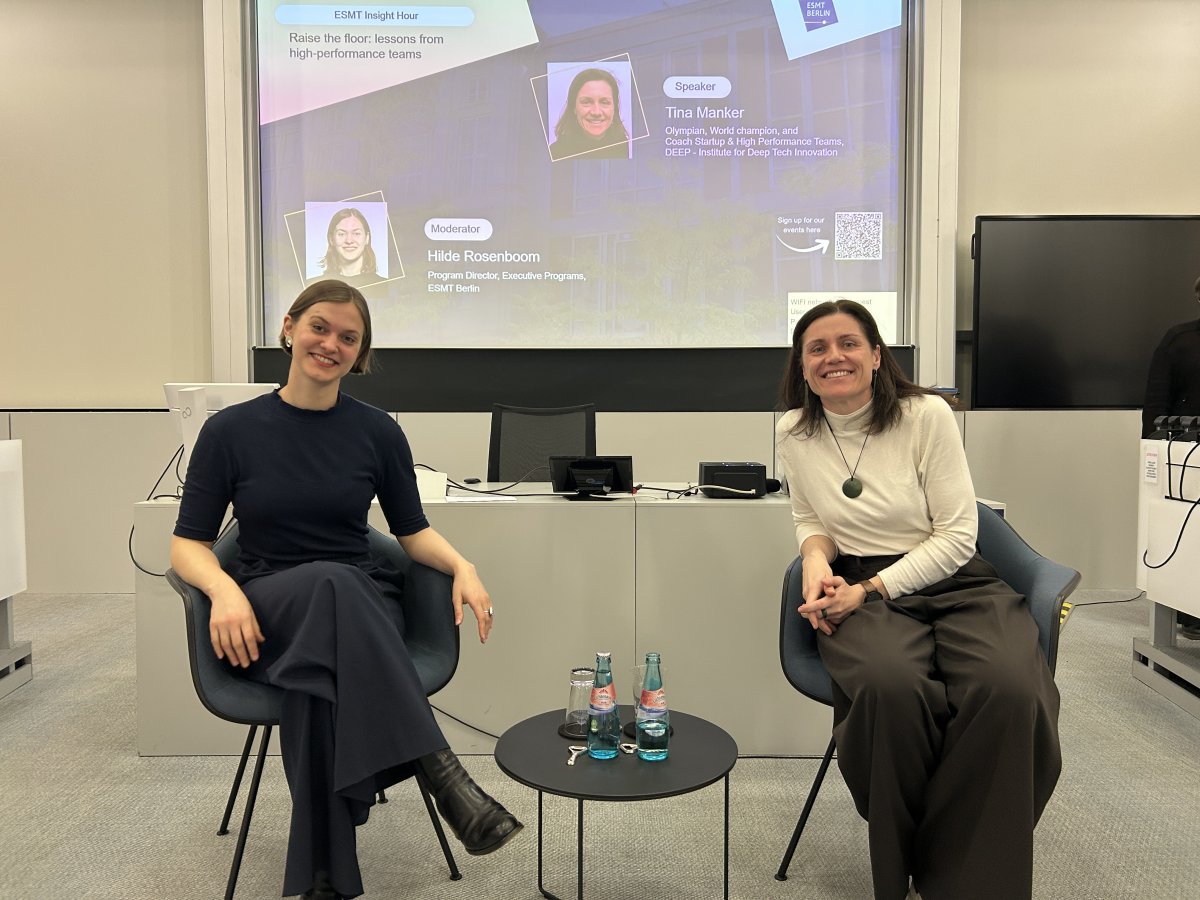
Manker knows what it takes to build and sustain performance under pressure. She represented Germany at the London 2012 Olympic Games, became World Champion in 2011, and won World Championship Bronze in 2010. After her competitive career, she worked as a performance life coach at High Performance Sport New Zealand before joining ESMT Berlin, where she now serves as team coach for the DEEP Pioneers program – a deep-tech startup initiative run by DEEP – Institute for Deep Tech Innovation. She shared these perspectives at an ESMT Insight Hour, in conversation with Hilde Rosenbloom, program director of executive programs at ESMT, drawing on both elite sport and her work coaching startup and leadership teams.
Tension is not the problem
“If your team doesn’t have tension, you are not high performing,” Manker says. It is a deliberately strong claim. “You are not close enough to the edge if there are differing opinions in the room and if there isn’t a little bit of friction.”
The same logic applies beyond sport. In coaching founding teams in the DEEP Pioneers program, Manker sees a consistent pattern: the risk that teams face is often not technological uncertainty, but the slow accumulation of unspoken assumptions, unresolved frictions, and avoided conversations that harden over time into something much harder to address.
“Go the long way early”
The response, Manker argues, is not a structural fix but a conversational one. One principle sits at the core of every team that sustains its performance: the conversation – not the org chart, not the KPIs, not the shared vision document – is the relationship. Each exchange either builds trust or erodes it. “If your conversation is full of care and kindness, chances are the relationship is too. If your conversation is full of passive-aggressive impatience, chances are that’s where your relationship is going.”
Avoiding difficult conversations does not protect performance. It simply delays the consequences.
In the DEEP Pioneers program, this translates into deliberate, sometimes painstakingly specific early work with co-founding teams.
- How often will you communicate?
- Through which channels?
- What does responsiveness mean to each of you?
- How will you make decisions when you disagree?
“People make all sorts of assumptions,” Manker notes. One founder may expect daily contact; another may assume fortnightly check-ins are sufficient. Neither approach is wrong – until the mismatch quietly becomes a grievance.
“If you want a shortcut, you need to go the long way early.” What this builds, over time, is what she describes as “relational capacity,” the conversation skills and resilience that teams draw on when the pressure rises and the easy conversations are behind them. Teams that have rehearsed directness in small moments are better equipped to handle it in large ones.
The same discipline applies to feedback. Many professionals say they value it, but Manker draws a sharper distinction. “What do you want – feedback or praise? Don’t get me wrong, I love getting praise. But the growth is in the feedback.”
Giving and receiving it, she notes, applies across all levels of a team. Working alongside a teammate with several Olympic medals, she had to learn to offer feedback upward as well as receive it. “She’s only ever going to go as fast as I’m going, and I’m only ever going to go as fast as she’s going.” The logic holds in any team with shared accountability.
Raise the floor
Better conversations are one part of the picture. The other is a discipline Manker describes as raising the floor rather than chasing the ceiling.
There is a tendency, in organizations as in sport, to focus on the visible peaks – the breakthrough quarter, the funding round, the public win. Manker’s argument is that the floor is what actually determines outcomes.
In her rowing career, no important races ever happened on a Tuesday. Some of her toughest training sessions did: 1,200 to 2,000 strokes, session after session, on a machine that offers no flattery and no excuses. Staying engaged in that kind of repetition – counting strokes, breaking hours into blocks of 100 seconds – is not glamorous. It is precisely the point. “Performance at the highest level is so good at the basics and at the fundamentals that nobody can get to them.” Medals may be awarded on Thursday, notes Manker, “But they were won on a Tuesday, and on a Monday, and on a Wednesday.”
For founding teams, Manker draws the same conclusion. “Lots of people just do a lot of the work,” she observes, “but they don’t make deliberate time to work on the team. In sport, we wouldn’t leave the team to chance.”
The start line
All of this is preparation for a moment that spectators rarely focus on. They watch the finish line. Athletes think about the start. “There’s nothing more you can do in that moment to get any better,” Manker reflects. “But you do not know the outcome yet.” All that remains is execution – together, drawing on whatever has been built between you across all those ordinary days.
Deep-tech startups, she notes, face their own version of this threshold. “Can we get to a team that will actually found and then develop from there?” The start line, for a founding team, is the moment when the work of building the relationship meets the reality of what they are trying to do together.
Teams defined by their willingness to address tension – early, directly, through the steady accumulation of daily behavior – are the ones who arrive at that moment ready. Before resentment builds. Before performance slips. Before the season is lost.
Interested in our events?
