Space is not neutral
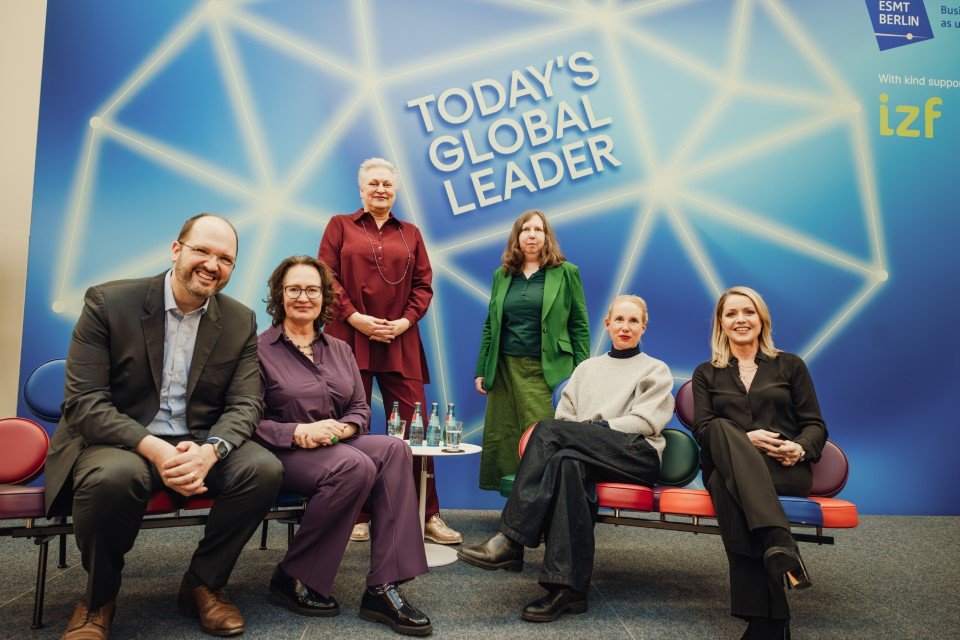
When Today’s Global Leader convened at ESMT Berlin on February 11, 2026, the speakers were seated on George Nelson’s iconic marshmallow sofas – circular cushions arranged like berries, designed in 1956. Seventy years later, they remain in production.
The sofa made the point before anyone spoke. “Space quietly shapes us before we even say a word,” said Nora Grasselli, lecturer in leadership and a member of the ESMT faculty, opening the evening. Leadership discussions typically begin with strategy or markets. Grasselli began with environment, directing everyone’s attention to the room itself.
If space shapes behavior, then it is not peripheral to leadership. It is structural.
That framing guided the conversation with Nora Fehlbaum, chair of the board of directors and former CEO of Vitra, a company whose business sits precisely at that intersection.
Crisis as architectural decision
The Vitra campus in Weil am Rhein did not emerge from master planning. It began with catastrophe.
In 1981, lightning struck the production site during a summer storm. An explosion followed. By morning, much of the facility had burned down. The family faced a decision: rebuild exactly what had existed – or use the destruction as a new beginning.
They chose renewal.
Within six months, production had moved into a new building designed by Nicholas Grimshaw. That decision initiated what would become a forty-five-year architectural evolution, with successive buildings by internationally renowned architects – not as a spectacle, but as a response to functional need.
The campus, as Fehlbaum described it, reflects an accumulation of choices over time. Each building answered a concrete problem. The result is not a monument, but an ecosystem.
The crisis became an inflection point.
A generational architecture
Fehlbaum situates Vitra’s development across three generational layers: commercial, cultural, and environmental.
Her grandparents built the commercial foundation. “They woke up thinking about how to pay salaries, how to find clients,” she noted. Survival and stability were paramount.
The second generation sustained commercial success while adding cultural ambition. The Vitra Design Museum was founded, and architecture became part of the company’s identity.
The third generation, Fehlbaum explained, signed a commitment to continue both missions. But they also wanted to define their own contribution: environmental responsibility.
“We see Vitra as a commercial, cultural, and environmental company,” she said. “These three aspects feed each other.” This layering matters. It shows how institutions can expand purpose without abandoning their foundations. Physical space carries that history visibly.
The office reconsidered
Hybrid work introduced a more immediate managerial challenge: why gather physically in one space?
Fehlbaum described Vitra’s “club office” as a response. If focused work can occur elsewhere, the office must offer something more – a place for exchange and encounter, as well as a shared identity.
To operationalize this, Vitra codified four workplace types:
- Workplace residents: roles requiring daily physical presence
- Workplace enthusiasts: primarily office-based by preference
- Workplace citizens: hybrid, typically around three days per week
- Nomads: location-independent
These are negotiated annually, not weekly. The system recognizes functional differences rather than imposing uniform policy.
The structure does not eliminate flexibility. It clarifies expectations. “If you are in a transition,” Fehlbaum said, “don’t only change your thinking, change your spaces.”
The statement was pragmatic. Organizations often call for new behaviors in environments built for older ones. Adjusting spatial logic can make change credible.
Durability and time horizon
The marshmallow sofas that opened the evening were not incidental.
Vitra’s vision according to Fehlbaum is to produce “products that have the aspiration to one day become a classic,” and for this “repairability needs to be built into these products.” She also noted, “We are actually currently buying back, repairing and reselling these products.”
Designing for repair and recirculation reflects a particular stance toward value. “When you invest in a classic, you do so because you know it will withstand time – it gives you a sense of security.” Durability communicates accountability. Products designed to last decades signal a longer time horizon than those built for rapid replacement. The object signals a strategic choice.
Renewal at the top
Fehlbaum herself recently transitioned from CEO to chair of the board of directors after twelve years in the executive role.
“After 12 years, you see the same question come your way the third time,” she reflected. “Are you really going to answer it a different way?”
At this point, she reasoned, the company likely knew everything she knew. It required someone who might approach familiar questions differently – even “naively.”
The decision echoed the story of the campus. Renewal is not always forced by crisis. It can be chosen. Structures must change to make room for new thinking.
Leadership made visible
The strength of the evening lay in the interplay between Grasselli’s framing and Fehlbaum’s execution.
One articulated the principle: space shapes behavior. The other demonstrated how corporate decisions – about architecture, workplace design, governance, and succession – operationalize that insight.
Before collaboration is encouraged, proximity has already structured interaction. Before sustainability is declared, materials have signaled commitment. Before culture is codified, environment has established norms.
Space does not replace strategy. It shapes how credible strategy feels.
As part of the Today’s Global Leader series – supported by izf–Initiative Zukunftsfähige Führung and the Karl Schlecht Stiftung – the conversation underscored a recurring theme at our school: leadership is exercised through structures as much as through statements.
For institutions committed to developing responsible leaders, this is not an abstract lesson.
The environments leaders build – and the structures they are willing to renew – communicate continuously.
The question raised on February 11 was simple: If space shapes behavior, who is shaping the space?
Interested in our events?
Event photos
