Leadership failure begins with self-deception

When Manfred Kets de Vries asks a room of executives to name three people smarter and more capable than themselves, he is not looking for an answer. He is watching how long it takes them to think of one – and what that reveals.
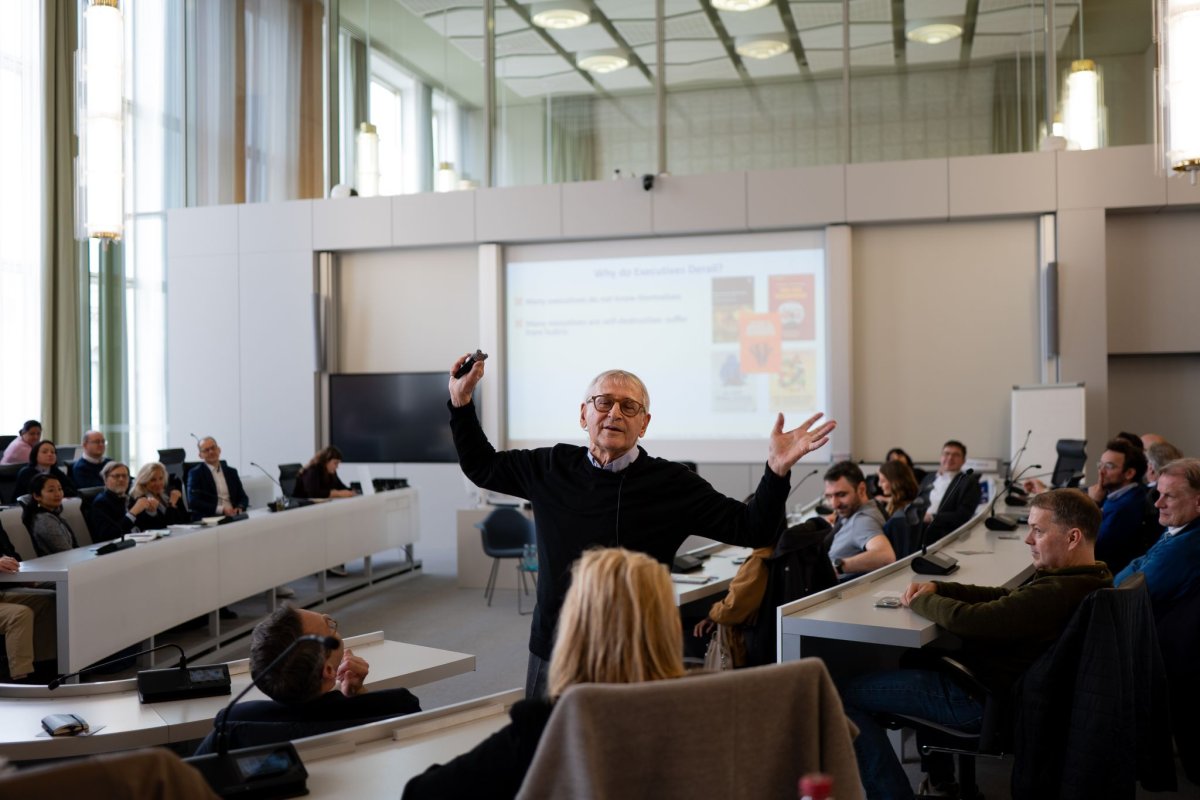
“That,” he told an audience at ESMT in March, “is a pretty good sign of narcissism.”
It is a small exercise with a sharp point, typical of Kets de Vries’s approach. Kets de Vries is a distinguished clinical professor of leadership development and organizational change at INSEAD and a visiting distinguished professor at ESMT. He has written more than 60 books applying psychodynamic thinking to leadership. He is not interested in the “five steps to transformational success.” He is interested in what happens beneath the surface – in the gap between how leaders see themselves and what is actually driving their behavior. That gap, he argues, explains most of what goes wrong in organizations.
“Most people don’t know themselves,” he said.
The hidden drivers of irrational leadership
Most executives consider themselves rational actors who rely on data, experience, and structured analysis. Yet even highly capable leaders sometimes derail, occasionally in dramatic ways.
Kets de Vries's explanation is blunt. “Rationality? Screw it. It’s an illusion. We rationalize afterwards.”
The patterns that shape behavior are formed long before anyone reaches a leadership role. The first organization people know is the family — who held power, who got heard, who had to perform to earn approval. Those dynamics do not fade with seniority. If anything, they become harder to spot. Leaders who seek to avoid these elements instead act them out.
“The past is the lens through which we understand the present and shape the future,” he said. And those lenses, unless examined, can distort everything.
Power, echo chambers, and the rise of hubris
As executives move up, honest feedback becomes rarer. Dissent feels risky. People tell the powerful what they want to hear – not out of malice, but out of self-interest and the reasonable fear of consequences. The leader’s working model of reality detaches, gradually, from what is actually happening.
“The moment you are a senior executive,” Kets de Vries said, “you are surrounded by liars.”
Success accelerates the slide. The traits that once drove performance – confidence, decisiveness, ambition – can calcify into rigidity. Leaders start to believe their own story. The result is more authority, less self-awareness. Poor decisions take root not because leaders lack intelligence, but because they lack reflection.
Falling versus jumping
If unconscious patterns shape behavior, the central task of leadership becomes clearer: creating enough distance from those patterns to act with awareness rather than react from habit.
Kets de Vries describes this with a deceptively simple contrast: falling versus jumping. When leaders are falling, they respond automatically – driven by impulses they don’t fully understand. When they are jumping, they act with intention, even in uncertainty.
The challenge is not action, but awareness. This is not about slowing everything down. It is about resisting the urge to close prematurely on a conclusion, especially under pressure. It is what is sometimes called “negative capability” – the ability to stay with uncertainty long enough to understand what is actually happening.
“Keep your mouth shut for a while,” he advised, “and see what happens instead of immediately coming to some kind of conclusion.”
Leadership, meaning, and what gets you out of bed
As leaders begin to reflect more deeply, their focus tends to shift. They may arrive with questions about strategy and organizational transformation. But over time, the conversations become more personal – turning to relationships, purpose, and what actually matters.
Kets de Vries has watched it happen repeatedly: “In the end they talk about their spouse, their children, their parents. And they talk about meaning.”
Lasting performance, he suggests, depends on some alignment between what a leader does and what a leader values. And it has organizational consequences. Leaders without clarity about their own motivations struggle to create meaning for others. Those who understand themselves are better equipped to build environments where people feel engaged, trusted, and genuinely seen.
Self-knowledge, in that sense, is not a personal indulgence. It is an organizational asset.
The mystique, demystified
To strip leadership down to its essentials, Kets de Vries uses an unlikely frame: the silverback gorilla. Find the food (vision). Protect the group (safety). Maintain some order. “Don’t buy another leadership book,” he told the room. “This is it. Direction, protection, order.”
The reductionism is intentional. Leadership is not mysterious because it is complex. It feels mysterious, Kets de Vries argues, because most people avoid looking inward – and power makes that avoidance easier and more costly at the same time.
“The hardest thing to see,” he said, “is right in front of your eyes.”
For leaders willing to look, that is also where the work begins.
Manfred Kets de Vries delivered this lecture at ESMT Berlin on March 20, 2026, as part of an afternoon session on leadership development and organizational performance, facilitated by Professor Konstantin Korotov. The full recording is available on YouTube.
The leadership mystique: A session with Manfred Kets de Vries
