AI won’t transform your company unless leadership changes first
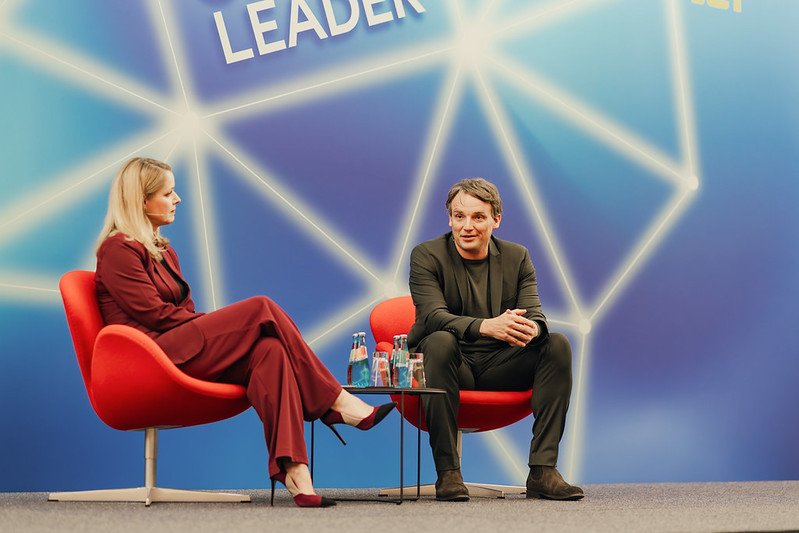
When, at just 39 years old, Christian Klein became the CEO of SAP, he took the helm of one of Europe’s most strategically important technology companies. He also faced a fundamental question: how do you transform a business that much of the world depends on, while the world is still depending on it?
Five years later, Klein’s answer is clear – and it goes beyond the purely technical facets of enterprise software.
As part of ESMT Berlin’s Today’s Global Leader series in March, he emphasized that the successful adoption of cloud ERP depends on having a clear transformation strategy in place. He also noted the importance of customers aligning business and process priorities before investing in new technological capabilities.
The conversation, moderated by journalist Astrid Frohloff and preceded by contributions from ESMT President Jörg Rocholl and DEEP Institute Managing Director Thorsten Lambertus, placed Klein’s remarks within a wider debate about leadership, deep tech, and Europe’s role in the AI era.
The companies struggling the most with digital transformation, in his view, are not failing because the technology is too complex. Technology alone cannot resolve structural or strategic challenges within an organization. In his view, companies facing the greatest hurdles in digital transformation are often not hindered by complex software, but by the absence of a clear vision for how processes, responsibilities, and business models should evolve.
AI only creates value when the business changes
SAP systems sit at the core of global industry, touching around 80 percent of the world’s B2B transactions. Over decades, companies have built layers of customization on top of that core – processes, workarounds, and habits that define how their organizations actually run.
That is what makes transformation challenging. Moving to the cloud – or adopting AI – means dismantling institutional habits alongside legacy code.
“Changing and moving from an ERP on premise, heavily customized,… doing a lot of change management on the business side… it’s much harder than switching to a new mobile phone,” Klein said.
This is why Klein’s advice to customers is consistent: define the business model first. Understand what one general ledger across the company really means. Agree on how demand and supply chain planning will work. Then connect the technology to it.
“Just buying a piece of AI and believing you transform a company is so wrong,” he said, “because then AI will never unfold the value you’re actually expecting out of it.”
From software to agentic systems
What follows from this is not just better software, but a different model of how work gets done.
Today’s enterprise systems are transactional. Humans input data, trigger processes, and interpret outputs. The next generation, Klein suggests, will support organizations in an increasingly autonomous, proactive way.
Rather than competing to build foundational large language models (LLMs) – a race Klein has chosen not to enter – SAP is focusing on applied AI embedded directly in enterprise workflows. While LLMs are powerful they remain generic: they understand language and code, but they don't inherently know how a supply chain is orchestrated or how payroll processes run. SAP, with over 50 years of accumulated process logic and proprietary business data, does. By training its models on this foundation, Klein argues SAP can build something no publicly trained model possesses: AI that understands how enterprise operations actually function.
The result is what he calls an “agentic AI layer” – systems capable of supporting activities such as closing a financial period, running procurement sourcing, or managing workforce scheduling with significantly reduced manual effort. But capability and autonomy are not the same thing, and Klein underscores the importance of maintaining clear guardrails. Governance, he notes, is not optional: “You cannot just put an agent live in a financial system, in a payroll system.”
However sophisticated the agents become, a human decision-maker must still sign off, and organizations must ensure that expert validation is embedded into their processes.
Europe’s challenge: speed, not capability
The question Klein poses to his customers – are you ready to actually transform, or just upgrade? – applies equally to Europe as a whole.
The continent is not short of talent or industrial expertise. What it lacks is the structural conditions that allow good ideas to move fast. Regulatory fragmentation is his primary exhibit: even within Germany, a startup encounters a different interpretation of data protection law in Berlin than in Baden-Württemberg. Multiply that across 27 EU member states and the cost becomes prohibitive especially for innovative start-ups and younger companies Europe needs most. “We call Europe a union,” Klein said, adding that in this specific regard it often does not operate as one.
Yet this is precisely the terrain where Europe has a genuine right to compete. Its industrial depth, its data, and its domain expertise are exactly what applied AI at enterprise scale requires. “This game is not yet played.” Europe's chances of winning it, Klein argues, depend on one thing: “Are your chances to win higher? Definitely – when Europe simplifies.”
The leader behind the transformation
Klein spent much of the evening presenting a straightforward assessment: that transformation is hard, that jobs will change, that Europe is falling behind where it needs to move fast. Regarding what the changes mean for employees, he made clear that "It would be a lie" to say the way we work today will stay the same.
The same directness that makes him a demanding strategist also makes him, by his own account, a deliberate one. He regularly seeks dialogue across all levels of the organization, for instance by joining junior employees for lunch in the canteen, to better understand what is happening on the ground. He is open about decisions that did not turn out as intended. And when asked what he would tell his 19-year-old self – the student from Mühlhausen who fell in love with the way software connects to how businesses run – his answer is less about strategy than character.
Follow your passion. Keep learning from the people around you, however senior or junior. And when you are standing in front of your employees, your customers, your board: “Be authentic. Be yourself.”
It is perhaps the most unexpected advice from a CEO who has spent five years moving one of the world's most complex companies faster than most thought possible. But it is also, on reflection, the most consistent. Klein's argument throughout – that transformation fails when leaders rely solely on technology instead of making necessary strategic decisions – rests on exactly that quality: the willingness to say the uncomfortable thing, clearly, before anyone else is ready to hear it.
The full conversation is available on YouTube. The next Today's Global Leader event at ESMT Berlin will be announced shortly. Join our mailing list to participate.
Interested in our events?
Event photos
