Webinar: How can you build a career in AI with a business background?
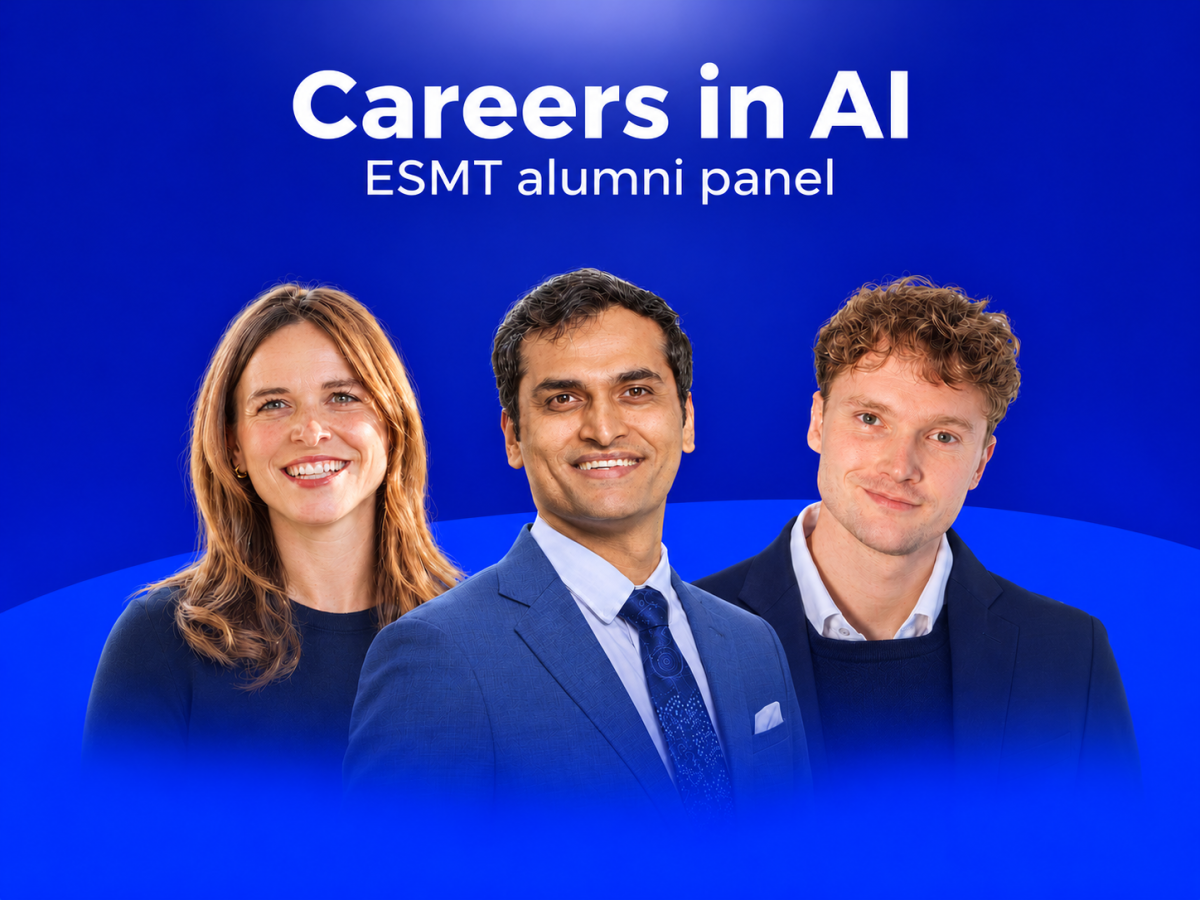
A career in artificial intelligence can begin in unexpected places: advertising, real estate, or a passion for transforming how companies work. In ESMT Berlin’s Careers in AI webinar, alumni Amber Willems, Punit Thakkar, and Jan Malte Jeddeloh shared how they found their way into the field—and what helped them make the transition.
Their experiences show several routes into AI: developing commercial expertise, working on a research commercialization project, and helping customers adopt new technologies. Across these different paths, they emphasized curiosity, practical experience, technical understanding, and the ability to connect technology with business needs.
This article summarizes the alumni discussion and audience Q&A. Roles and professional experiences reflect what the speakers shared during the webinar.
Three different paths into careers in AI
Working in AI means different things for each of the three alumni. Their roles illustrate how business skills can contribute to developing, commercializing, and adopting technology.
ESMT alumnus |
Role |
Main focus |
Study program at ESMT |
|---|---|---|---|
Go-to-market team for advertising at OpenAI |
Working with customers and product colleagues to build a new advertising channel |
||
Portfolio manager at Fraunhofer HHI |
Bringing research to market through startups, technology licensing, and partnerships |
||
Modern workplace specialist at Microsoft |
Helping business customers identify opportunities for AI and automation |
||
| ESMT alumnus: | |||
| Role: | |||
Go-to-market team for advertising at OpenAI |
|||
| Main focus: | |||
Working with customers and product colleagues to build a new advertising channel |
|||
| Study program at ESMT: | |||
| ESMT alumnus: | |||
| Role: | |||
Portfolio manager at Fraunhofer HHI |
|||
| Main focus: | |||
Bringing research to market through startups, technology licensing, and partnerships |
|||
| Study program at ESMT: | |||
| ESMT alumnus: | |||
| Role: | |||
Modern workplace specialist at Microsoft |
|||
| Main focus: | |||
Helping business customers identify opportunities for AI and automation |
|||
| Study program at ESMT: | |||
These are individual career stories rather than a hiring formula. Each speaker brought a different combination of experience, interests, and opportunities to their transition.
Amber’s tips: Build things, stay curious, and develop relevant experience
How Amber moved from an interest in technology to OpenAI
Amber had wanted to work in technology since she was a teenager. During the webinar, she described a career that included three years at Google before joining OpenAI’s advertising go-to-market team in London.
Her route also included experience at Amazon and EY, as well as part-time work at Adobe while studying for her Master in Management at ESMT. At Google, she pursued projects related to AI and building new things.
That background matters when understanding her transition. Amber’s move into AI combined business education with professional experience and practical exploration. She also acknowledged the role of timing and luck.
Use AI to understand what it can do
Amber’s clearest advice for people interested in AI careers was to start using the technology themselves.
She described experimenting with agents and learning through building. For her, this willingness to explore demonstrates curiosity and initiative. When discussing her own experience interviewing candidates, she highlighted a founder mentality: being comfortable starting from scratch and figuring things out.
Her practical takeaway: Give yourself something concrete to build or investigate. The experience of testing an idea, encountering problems, and improving it can help you discuss AI from direct experience.
Choose academic projects with your interests in mind
Amber wrote her thesis on generative AI in the retail sector, giving her an opportunity to explore a subject connected to her professional interests.
Her experience suggests that a thesis can serve two purposes: meeting an academic requirement and developing a deeper understanding of a field you may want to enter.
Rather than choosing a topic simply because AI is popular, consider which business question you want to understand. A focused question can make your research more useful for future career conversations.
Learn to work with uncertainty and different people
Amber described a working environment where priorities move quickly and customer conversations feed into product discussions. Being comfortable with ambiguity is part of her daily work.
She also credited ESMT’s international group work with helping her collaborate in a small team. Learning to work with people who have different perspectives was preparation for the coordination her role requires.
Amber’s central message: Curiosity becomes more valuable when you act on it. Explore the technology, build relevant experience, and learn to contribute when the next steps are still taking shape.
Punit’s tips: Use projects to change direction and connect research with business
How Punit moved from real estate into technology commercialization
Punit’s route involved a substantial career change. After studying engineering and spending around ten years in real estate, he wanted to move into technology.
During his Full-time MBA at ESMT, he worked on a consulting project with Fraunhofer HHI. The project involved identifying potential markets for explainable AI technology.
That assignment became a bridge into employment. Punit described how the project helped him strengthen his relationship with the organization and identify a full-time opportunity. At the time of the webinar, he had graduated in May 2026 and was working there as a portfolio manager.
Treat a practical project as an opportunity to demonstrate your contribution
Punit’s story provides a concrete example of how a career transition can develop through working on a real business problem.
His consulting project allowed him to apply business analysis in a research environment. It also gave both sides an opportunity to understand how they could work together.
His practical takeaway: When choosing a project, consider the problem you will help solve and the organization you will learn about. A relevant assignment can help you build sector knowledge and professional relationships, even when it does not lead directly to a job.
Learn enough to connect scientific work with commercial opportunities
Punit described three main areas of responsibility:
- Supporting startups created by researchers.
- Licensing technologies to external startups and managing that portfolio.
- Supporting collaboration with universities and companies.
His daily work includes reading scientific papers and understanding research well enough to explore its business potential. He also pointed beyond large language models to areas such as forecasting and time-series models.
For someone entering AI from business, his experience highlights the importance of understanding the technology behind a commercial proposition. Assessing an opportunity requires more than familiarity with industry terminology.
Be clear about the value you add
Punit encouraged participants to ask what they contribute beyond an AI-generated answer.
In his role, that contribution involves interpreting research, assessing opportunities, and providing direction. He connected this with the business discipline of weighing risk and return.
His advice was to develop enough knowledge of the field to make informed judgments—and then be ambitious about what that knowledge enables you to do.
Punit’s central message: A career change becomes more tangible when you apply your existing skills to a relevant problem and build the knowledge needed to contribute in a new environment.
Jan’s tips: Combine technical understanding with communication and change management
How an interest in transformation led Jan to Microsoft
Jan did not initially set out to build a career in AI. His starting point was an interest in transformation across industries, including agriculture, food supply chains, and automotive.
A Microsoft presentation during his studies helped him see technology as a way to work on those interests across different sectors. As large language models became more prominent during his time at the company, AI became part of that work.
His experience illustrates another route into the field: developing AI responsibilities within an existing technology career.
Start with the customer’s business problem
Jan described helping customers identify where AI and automation could improve their work.
For a sales team, that could mean examining which internal processes take time away from customers. The discussion then becomes about how technology could support those processes and help employees work more effectively.
His practical takeaway: Learn to investigate how people work before proposing a tool. Understanding a process and its difficulties gives you a stronger basis for discussing where AI could help.
Develop technical knowledge alongside communication skills
Jan was direct about the importance of technical understanding. Being able to create an app or agent does not remove the need to understand the concepts behind it.
At the same time, technical knowledge needs to be communicated. In his experience, helping organizations adopt technology requires people who can connect technical possibilities with business processes and explain their reasoning clearly.
He also credited ESMT coursework on decision-making, behavior, and organizational networks with helping him understand stakeholders. Presentations and group assignments helped build his confidence.
Pay attention to the people experiencing change
For Jan, responsible adoption also means giving people time to understand what is happening.
He described the importance of pausing, reflecting, and talking with employees and customers who may feel overwhelmed by the pace of change. Introducing technology requires attention to how people experience and use it.
Jan’s central message: Build technical understanding, explain its business relevance, and help people navigate the changes it brings.
What these experiences mean for your next career step
Taken together, the three alumni stories suggest a useful starting point: identify where your existing experience meets a problem that AI could help address.
Amber brought commercial experience and a habit of experimenting. Punit used a consulting project to apply business skills to research commercialization. Jan connected an interest in transformation with customer-facing technology work.
A practical next step could be to:
- Choose a direction. Identify whether you are most interested in customer adoption, commercial strategy, research commercialization, or another area.
- Investigate a specific problem. Use a thesis, workplace assignment, or personal project to explore it.
- Build your understanding. Learn enough about the relevant technology to discuss its possibilities and limitations.
- Explain your contribution. Be ready to describe the problem, your decisions, and what you learned.
These steps are a synthesis of the discussion. They are ways to structure your exploration, rather than requirements set by the speakers’ employers.
Note: This blog post was created with the help of AI.
Frequently asked questions
Can you work in AI with a business background?
Yes. The webinar featured business-facing roles in go-to-market work, technology commercialization, and customer adoption. These roles combine business skills with an understanding of technology. Requirements vary by position.
Do you need to be an engineer to build a career in AI?
An engineering background is not essential for every AI career. However, technical understanding remains important, including in commercial and customer-facing roles. The depth of knowledge you need depends on the responsibilities of the position.
How can you gain relevant AI experience before changing jobs?
Experimenting with AI tools, building projects, and exploring AI-related business questions can help you develop practical experience. Academic research and consulting projects also provide opportunities to investigate how AI applies to specific industries or challenges.
Can an MBA help you transition into AI?
An MBA can provide opportunities to apply business skills to AI-related challenges through consulting projects and industry collaboration. In the webinar, one graduate described how a consulting project led to a role in technology commercialization. Individual outcomes depend on previous experience, contributions, and available opportunities.
Which skills are important for AI careers?
The discussion highlighted curiosity, practical experimentation, technical understanding, communication, and business judgment. Working with uncertainty, understanding stakeholders, and helping people adapt to change were also recurring themes.
How can experience from another industry be relevant to AI?
Industry experience can help you understand business processes, customer needs, and operational challenges. That knowledge provides useful context when assessing where AI could create value and how it could fit into existing workflows.
What experience can support a move into an AI go-to-market role?
Relevant commercial experience, customer understanding, and practical AI projects can support a transition. The webinar also highlighted initiative, experimentation, and experience building new things. These are insights from an individual career journey rather than an official hiring checklist.
What does responsible AI adoption involve in business roles?
Responsible adoption includes communicating risks openly, applying informed judgment, and supporting people through change. The discussion emphasized trust, reflection, training, and understanding the value that human expertise adds when using AI.
Study at ESMT Berlin
