Investing in your own development: Part-time MBA first impressions
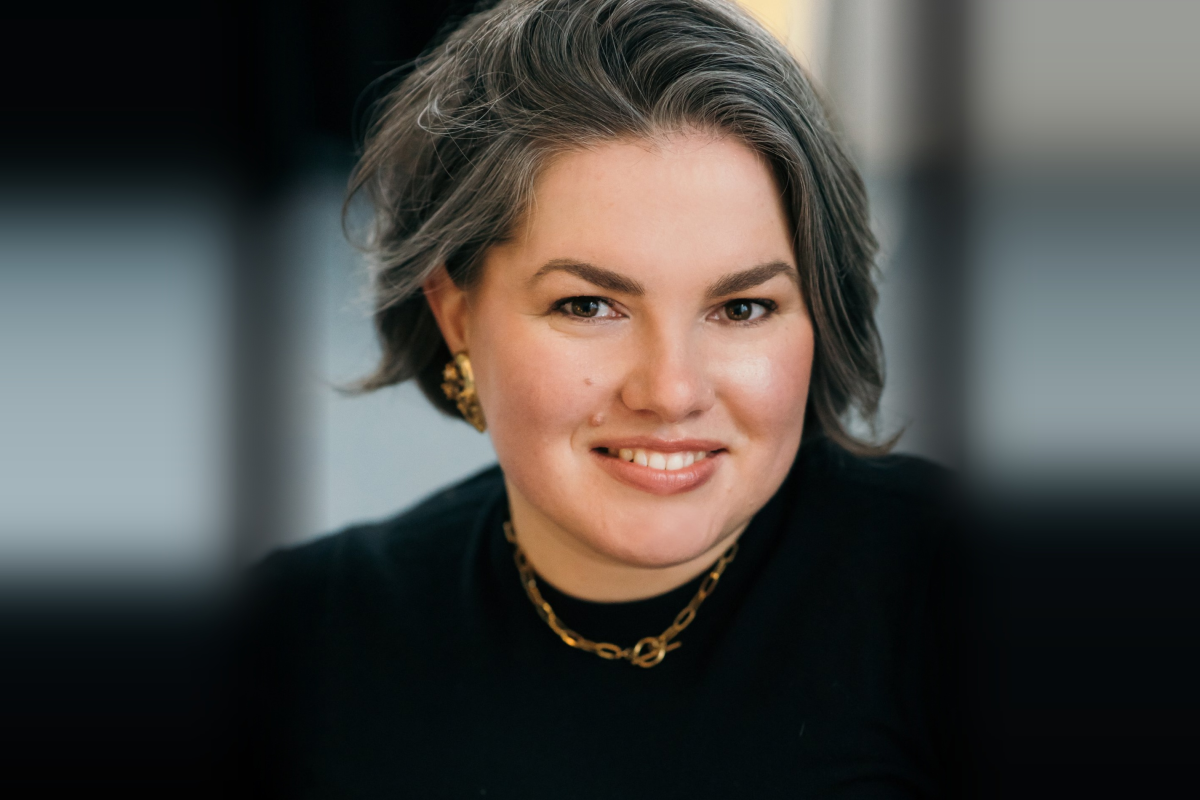
Being willing to question what you already know: Svitlana's story
Svitlana Tanchyk has just completed the first residency of the Part-time MBA (PTMBA), and already the program is helping her grow her network, challenge her way of thinking, and build growth.
In this blog, Svitlana, Class of 2028, shares her first impressions of what will be a two-year Part-time MBA journey. She talks about what drew her to the program and to ESMT Berlin; what the admissions process was like; and how alumni played a part in her decision to apply.
She also takes us inside the first residency of the program, covering what it was like to study inside a German landmark, and how it helped her connect with her cohort on a new level.
Additionally, she explains why it is the people around you that are crucial to your MBA success: from admissions staff, to faculty, your support network at home. And then of course, there's your cohort. As Svitlana puts it, "discovering those stories has been one of the best parts of the program so far."
Hi Svitlana, could you please introduce yourself? What has your career path looked like so far?
Hello! I’m Svitlana Tanchyk, and for nearly 15 years my work has been about one thing: keeping operations running when conditions refuse to stay stable.
My career has spanned retail and import operations in Ukraine, risk management in Egypt, and business development in Bulgaria, each teaching me how supply chains behave when volumes, suppliers, and timelines change at once. I later returned to supply chain leadership in Ukraine, first in retail and then in humanitarian logistics, where disruption was the norm and medical supplies still had to get through.
After the full-scale invasion forced me to leave Ukraine in 2022, I rebuilt my career in Germany, designing global logistics solutions and leading transformation programs across Europe, Asia-Pacific, the Americas, and the Middle East and Africa. Today, I also advise on operations and AI strategy.
Beyond my core work, I speak at professional events, universities, and business schools; co-host podcasts, including one close to my heart about Ukrainian women building their careers abroad; mentor women starting their careers in supply chain, pro bono; and contribute to digital product development.
My ambition is to take everything I have learned to COO level, where keeping an entire organization stable and moving forward is the job itself.
You have recently joined the Part-time MBA Class of 2028 – congratulations! Why did you decide to pursue an MBA qualification?
"This wasn’t a spontaneous career move; I had been working toward it for a long time."
Thank you! An MBA has been on my mind for 15 years. Early in my career, I watched my cousins graduate from leading business schools and saw how their careers developed afterward. The advice I received then was not to rush: build real experience first, so the program would be practical rather than theoretical.
As my responsibilities grew and I began thinking more seriously about executive leadership, I knew the time had come. I had reached a point where experience alone would not take me where I wanted to go. I wanted to complement my operational expertise with a broader understanding of strategy, finance, leadership, and how organizations make decisions.
I researched schools and compared programs. This wasn’t a spontaneous career move; I had been working toward it for a long time.
Why did you opt for a Part-time MBA program instead of a full-time or fully remote option?
The in-person element was non-negotiable for me. I learn best through live discussion, challenging different perspectives, and building relationships face to face. A fully remote program could not give me that.
At the same time, I didn’t want to put my career on hold to study business; I wanted to study business while continuing to practice it. Being able to apply what I learn to real professional challenges straight away makes the program far more valuable to me.
There was also a personal consideration: I’m funding my MBA myself. For me, it is an investment in my own development, and I approach it like any significant investment: with clear expectations and close attention to the ROI. It also keeps my career decisions fully my own. The part-time format makes all of this possible, because I can keep working while I study.
And why did you choose ESMT Berlin in particular?
"When people act as ambassadors for their school in a private conversation, with nothing to gain from it, that tells you a lot."
Officially, it was a well-considered, analytically sound decision. I live in Germany and wanted to study at the country’s top business school. ESMT is ranked #1 in Germany in the Financial Times European Business Schools ranking and holds the Triple Crown accreditation (AACSB, AMBA, and EQUIS), which fewer than 1% of business schools worldwide have. That put it on my shortlist.
Unofficially, the alumni won me over.
I reached out to several of them on LinkedIn, and they were generous with their time. They spoke openly about the professors, the learning experience, and how the program had shaped their careers.
When people act as ambassadors for their school in a private conversation, with nothing to gain from it, that tells you a lot. Their stories made the decision easy.


What was the admissions process like? Did you get any support from ESMT along the way?
I looked at it the way I look at any operation: as a customer journey. And it worked.
The website was easy to navigate, which is not a given. Every step and deadline was clearly defined. ESMT Bites, the school’s short online lectures, let me experience the faculty and teaching style before I committed. That’s a smart way to reduce uncertainty for someone making a two-year decision.
What impressed me most was execution. The school met its own deadlines. As a candidate, I never had to wonder whether I was simply waiting for the next milestone or whether there was something I needed to do. In operations, that is the difference between a process people tolerate and one they trust.
You have just completed your first Part-time MBA residency. How did it feel to come to campus and meet your cohort in person for the first time?
"You meet ambitious people with different experiences and goals, and professors who are genuinely invested in your learning. The discussions are challenging in the best possible way."
Fantastic, and not to be underestimated.
You meet ambitious people with different experiences and goals, and professors who are genuinely invested in your learning. The discussions are challenging in the best possible way.
It is also intense. You spend a week with more than 40 new people and are constantly rotated between groups, so every day means building new connections. You need to stay focused and contribute. Participation is assessed, but more importantly, discussion is where much of the learning happens.
After many years away from the classroom, I needed a little time to adjust to that rhythm. Being an experienced professional doesn’t automatically make you a comfortable student.
What was the first residency schedule like? Was it all campus-based, or did you get to see some of Berlin?
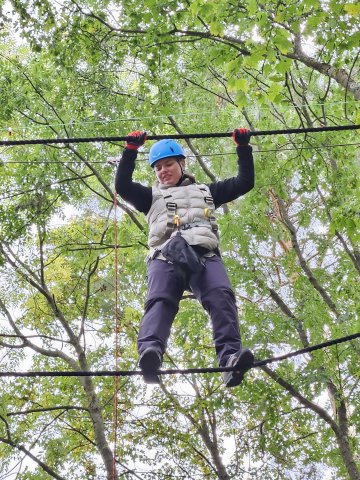
Most of the week was campus-based. Days started at 8:30 and were packed with classes and group work, often followed by evening gatherings, so there wasn’t much time for sightseeing. We did spend one full day outdoors doing team activities, which was great fun and a welcome change from the classroom.
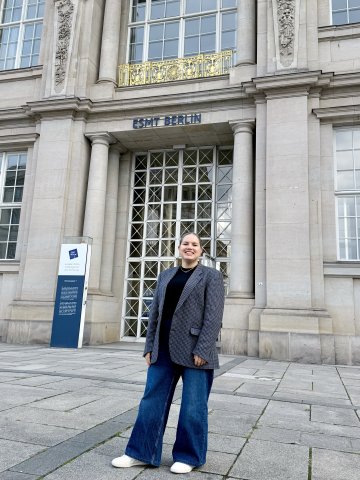
But in a way, Berlin came to us. ESMT’s campus is the former State Council building of the GDR, right in the historic center of the city. Walking into class every morning through a building with that much history never quite felt ordinary.
Has coming to campus for the residency helped your cohort feel more like a community? Did you get a chance to network together outside of class?
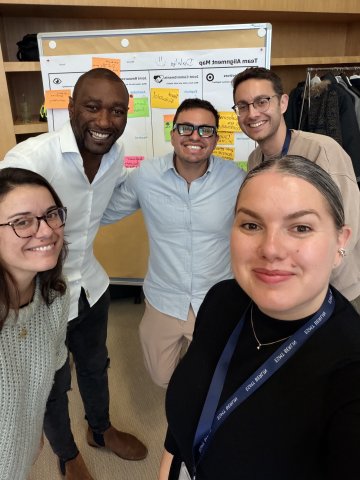
Yes, absolutely. For the first time, all the study groups were in one room, and that changed the dynamic. For my own group, “Dahlia,” it was particularly special. After a month of calls several times a week and hundreds of messages, we finally sat at the same table.
The first residency was mostly about getting to know each other, in class and after hours. The next one will widen the circle, with a networking event bringing together students from other ESMT programs and alumni.
The school opens plenty of doors, in Berlin and in other cities. But nobody networks for you. The relationships are ours to build.


What was your single biggest takeaway from the first residency?
I will be the one receiving the degree, but it will be my support network’s achievement too.
From the outside, an MBA looks like a clear goal. The path to it is not the polished success story you see on social media. Going back to school mid-career means admitting there are areas where I still want to grow and accepting that there will be moments of doubt along the way.
During the first residency, I realized I wouldn’t have to face those moments alone. My loved ones, friends, and classmates understand the pressure because they carry their own version of it. I’m grateful for their patience with my early-morning and late-night calls, and for their genuine interest in every part of the program. Some of them are even further ahead than I am: they’re already choosing their outfits for my graduation in November 2028.
What has it been like to return to being a student after time spent building a post-graduate career? Does it require a deliberate shift in mindset?
"The real mindset shift is not learning how to study again. It is being willing to question what I already know"
Yes and no. The rhythm is very different from a corporate workday, but years of hands-on experience help me connect the content to real-life situations. Almost every concept links to something I have done, worked on, or discussed with people in my network.
My first master’s degree felt theoretical; this one feels practical. There is also a hidden benefit: whenever I want to explore a topic further, I know people who deal with it every day.
The real mindset shift is not learning how to study again. It is being willing to question what I already know. Experience gives you a foundation, but it shouldn’t make you less curious.
Although it is still early in the program, have you found any useful tips for balancing your studies with your professional and personal life?
Don’t carry over the habits from your first degree. You need to rethink how you learn and how you manage your time. And the elephant in the room is AI.
ESMT Berlin has what I consider a modern AI policy: students can use AI tools, but must be transparent about what they did themselves and what they used AI for. Some might see allowing AI in academic work as lowering the bar. I see it as the right approach for a school that trains future leaders. AI is not going away, and future leaders will be the ones deciding how ethically it is used in their organizations. Learning that discipline starts here.
The reading, the point of view, and the arguments I defend have to be mine. AI can take on the mechanics: structuring notes, drafting an initial presentation layout, or testing my understanding before an exam. That is time I give back to my work, my loved ones, and, ideally, my sleep.
I apply the same principle in my advisory work on operations and AI strategy: people own the judgment, and tools handle the routine. The real skill is using technology without outsourcing your thinking.
What has been your favorite Part-time MBA memory so far? And what part of the program are you most looking forward to?
"Behind every professional profile in our cohort is a person with their own story, and discovering those stories has been one of the best parts of the program so far."
My favorite memories are always about people. One small conversation with a classmate stays with me:
“You know, I think we will become good friends.”
“Oh my God, I’m so happy you said that. I was thinking the same thing!”
Behind every professional profile in our cohort is a person with their own story, and discovering those stories has been one of the best parts of the program so far.
Looking ahead, I’m most curious about the International Field Seminar. I have lived and worked in four countries and led projects across Europe, APAC, the Americas, and MEA. Along the way, I’ve seen how differently companies make decisions: who owns them, how fast they move, and how much risk they accept. I want to understand how business leaders in a new market handle this, challenge my own assumptions, and exchange perspectives with my cohort.
Thank you, Svitlana!
Svitlana Tanchyk is an Operations & AI Strategy Advisor, podcast co-host, and corporate speaker. If you would like to hear more of her thoughtful insights on operating under uncertainty, speaking at global events, and life in the ESMT Part-time MBA, you can follow her on LinkedIn.


Get an insider's view of life on campus at ESMT
