Cloud consulting to business strategy: a healthcare AI consultant's Part-time MBA
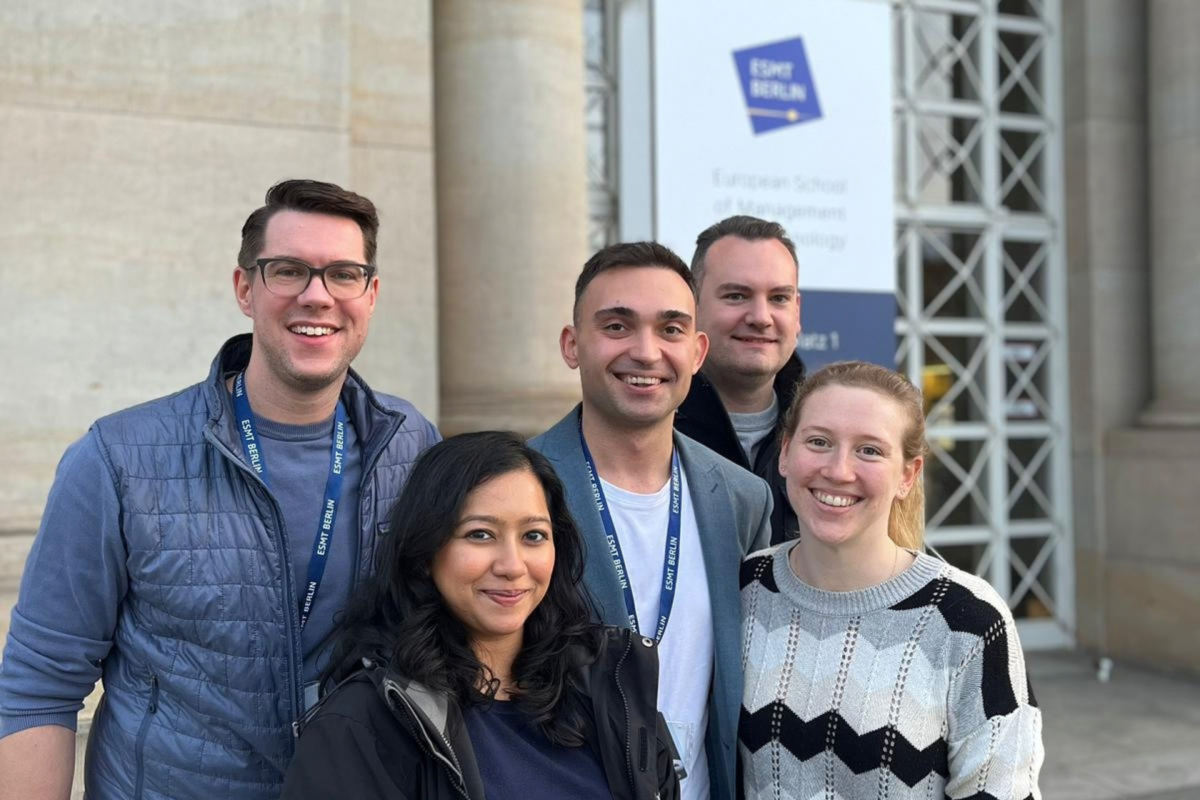
Building a completely different toolkit: Pavel’s story
Pavel Seraphimov knew that, in order to grow as a leader, he had to understand how to “ask the right business questions before anything gets built.” It was that mindset that drew him to the Part-time MBA (PTMBA) at ESMT Berlin.
In this blog, Pavel (Class of 2026) explains how the PTMBA program has helped him meet that challenge, helping him transform from a curious technologist into a strong leader who is able to understand the business reasons behind decisions and make “better-calibrated judgements.”
Pavel outlines the many PTMBA highlights he has experienced during his two years at ESMT, including a blended learning format that has deepened his business knowledge; in-person residencies that turned his cohort from strangers into friends; and international components that include learning modules in both Shanghai and Vancouver.
He also shares his tips for balancing full-time work with hobbies, life commitments, and a part-time MBA – drawing on the mindset he employs in his hobby as an endurance cycling enthusiast.
Hi Pavel, could you please introduce yourself?
I’m Pavel, a Healthcare & Life Sciences AI/ML Consultant at Amazon Web Services (AWS). I help large pharmaceutical organizations across Europe design, build, and scale their AI and machine learning capabilities in the cloud. Before AWS, I spent over a decade in software engineering, leading teams across e–commerce, banking, and IoT. At AWS I moved into a cloud consulting role, guiding the architecture and direction of AI programs for pharmaceutical clients. Originally from Sofia, Bulgaria, I have lived in Copenhagen and Berlin, and have fallen in love with both, as different and colorful as they are.
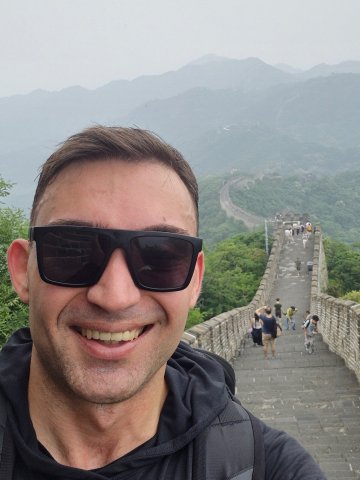
Outside of work and the MBA, I’m an endurance enthusiast. I’ve cycled solo from Berlin to Zurich (over 1000km), Berlin to Amsterdam, and Berlin to Copenhagen. My next dream is Vitosha 100, an ultramarathon near my hometown Sofia, which I’m planning for 2027.
That mix of curiosity, endurance, and a love of building things is probably the best way to describe who I am.
Why did you decide to get your MBA, and why chose a part-time program?
Growing up in Sofia in a family of engineers, I was shaped toward technical thinking from the start. I studied software development in Denmark, drawn by the Nordic Triple Helix model; the collaboration between universities, industry, and government that makes Scandinavian innovation so effective (LEGO, Unity, Too Good To Go, to name a few). After graduating, I built my career across telecommunications, e-commerce, banking, IoT, and eventually healthcare and life sciences consulting.
But the further I advanced, the more I felt the gap: no formal education in economics, finance, or strategy. I had led small engineering teams for a few years, but I'd learned leadership on the job. I wanted the formal grounding in strategy and finance before stepping into other roles.
I joined AWS’s cloud consulting organization and realized that solving technical challenges isn't the hardest part. It's asking the right business questions before anything gets built. The Part–time MBA let me do that without pausing a career that was giving me so much energy.
What drew you to the Part-time MBA at ESMT instead of an entirely online program?
“There is something irreplaceable about working on a group assignment at 7:00 p.m. on a Friday with classmates from different countries who all see the problem from a completely different angle.”
I looked at several programs, including purely online options. ESMT stood out for three reasons.
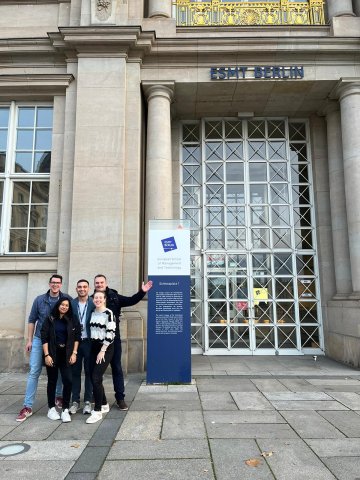
First, the part-time model: the online modules gave me the flexibility to manage my workload at AWS, while the Berlin residencies delivered the human connection that turns classmates into a real network. Second, the cohort diversity: different nationalities, different industries, and functions. Third, ESMT's focus on business innovation and technology felt like a great fit. The school doesn't treat technology as a separate elective, it's woven into the courses, and we had a lot of interactive in-person content.
There is something irreplaceable about working on a group assignment at 7:00 p.m. on a Friday with classmates from different countries who all see the problem from a completely different angle. That's what drew me to ESMT, and it's exactly what I got.


You are an AI/ML Consultant at Amazon Web Services (AWS). Can you give us a top-level overview of what your role entails?
I lead the technical direction of AI engagements, which means influencing client executives, engineering teams, and data scientists across organizations. I work with large pharmaceutical companies across Europe, helping them architect, build, and scale AI and machine learning solutions on the AWS cloud.
On a practical level, that means I might spend one week designing an enterprise orchestration platform, and the next figuring out how to operationalize data pipelines for a company’s use cases. But the technical architecture is only part of it. A huge part of my job is translating between the engineering teams and the business stakeholders. Helping organizations understand what's actually feasible, and helping the data science team understand what the business actually needs.
You switched to AI/ML from Cloud Application part-way through your degree program. How did the PTMBA help you decide to make the switch?
“The PTMBA gave me the vocabulary and the frameworks to understand that what I was seeing wasn't just a technology shift; it was a business opportunity.”
Honestly, the shift was already beginning before the PTMBA. I was working with healthcare and life sciences companies, and the momentum toward AI was impossible to ignore. I was fascinated by how machine learning could accelerate drug discovery, optimize clinical trials, and transform patient outcomes. But the PTMBA gave me the vocabulary and the frameworks to understand that what I was seeing wasn't just a technology shift; it was a business opportunity.
Is it beneficial to do an MBA, even when you're already in an industry or role that is very much at the forefront of innovation?
Especially then. In consulting, you're only as good as the outcomes you deliver for your customers. Delivering technical excellence gets you to the table. But the conversations that actually move the needle, the ones about business value, investment trade-offs, or why a transformation is stalling, those require a completely different toolkit.
Before the MBA, when a customer's leadership pushed back, I'd reach for a workshop or a Proof of Concept (POC). Those still matter, but now I first try to understand the business reason behind the pushback and address that.
Courses in Business Economics, Strategic Foresight, and Entrepreneurship taught me not to take things at face value. Porter's Five Forces reframed technology adoption as a strategic decision, not a technical one. Entrepreneurship taught me that what people do often differs from what they say, and that testing should capture real behavior, not just opinions. That combination changed how I approach every client conversation.
What is it like to balance a demanding workload with part-time study? Do you have a set schedule to fit it all in?
It's demanding. I won't pretend otherwise. AWS consulting already involves a lot of travel and intense project work, so adding an MBA on top required a lot of discipline.
My approach was to treat the MBA like one of my long solo rides. Those trips taught me that you don't survive by sprinting, you survive by maintaining a sustainable pace and not skipping rest days. I applied the same philosophy to the MBA. Consistent weekend study blocks, usually Saturdays and Sunday afternoons.
The physical side also matters more than people think. Going to the gym, jogging, and biking are how I decompress.
What are the in-person residencies like? Do they expand on the topics you learned online?
“The residencies add a layer you simply cannot replicate on a screen: being in a room with 40+ people from different industries, debating real cases, and then continuing the conversation over dinner.”
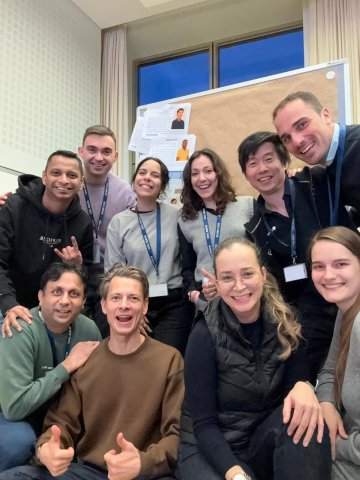
The online modules build your foundational knowledge, and they're well-structured and engaging. But the residencies add a layer you simply cannot replicate on a screen: being in a room with 40+ people from different industries, debating real cases, and then continuing the conversation over dinner.
What I appreciate most is how the in-person sessions build on the online work with case studies rather than just repeating it. You arrive having done the case study reading, and the classroom becomes a space for thinking, debate, and pressure testing yourself. Faculty members challenge you differently when they can read the room and pivot the discussion based on what's emerging. The energy is different, the depth is different.
Does your cohort socialize during these residencies and is there a difference between connecting online and in person?
Absolutely. The difference is hard to explain until you've experienced it. Online, you see someone's professional competence. In person, you see who they really are and what they're passionate about outside of work. The best bonding happens organically: a long dinner after a study day onsite, walking through Berlin together, or playing sports together.
Hopefully by the end of the program, we all stay in touch and call each other when we need advice on a career move, an opinion from somebody from another background, or somebody to meet on the other side of the world.


What is your ESMT networking experience like? Is it just within your cohort, or do you have a chance to connect with other students or faculty?
The cohort is the core, but the ESMT network extends well beyond it. During residencies, you interact with faculty members who bring real-world consulting and research experience into the classroom, and those connections continue after the course ends. Several professors have been quite generous with their time, offering guidance that goes beyond the curriculum.
ESMT's membership in the Global Network for Advanced Management (GNAM) gave me access to exchange opportunities at top business schools worldwide, such as UBC Sauder and IE Business School.
How about outside ESMT? You went on an exchange to UBC Sauder in Vancouver; what was that experience like?
“My team developed a concept for a community material kiosk in Mukuru, one of Nairobi's largest informal settlements, where recyclable waste could be exchanged for building material credits.”
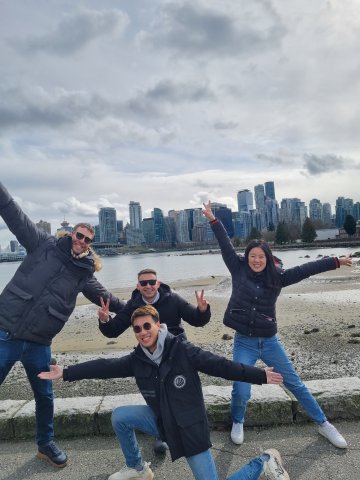
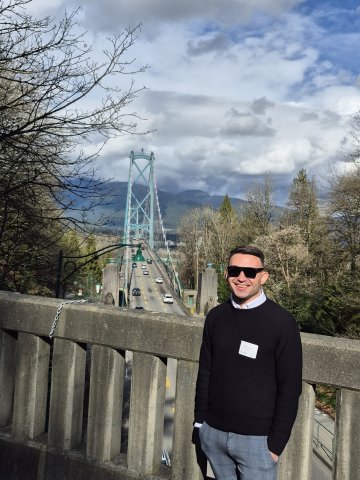
I chose the exchange at UBC Sauder in Vancouver for a course called Sustainable Development Goals, Cities, and Inclusive Prosperity, and it delivered more than I expected.
The course challenged us to apply business thinking to one of the world's toughest problems: how to create safe, affordable housing in informal settlements. My team developed a concept for a community material kiosk in Mukuru, one of Nairobi's largest informal settlements, where recyclable waste could be exchanged for building material credits. The project brought together everything the Part-time MBA had taught me: strategy, stakeholder management, financial modeling, sustainability – all applied to a problem that genuinely matters.
Beyond the classroom, Vancouver itself was extraordinary. The mountains, the mix of cultures. It's a city that makes you think differently.



As you approach graduation, what has been your favorite Part-time MBA memory? And what will stick with you in your career?
“I came in as a technologist. I'm leaving as someone who can make better–calibrated judgments, grounded in data and proportional to the impact a decision can have on the business.”
Two memories stand out.
The first is from our very first residency, when we spent the entire day near a lake outside Berlin – navigating forests, solving challenges as teams. By evening, beers in hand, we were no longer strangers but a cohort. That day set the tone for everything that followed.
The second is the International Field Seminar to Shanghai. We visited Bosch's UAES joint venture, Infineon and Allianz China, and connected what we saw to the strategy frameworks we'd studied. At one visit, an executive openly admitted they might be wrong but argued that effective leadership means making decisions under uncertainty. I recognized it straight away from our strategy case studies, and that's when I saw how closely they reflect real business decisions.
What will stick with me professionally starts with my final Part-time MBA project. I explored how pharmaceutical companies can take agentic AI from pilot to production without compromising on governance. I interviewed expert practitioners and ran a survey, and the result surprised me. Unclear accountability ranked first among seven barriers to production, while tooling ranked sixth. So I designed an operating model around ownership, risk-based controls and clear go/no–go decisions for each agent. The biggest lesson was that governance fails when it's treated as a final checkpoint. It has to be part of how teams work from day one, which makes it as much a leadership and organizational challenge as a technical one.
I came in as a technologist. I'm leaving as someone who can make better-calibrated judgments, grounded in data and proportional to the impact a decision can have on the business. The MBA also showed me where I still want to grow. I've spoken at AWS Community Day conferences, and presenting to larger audiences is something I'm now actively working on. Knowing your gaps as clearly as your strengths is something no technical certification can give you, and it's what I'm taking into the next stage of my career.
Thank you, Pavel!
Pavel Seraphimov is a Healthcare & Life Sciences AI/ML Consultant at Amazon Web Services (AWS). If you would like to hear more of his insightful takes on AI, consulting, and business, you can follow him on LinkedIn


Get an insider's view of life on campus at ESMT
