A scientific foundation meets business depth in the Global Online MBA
Diversity of perspective is what makes it interesting: Gul's story
The Global Online MBA (GOMBA) is a fully remote MBA, which means that students can join from anywhere in the world. For Gul Sanliturk, Class of 2026, that meant taking part in classes hosted in Berlin – while working full time in the UAE.
In this blog, Gul outlines why this remote-first set up was the perfect choice for her MBA, giving her the flexibility and depth to make a career transition during the program, rather than having to wait for graduation.
She also explains how this online setup attracts a richly international cohort that you get to know "through how they think and how they work" before you meet them in person. The result? A network of trusted peers, coming from different roles, industries, and countries, who you can rely on throughout your degree and into the future.
Hi Gul, could you please introduce yourself?
I’m originally from Turkey and have been based in the UAE for most of my corporate career. I trained as an orthodontist, but I moved into industry quite early and have since worked across medtech, innovation commercialization, biotech, and strategy consulting.
What has been quite consistent is that I tend to gravitate towards propositions where something scientific or technical is being brought into the real world: how you position it, how people adopt it, how organizations make decisions about it, and ultimately how you turn an interesting idea into something viable.
More recently, I set up my own consultancy in Abu Dhabi, so my work is now mainly focused on strategy, market development, and commercial projects, especially around emerging technologies.
You have been named one of Poets&Quants 2026 Best & Brightest Online MBAs. Congratulations! How did you feel when you heard the news?
I was genuinely surprised, and very, very happy. It was lovely news to receive.
When you’re doing an MBA remotely, while also juggling work, deadlines, career changes, and just normal day-to-day life, it’s easy to lose track of how much is actually happening. You become so focused on the next thing that needs to be done that you don’t really think of stopping to look back.
So, the recognition gave me a reason to do that. Looking back, a huge amount had happened during those two years, both professionally and personally, and the MBA had been running alongside all of it. I felt very grateful to have that journey recognized, and it was also great to have a chance to appreciate how much had happened along the way.

What does it mean to you to represent ESMT on a list like this?
"That industrial foundation gives ESMT a very practical character. You are constantly being pushed to take concepts out of theory and apply them to actual business problems."
It genuinely means a lot to me, and I’m very proud and grateful, also because there is something about ESMT’s identity that appeals to me personally.
I remember finding out that ESMT had been founded by 25 major global companies and thinking about how unusual that was. I hadn’t heard of so many well-known companies coming together to create a business school. That industrial foundation gives ESMT a very practical character. You are constantly being pushed to take concepts out of theory and apply them to actual business problems.
I also genuinely love ESMT’s “business as unusual” tagline. It resonated with me from the beginning because my own route into business has been anything but conventional. I came from a clinical and scientific background, moved across different parts of healthcare and business, and continued changing professionally during the MBA itself.
So representing ESMT feels meaningful because I really see a parallel there. The school brings together academia and industry, theory and application, and people coming from very different geographies and backgrounds. In a way, my own career has been about crossing some of those boundaries too.
Let’s go back to the start of your program. What prompted you to choose to pursue an MBA, especially given your background in healthcare?
I decided to do an MBA precisely because my profile was becoming broader than healthcare alone.
What I had noticed was that the more I worked in industry, the more the questions I was dealing with at work were becoming much broader than my original education. I could be starting with a clinical or customer question, but very quickly it would become a question about commercial priorities, organizational behavior, resource allocation, operations, or strategy.
I wanted enough depth across those different areas to understand how the pieces fit together and to make better decisions across them, while still bringing the scientific foundation I already had.
What drew you to the Global Online MBA program in particular?
"The MBA could take place with all of the other things going on in my life while still giving me structure and academic continuity."
When I was considering starting an MBA program, I couldn’t really predict what the upcoming two years would look like for me, both personally and professionally.
A fixed-format program would have meant organizing the rest of my life around the MBA. The Global Online MBA allowed the opposite: the MBA could take place with all of the other things going on in my life while still giving me structure and academic continuity.
And that actually became quite important, because my work, sector, and responsibilities did change a few times while I was studying. Being able to continue the program through those changes was much more important to me than just being able to study from home.
You moved into new roles during the program. Do you think the GOMBA is useful for those navigating career transitions or moving into senior roles?
What it can do is make you much more comfortable operating outside your original area of expertise. When you move into more senior or more strategic roles, problems don’t come to you in separate boxes labelled marketing, finance, operations, or people issues. They tend to contain a bit of everything.
When you change industries, functions, or levels of seniority, there will always be areas where someone else knows considerably more than you do. Having that broader understanding makes transitions easier because you can enter an unfamiliar environment and get oriented much more quickly. You become better able to understand the commercial question, the financial implications, the customer perspective, the operational constraints, and the organizational side of a decision at the same time. That broad perspective is very useful.
Were you able to apply the learnings from the program to work in real time? Did any particular topics or modules stick with you?
The most useful habit I’ve developed is probably looking at the same problem through several lenses.
If something isn’t working, is it the strategy? Is it the customer proposition? Is there a process bottleneck? Are the incentives wrong? Is the organisation measuring the wrong thing? Or are we responding to an assumption that hasn’t actually been tested?
Different modules gave me different ways of asking those questions. I use individual frameworks when they are useful, but the bigger benefit has been learning not to jump immediately to the first plausible explanation.
What was it like to learn online? How much of the week would you commit to MBA studies, and did you follow a particular routine?
"For me, online learning was less about maintaining a perfect timetable and more about learning how to manage myself."
I never really had one fixed routine, and eventually I stopped thinking that I needed one.
On average, I would say around 20 hours a week, but the reality was more variable. Some weeks were lighter, while others were more intense around exams, assignments, group projects, or work deadlines.
I also think this is quite personal. Some people genuinely work better with a regular routine and the same study blocks every week. For me, it worked better to be more flexible and adjust depending on what the week looked like, how much time I had available, and what kind of work needed to get done.
Over time, I became much better at matching the work to the time I had: some things could fit into shorter periods, while analytical work or major assignments needed a proper block of concentration.
So, for me, online learning was less about maintaining a perfect timetable and more about learning how to manage myself.
Do you have any tips for balancing online study with full-time work or consultancy?
It is very easy to look at an online MBA, see that it is flexible, and assume things will get done somehow. But an important work deadline, a group assignment and an exam can come in on the same week, and then that’s a different story...An online program gives you much more control over when you do the work, but the work still has to be done.
Be realistic about what kind of person you are. If you know you procrastinate, build deadlines for yourself. If you are a perfectionist, decide in advance where perfection is actually worth the time. If you concentrate better late at night, don’t design a study plan for someone who wakes up at 5 am.
I therefore became more protective of having some buffer. I also learnt that not every piece of work deserves exactly the same amount of perfectionism. Knowing where something genuinely benefits from another two hours of thought (and where it does not) is probably one of the more transferable skills I developed.
Alongside managing the calendar, I found that “attention management” is also needed. You can technically have two free hours and still be completely incapable of doing two hours of difficult work that needs a lot of focus after a demanding day.
I became much more aware of which tasks required my full concentration, and which could be done when my energy was lower. That made the workload much more manageable than just allocating blocks of time.

What about your cohort: were you able to connect and network with each other online?
"One thing I actually found interesting about the online format is that you often first get to know people through how they think and how they work."
Yes, and one thing I actually found interesting about the online format is that you often first get to know people through how they think and how they work.
You see how somebody approaches problems, whether they ask interesting questions, how they behave when a deadline is approaching, how they listen, and what they contribute when the study group is facing a challenge. That tells you so much about a person. By the time you connect professionally outside the classroom, you often already have a fairly good sense of each other.
Over time, you also learn who has experience in a particular industry or market, so the cohort becomes a very useful source of perspectives when you are working through something outside your own field.
I also like that the network is geographically dispersed. I now know people I can call in completely different industries and countries and get a perspective I would not naturally encounter in my own professional circle.
Where were you based while studying? Did you get a chance to visit ESMT during the program, and what was it like to meet your cohort in person?
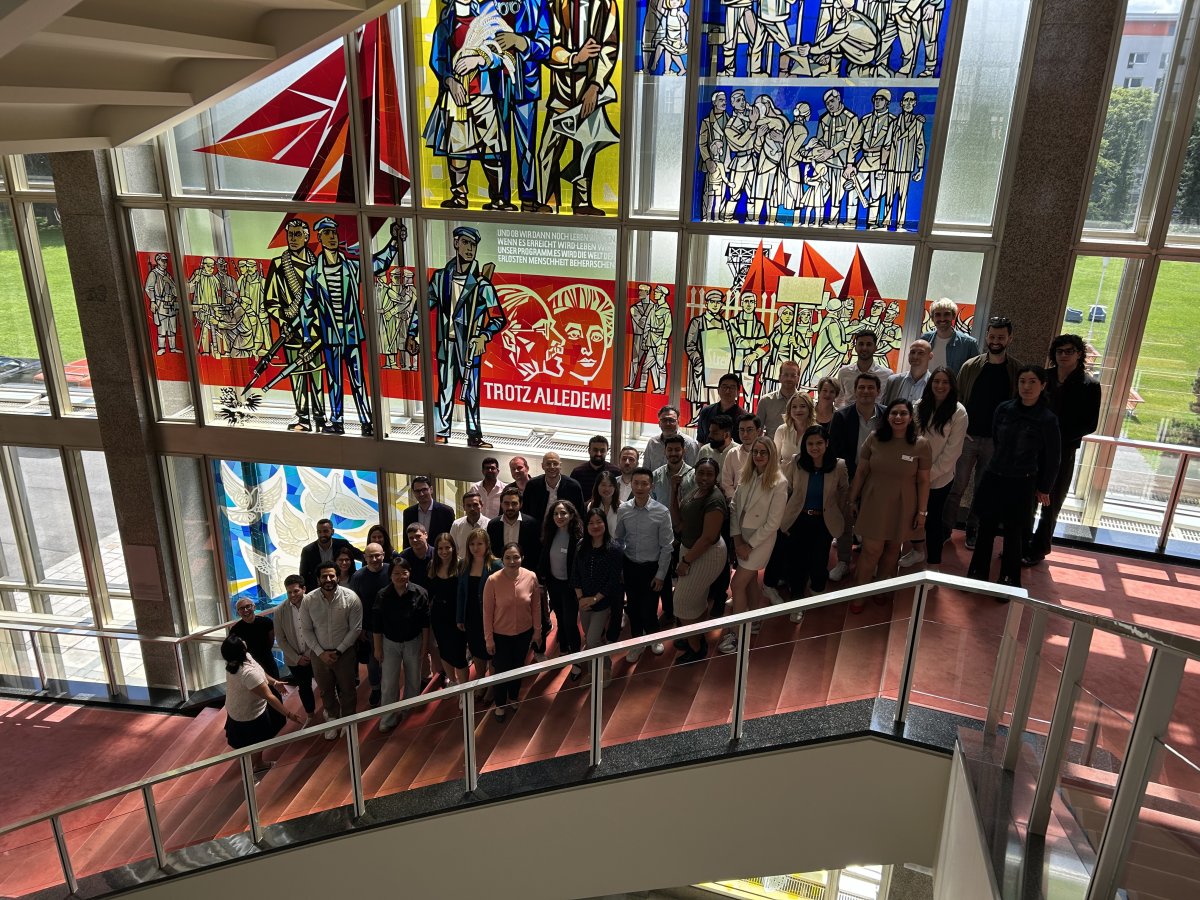
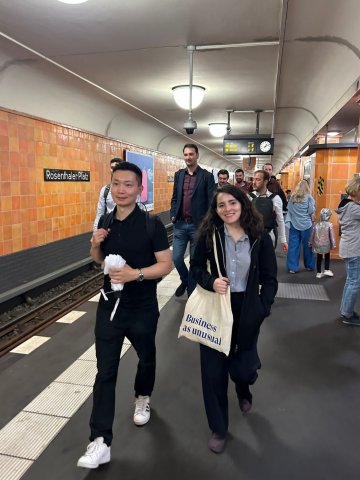
I was based in the UAE throughout the program, and I did get the chance to spend time at ESMT during the Berlin Experience Week.
By the time the class met in Berlin, we had already spent a lot of time together online. You already know people’s personalities, their sense of humor, how they communicate, and what they’re like to work with. So, meeting in person felt very natural.
I think what Berlin Experience Week added was the chance for a cohort that is normally spread across different countries and time zones to actually be together in one place. We were all going through the same program, but alongside different jobs, lives, and time zones, so it was really special to have that part of the MBA that we were all experiencing together in the same place.
Do you have any advice for students thinking about joining the Global Online MBA – especially those who don’t live in Germany or Europe?
" I think that diversity of perspective is part of what makes it interesting. You learn from how other people in different sectors and regions see the same problem, and you’re also bringing a perspective that others may not have."
There is a lot of value that comes from having different markets and experiences in the same group. I was often looking at a case through the lens of Turkey, the Middle East, or healthcare, while somebody else might approach the same question from Europe, Africa, Asia, or an entirely different industry.
So, if you are considering the program from outside Europe, I think that diversity of perspective is part of what makes it interesting. You learn from how other people in different sectors and regions see the same problem, and you’re also bringing a perspective that others may not have. I would advise to actively use that. If something works differently in your market, say so. If a case makes an assumption that doesn’t apply where you work, challenge it. A large part of the value of an international cohort is that not everybody is looking at the world from the same place.
You were also the MBA Programs Representative on ESMT’s Sustainability Task Force. What was that experience like?
I was very grateful to have the opportunity to be part of the Sustainability Task Force. It gave me a different perspective on ESMT and a chance to see how the school thinks about sustainability across different parts of the institution. I found it really interesting to see how broadly it was considered and the different ways that sustainability could be applied in practice.
It was also rewarding to see the discussions translate into live initiatives across the school, with the Sustainability Action Grants being one example. I was really happy to see this project go from an idea that emerged in the Task Force to something that was launched and gained traction within the ESMT community.
Being part of the Task Force gave me a much better appreciation of the breadth of ESMT’s work around sustainability and how seriously the school approaches it.
Looking back, what would you say to your pre-MBA self?
"I’ve come out of it much more comfortable with not being certain, and better at working through ambiguity rather than feeling like the first thing I need to do is resolve it."
Before the MBA, I probably assumed that as you gain more experience and knowledge, you gradually reach a point where you know the answers.
I think I’ve come out of it much more comfortable with not being certain, and better at working through ambiguity rather than feeling like the first thing I need to do is resolve it.
Now, instead of looking for a clear answer, I tend to start by thinking through what we actually know, what we are assuming, what the priorities are, what trade-offs are involved, and what evidence would actually help to make a decision.
I think I would tell myself not to expect that becoming more experienced means feeling more certain all the time. More often, it means being able to work through the ambiguity and still be able to move forward without having every answer.
Thank you, Gul
Gul Sanliturk is a consultant specializing in strategy, market development, and commercial projects. If you would like to read more of her insights about business and emerging technologies in Abu Dhabi, you can follow her on LinkedIn.


See more student & alumni stories from ESMT Berlin
