Ctrl + Alt + Reboot: Lessons from Merck KGaA's IT Transformation
Moderated by Nan Guo, Chief Digital Officer, ESMT Berlin
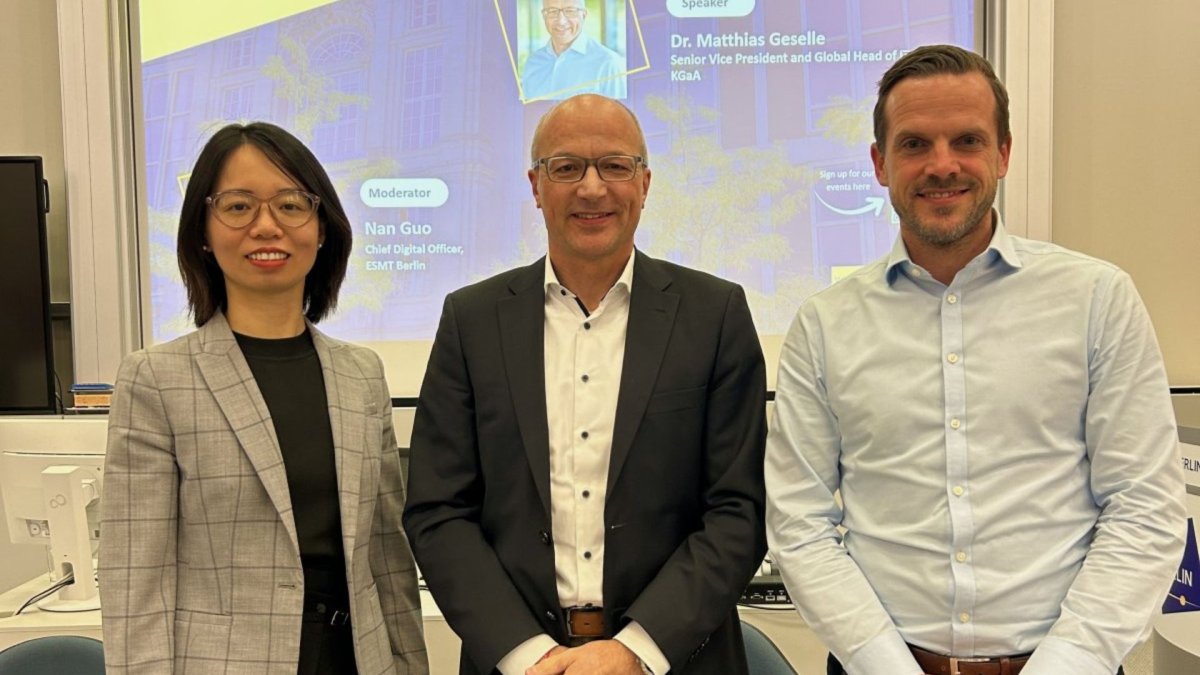
Event snapshot
Merck KGaA launched a major transformation of its IT Infrastructure organization after persistent shortfalls in compliance, transparency, and business orientation. The timing was far from ideal: shortly after the reboot began, Merck entered a company-wide restructuring that shifted nearly half of the workforce and raised expectations across the group. In this ESMT INsight Hour, Matthias Geselle explained how he led a high-stakes reboot without disrupting day-to-day operations, while also strengthening security, reducing audit risk, and improving performance.
The central challenge was to rebuild the system while keeping it stable and secure. Geselle described a transformation that unfolded over roughly three years and delivered tangible results in cost, compliance, cybersecurity, and organizational engagement. The session offered a grounded look at what large-scale IT renewal really requires when legacy environments, regulatory pressure, and changing business needs collide.
Why Merck needed an IT reboot
Geselle stepped into the role at a moment of tension. The IT Infrastructure unit had proven its value during the pandemic, enabling remote work quickly and keeping services running under strain. Yet outcomes for internal customers were uneven. Senior leadership saw clear gaps: too many audit findings, limited transparency on costs and performance, slow demand management, and a lack of agility in responding to shifting business priorities. These issues were increasingly inconsistent with Merck’s direction, particularly as cybersecurity expectations rose, smart manufacturing initiatives scaled globally, and mergers and acquisitions demanded faster IT integration.
The transformation therefore had to achieve several goals at once. Compliance risk needed to fall quickly, but IT also had to adopt a new cybersecurity operating model and support IT/OT convergence in manufacturing. All of this had to happen without compromising operational continuity. The reboot was not framed as a technology refresh alone, but as a reset of leadership focus, governance, and service orientation toward the business.
Top five learnings from Merck’s IT transformation
1) Start with calibrated listening before acting
Geselle began the transformation by running deep-dive listening and diagnostic sessions to understand how the infrastructure organization actually worked, rather than relying on inherited assumptions. This helped him refine priorities and avoid pushing a plan that didn’t match operational reality. It also built early trust because teams felt their experience shaped the direction of change. This matters because transformations fail most often when leaders move too fast on an untested blueprint and lose the organization before the work even starts.
2) Prioritize ruthlessly and make change visible early
A key leadership move was choosing which problems to tackle first and which to park, instead of trying to fix everything at once. Geselle paired that focus with early, visible actions—such as resetting leadership roles and decision patterns—so people could see momentum quickly. These first signals reduced skepticism and clarified that the reboot was real, not another temporary initiative. This matters because visible early progress creates credibility and energy, while lack of focus leads to transformation fatigue and slow collapse.
3) Modernize through evolution while protecting continuity
Geselle framed the reboot around rebuilding without interrupting operations, which meant evolving core systems carefully rather than pursuing disruptive “rip and replace” changes. He differentiated between areas where bold redesign was safe and areas where stability had to dominate due to business-critical dependencies. That sequencing allowed modernization even during a company-wide restructuring, without destabilizing daily service delivery. This matters because infrastructure transformations happen in 24/7 environments, and losing operational reliability destroys business trust and starves the transformation of support.
4) Measure outcomes relentlessly and only call change real when it repeats
The transformation was tracked through hard KPIs in compliance, cybersecurity, cost, and performance, and Geselle emphasized that improvements only count when they hold over two business cycles. Under that discipline, Merck saw sustained reductions in audit findings, stronger cybersecurity ratings, achieved savings targets, and higher employee engagement. The two-cycle rule prevented celebrating short-term spikes and forced the organization to build durable capability. This matters because many transformations look successful on slides but fade in the next budget, audit, or engagement cycle if the operating system hasn’t truly changed.
5) In transformation, leadership capability outweighs narrow domain expertise
Geselle stressed selecting leaders who could drive change and motivate people, even if they were not the deepest technical specialists in a given domain. At the same time, he protected technical excellence by building senior expert career paths so critical specialists could grow without having to become managers. This balance helped attract talent, retain know-how, and keep teams aligned during a multi-year reboot. This matters because transformation is ultimately a people and operating-model challenge, and strong leadership is what converts technical intent into lasting organizational behavior.
What made the reboot work: approach, impact, and lessons
Merck’s reboot followed a three-phase arc: first, a calibration stage to listen deeply, validate assumptions, and pick a small number of priorities that could show visible progress early; second, a modernization stage that increased investment to reduce technical debt, strengthened cybersecurity governance, and enabled IT/OT convergence while evolving core systems carefully to protect continuity; and third, a sustainment stage that embedded new ways of working through rigorous, repeatable KPIs. The impact was tangible across both hard and soft measures: audit findings dropped sharply and were closed faster, cybersecurity posture improved enough to raise insurance ratings and lower fees, savings targets were achieved, and employee engagement rose even through a period of major restructuring. For leaders, the case underlines that infrastructure transformation is fundamentally a leadership-and-operating-model challenge executed in a 24/7 environment, where sequencing change without disrupting operations is critical. It also shows that compliance and agility can reinforce each other when compliance debt is reduced systematically, and that durable transformation is only real when results hold across multiple business cycles.
