Bureaucracy Index 2026: Business sector hit hardest

The Bureaucracy Index is compiled jointly by university professor Dr. Stefan Wagner of the University of Vienna in collaboration with ESMT Berlin and the online platform buzer.de.
The index shows that the volume of federal legislation, measured in standard pages, has increased continuously over the past 15 years. In 2026, the Bureaucracy Index exceeded its 2010 level by more than 62 percent, increasing from 24,765 standard pages in 2010 to 40,270 in 2025. Historically, the overall volume has not decreased in any legislative term. Changes in government and repeated commitments to reducing bureaucracy have yet to bring about a structural turnaround.
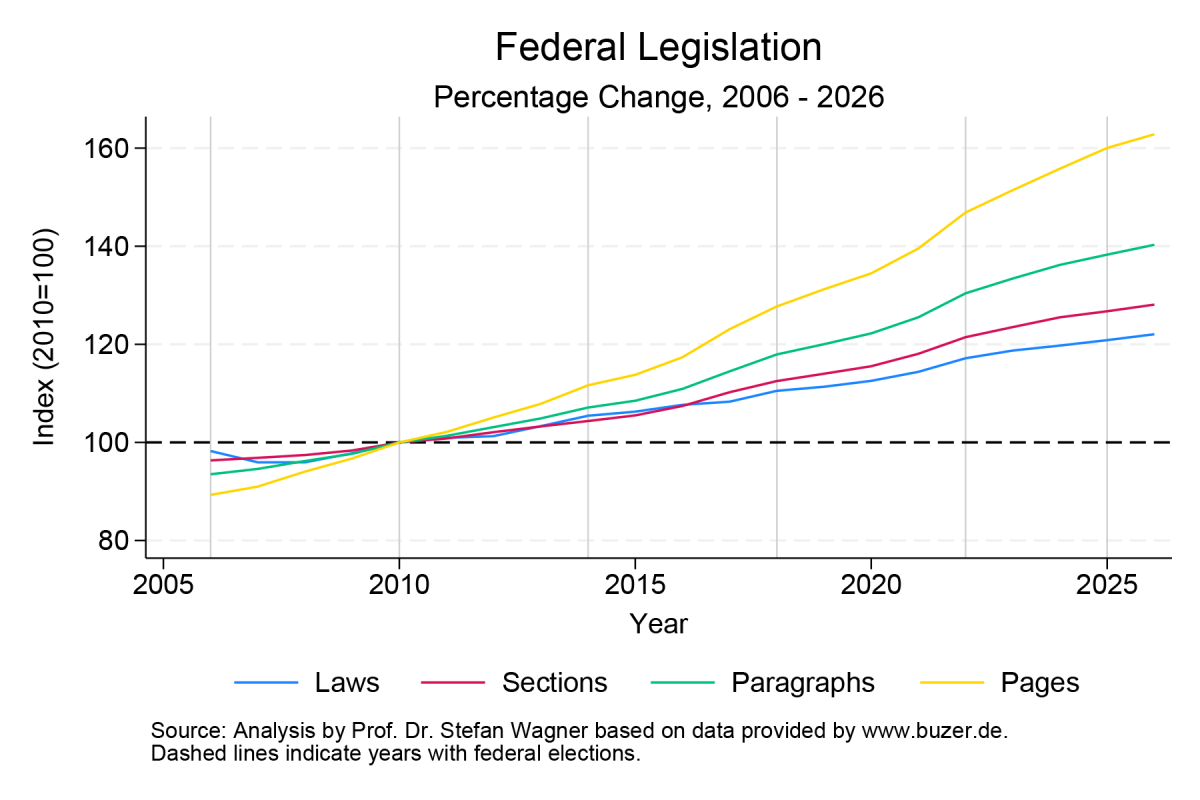
An analysis of federal election years over time illustrates that the long-term upward trend remains in place regardless of which party holds the majority. “The data indicate structural growth in legislation,” says Stefan Wagner. “We do not observe cyclical fluctuations, but rather a stable upward trend over many years.”
A differentiated analysis by legal area shows that the increase is by no means uniform. For years, commercial or business law has developed at an above-average rate. In the current five-year period, this area records the highest net increase since the beginning of the systematic evaluation, with 1,542 additional pages. At 16.5 percent, this marks the strongest growth of any legal field in Germany, placing commercial law at the top.
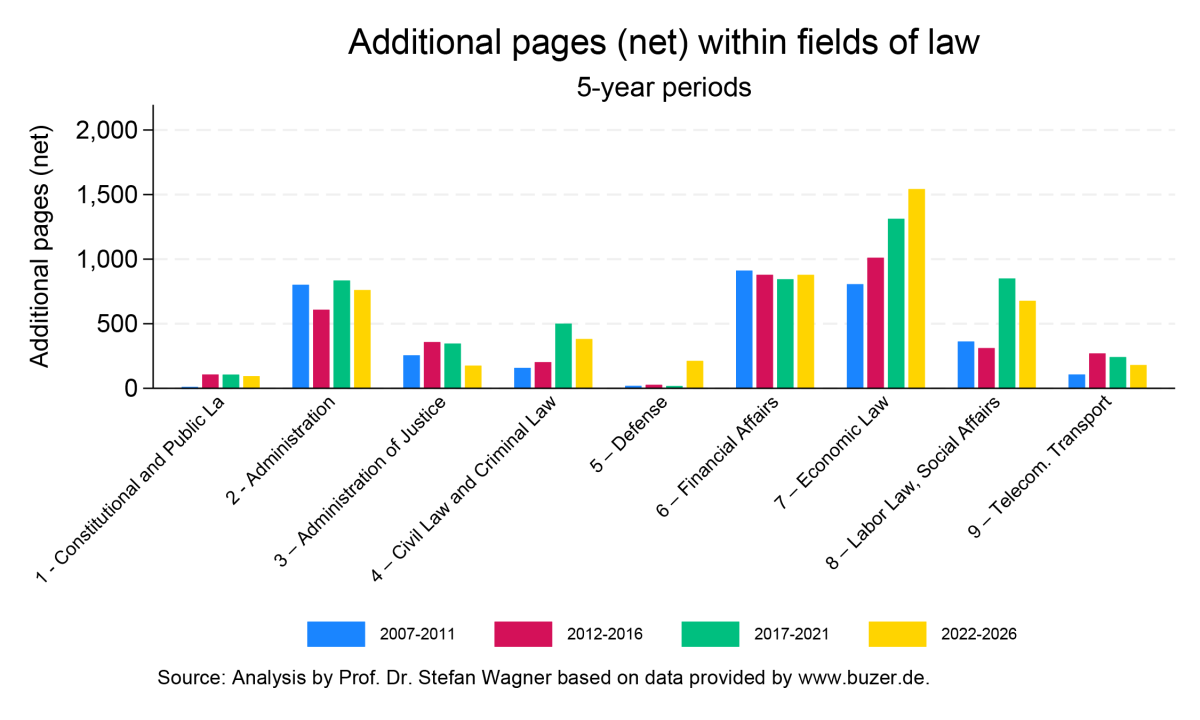
Growth in the financial sector also remains at a very high level. Alongside commercial law, it ranks among the most comprehensive and most relevant sets of regulations for businesses. Overall, the most recent figures indicate that the regulatory focus is increasingly affecting areas doing business in Germany. “It is precisely in those legal areas that directly affect entrepreneurial activity that we see the strongest regulatory development,” says Wagner. “If Germany wants to generate new growth momentum, deregulation must start here. Less complexity and leaner business regulation would directly improve investment and innovation conditions.”
The strongest relative increase within the past five years is recorded in the area of defense.
According to Wagner, this development does not come as a surprise: “On the one hand, the security policy situation has fundamentally changed since the beginning of Russia’s war against Ukraine. On the other hand, the one-off credit authorization of the German government for modernizing the armed forces has led to several adjustments in procurement law. The significant increase in this legal area reflects this reassessment of security policy priorities.”
In some areas, the growth of bureaucracy has even slowed slightly, Wagner explains: “In labor law and public administration, we observe slower growth, although not a decline, within the current period compared with the period from 2017 to 2021. Nevertheless, the net increase in legislation in these areas also remains at a high level.”
The Bureaucracy Index is based on a systematic evaluation of all applicable federal laws using the database www.buzer.de. It has been compiled since 2024. The scope of a law is measured in so-called normative pages, whereby one standard page comprises 1,500 characters including spaces.
About ESMT Berlin
