Why shame is a weak defense against greed
When Marcel Zeelenberg’s mother worked at a Dutch ministry, the minister’s chauffeur came by once a week, filled the car with the ministry’s toilet paper, and delivered it to the minister’s house. Everyone at the ministry knew about it. “[Ministers] don’t earn a super amount of money, but they can pay for their own toilet paper,” Zeelenberg said.
Zeelenberg, professor of economic psychology at Tilburg University, told the story at ESMT Berlin on September 10 when a student asked whether leaders normalize greed. He acknowledged that it was only an anecdote but drew a general lesson from it. “You give a strong signal if you do something in a position of leadership.” The message to ministry staff, he said, was that it was okay to steal from the boss.
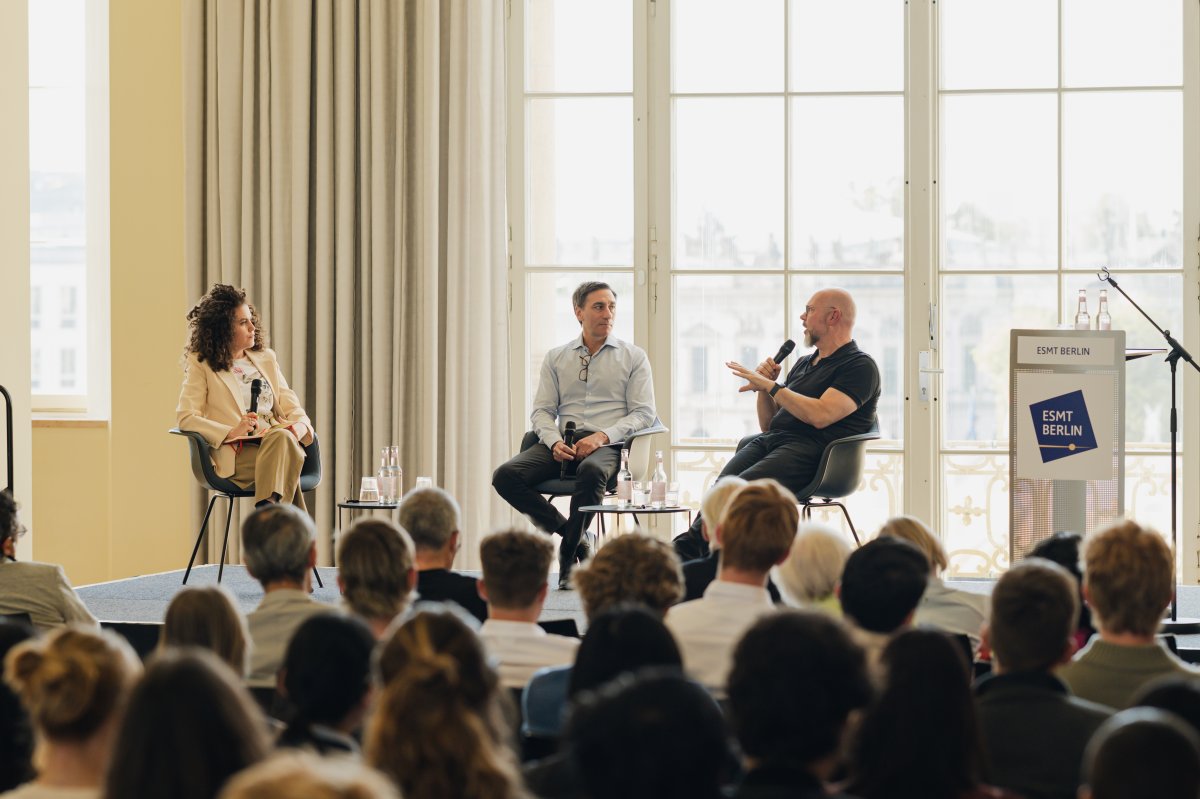
The exchange came near the end of the Gentz Lecture 2026, the flagship event of the Ingrid and Manfred Gentz Chair in Business and Society, held during the inauguration of ESMT’s new master’s students. After a welcome from Ingrid and Manfred Gentz, delivered by Ingrid Gentz, Zeelenberg used the lecture, “New insights on the morality of greed,” to present research on why some people are more willing than others to cross ethical lines.
An insatiable desire for more
Zeelenberg opened with a picture of The Very Hungry Caterpillar, the caterpillar that eats its way through more and more food each day. The book stands for the trait he and his colleagues have studied for about 15 years. “Greed is the insatiable desire for more,” he said. “It’s that simple.” He cited billionaire John D. Rockefeller’s reported answer when asked how much money it takes to make a man happy: “just one more dollar.”
Zeelenberg’s team measures greed with a seven-item scale built from statements such as “I always want more” and “As soon as I have acquired something, I start to think about the next thing I want.” Tracking the same participants from 2013 to 2019, the team found that “the people that were greedy six years ago are still pretty greedy.”
Greed scores are linked to how people behave. In a study of 3,786 Dutch teenagers, greedier students had more income but also spent more, saved less, and had more debts. Other studies found that greedier people treat relationships as instrumental. “They see other people as tools that they can use to achieve their goals,” Zeelenberg said. He also showed the logo of the Berlin shop Kauf Dich Glücklich, which translates as “buy yourself happy,” and noted that greedy people tend to be unhappy.
Less guilt after the line is crossed
Across several studies, greedier people found moral transgressions more acceptable and reported committing them more often, from keeping extra change when a cashier mistakes a €20 note for a €50 to cheating a little on a tax return. Bending the rules might make it easier to get more, Zeelenberg said, but a person still has to actually do it. He wanted to know what makes that step easier.
One answer concerns moral emotions, which Zeelenberg, paraphrasing the 18th-century economist Adam Smith, called “the cement of society.” In a study with Chelsea Blijlevens, 550 US participants read five scenarios, including one in which they find a wallet holding $50 and a wealthy stranger’s driver’s license at a time when they could really use some extra money. Half read that they returned it, and half that they kept the cash. Those who imagined keeping it reported more shame and guilt overall, but the greedier they were, the weaker those emotions became. “Greedier people feel less shame over their transgressions,” Zeelenberg said.
A second project, with Žiga Puklavec of the University of Mannheim and Tian-Yi Hu of Shanghai Normal University, asks whether greedy people also judge right and wrong differently. The first study did not produce the expected results, because its standard items asked people to judge others’ behavior, while greed concerns one’s own gains. “Know what you measure,” Zeelenberg said. In a second study of 495 participants, people said how much they would need to be paid to commit various violations themselves. Greedier participants named lower prices for violations of fairness and care, even after accounting for self-interest and the tendency to maximize. Zeelenberg described the project as a work in progress, but said the findings suggest that if you are greedy, “you feel fewer moral emotions about your transgressions and you actually have a totally different view of what is immoral.”
Checks and balances
In the panel discussion, Julia Langdon, assistant professor of organizational behavior at ESMT, asked whether bringing back social shaming might keep greed in check. Zeelenberg doubted it. “I would be fearful of shaming because I think shaming would work for the people that are already okay.”
He pointed instead to a study of CEOs at large American companies. Greedy CEOs were bad for their companies overall, he said, but a strong board that checked on them made a difference. Gianluca Carnabuci, holder of the Ingrid and Manfred Gentz Chair in Business and Society, who led the discussion, called this “maybe not exactly encouraging.” Zeelenberg disagreed. “It’s encouraging that you can do something about it. You need to have checks and balances.”
Zeelenberg also noted that people do not reach high positions by chance, and that greedier people may have more of the ambition it takes. Carnabuci questioned how far greed gets them, since leaders rarely rise alone. Greedy people may be burning bridges, he said, “because without a sufficiently powerful trust network around you, success is unlikely to come.” Zeelenberg answered that organizational culture plays a large role, and that in colder, more instrumental organizations, greedy people might still get there.
Norms around greed may be shifting. Across samples from 2013, 2019, and 2024, individuals became less greedy as they got older, yet later samples scored higher on average than earlier ones. “Society seems to become a little bit greedier over the years, even though people themselves become less greedy,” Zeelenberg said. He suggested this may reflect how people talk about greed and what they treat as normal.
Near the end of the evening, Zeelenberg described a greedy person alone on a desert island, piling up more coconuts than they could ever drink and harming no one. “You only hurt other people when there are more people on the island and there’s a limit to the amount of coconuts.” In organizations, where the island is always shared, he saw checks and balances as the practical answer.
The Gentz Lecture series is supported by the Krupp-Stiftung.
