Nobody will announce it
For nearly six decades, the standard account of what managers do came from Henri Fayol, a French industrialist who in 1916 described the job through verbs that included planning, organizing, coordinating, and controlling. In 1975, a young Canadian academic named Henry Mintzberg decided to check.
Mintzberg went and looked. He gathered every observational study he could find and shadowed five chief executives for a week himself. One study counted 583 activities in a foreman’s eight-hour shift, one every 48 seconds. The work was fragmented and relational, much of it done in conversation, and Mintzberg concluded in Harvard Business Review that “no job is more vital to our society than that of the manager.”
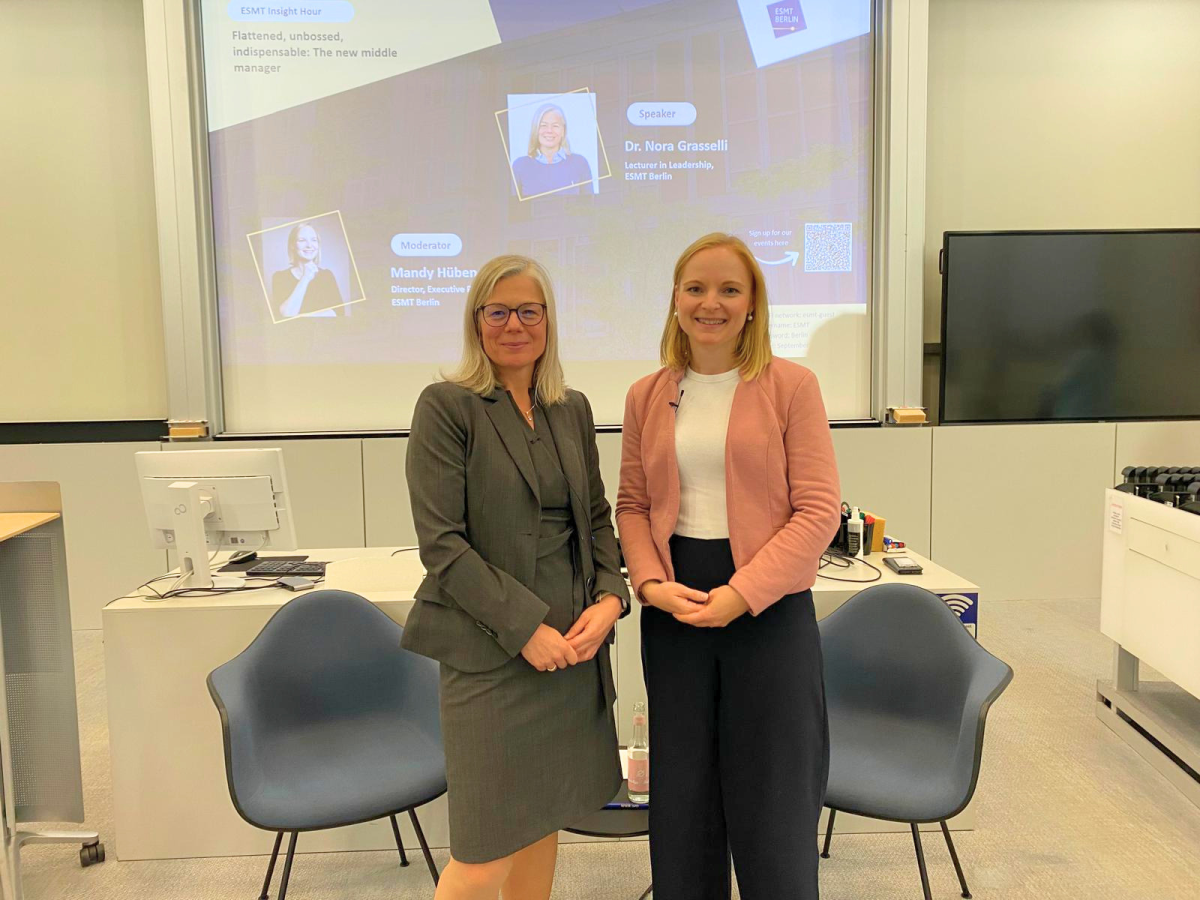
Nora Grasselli, lecturer in leadership at ESMT Berlin, opened her Insight Hour talk on September 24 with Mintzberg’s study and the relief it brought managers, many of whom had assumed that everyone else was calmly planning and controlling while they alone were keeping a lid on chaos. Her executive students still struggle to describe their own jobs. “They are extremely good at their job,” she said, “but they find it hard to say what the job actually is.”
The great flattening
Fifty years later, many companies want fewer managers. Amazon CEO Andy Jassy said in 2024 that he wanted at least 15 percent more individual contributors per manager. Meta, Bayer, Google, Microsoft, and Intel have made similar moves, and in September 2026 Uber announced 3,300 job cuts aimed at removing management layers.
The case sounds reasonable, Grasselli said, because of the manager most people picture: David Brent of the British sitcom The Office (Stromberg in its German remake), who calls a meeting to announce a meeting and performs Fayol’s verbs with total commitment while producing nothing. “Maybe it’s the David Brents he meant,” she said of Jassy.
By the measure of US employment, though, managers have rarely been more numerous. Managerial occupations rose from 9.2 percent of the workforce in 1983 to 13.6 percent in 2025, near their historic high, according to figures Grasselli presented. Some of that is title inflation. “We all know managers who don’t manage anyone,” she said. Nor does AI explain the recent cuts. Grasselli cited an analysis by The Economist that found no relationship between a sector’s AI adoption and how far it cut management. Much of the trimming instead reverses heavy hiring into management during the pandemic.
Same title, different job
Grasselli then gave the room 90 seconds. Turn to your neighbor, she said, and name one thing a manager did that made a real difference to your work. “Try to be as concrete as possible.” One participant described a manager who gave complete trust (“there’s nothing that replaces this”) and a manager “who fights for you, for your team, for your budget, for visibility.” Another described a boss who explained the big picture, skipped the micromanagement, and stepped in only in an emergency. Nobody, Grasselli pointed out, praised a manager for approving vacation requests.
Letian Zhang, then at Harvard Business School, found the same pattern in 34 million US job postings for managerial roles from 2007 to 2021. Postings requiring supervision fell from about 11 percent to under 9 percent, while those requiring collaboration rose from about 13 percent to nearly 30, largely within the same job titles. In Grasselli’s words: “Middle managers aren’t going away. Supervising is.”
A change of role is a transition, and transitions normally come with a new title, a new team, a new boss, or at least a LinkedIn update. Middle managers are getting none of these. In a 2021 article for MIT Sloan Management Review, Grasselli and her ESMT colleagues Ingo Marquart and Gianluca Carnabuci called this an invisible transition: a substantial change in the nature and scope of someone’s leadership with no change in formal position. The managers they surveyed found such transitions 27 percent harder to navigate than formal ones.
Five decades of research show that every leadership transition unsettles three things: identity (Who am I?), strategy (What do I build?), and the social system (How do I connect?).
Judgment, context, and performance
Grasselli applied those three questions to the transition most middle managers are living through now, the arrival of AI, offering the result as “more of an illustration” than a complete account.
On identity, a manager’s legitimacy has long rested partly on technical, operational, and political competence. AI adds a fourth: technology fluency. “Nobody is asking you to out-code your top engineers,” Grasselli said. Some of the finished, confident work landing on managers’ desks is what researchers call “workslop,” plausible and well presented but moving nothing forward. “It costs the reader more time than it saved the writer.” Legitimacy, in her view, now rests on judgment: knowing whether work that looks finished actually is.
Strategy still arrives from above as an abstraction, such as “become an AI-first organization,” and translating it for a team is the middle manager’s job. AI has more information than any manager but lacks context: what was tried before, what failed and why, and “which team will quietly drop this project because they have a different bonus system. This is not in any model.”
Connection raises a question most organizations have not answered: what good performance looks like now. How long a task took or how much AI went into it says nothing about quality. What matters is whether the work holds up when someone builds on it and whether it strengthens the team or just speeds up one person’s output. No process can settle that, Grasselli said. Teams have to work it out in conversation.
Who stays
Some roles should disappear, she said: jobs that amount to nothing more than planning, organizing, coordinating, and controlling, and brokerage roles that only open doors to the people with real expertise or power. “Those jobs will go. But that doesn’t mean those people will go.” The managers who last will be those who notice their job has changed and act without waiting to be told. “Nobody will announce it,” she said. “That’s the whole point.”
Telling the two kinds of manager apart is hard to do from above, she acknowledged. Her suggestion is to ask the people who report to them: “What does your manager do, and what contributes value?”
What organizations owe their managers
Grasselli was clear that the burden should not fall on managers alone. As AI speeds up output, finished work piles up on managers’ desks, a squeeze she compared to the burnout many middle managers suffered during the pandemic. Companies that ignore it risk losing their best people. If nobody will announce the change, she suggests that organizations do it themselves: treat it as a formal transition, give it a name, and offer the coaching, training, and time to learn that help leaders in transition succeed, along with room to fail. She does not think a new title is necessary. Pay, she added, “never hurts.”
The case for the job
Grasselli had opened her talk with “I love middle managers.” Asked whether younger people who want no part of the job are wrong, she put some of the responsibility on employers. “I want to take the pressure off Gen Z,” she said. “I think we didn’t do a good job of making this attractive.”
Asked by a student how future managers can collaborate better, she pointed to trust built on competence, integrity, and empathy, and singled out the last: “What differentiates AI agents from our team members is that AI doesn’t care.”
Before the discussion began, she had given the audience homework: “Who are you becoming? What are you building, and how are you connected?”
Nora Grasselli spoke at ESMT Berlin on September 24, 2026, in the Insight Hour session “Flattened, unbossed, indispensable: The new middle manager,” hosted by Mandy Hübener. A self-assessment tool drawing on ESMT’s leadership transitions research is available at ESMT Leadership Transitions.
