Fun, Authenticity, Empowerment, & Belonging: Pride Impact Club values
You can be whoever you want at ESMT: Christopher and Laura's story
The attack on the 2026 Christopher Street Day Parade (CSD; Berlin's Pride Parade) was a horrific event that will not – and should not – be forgotten.
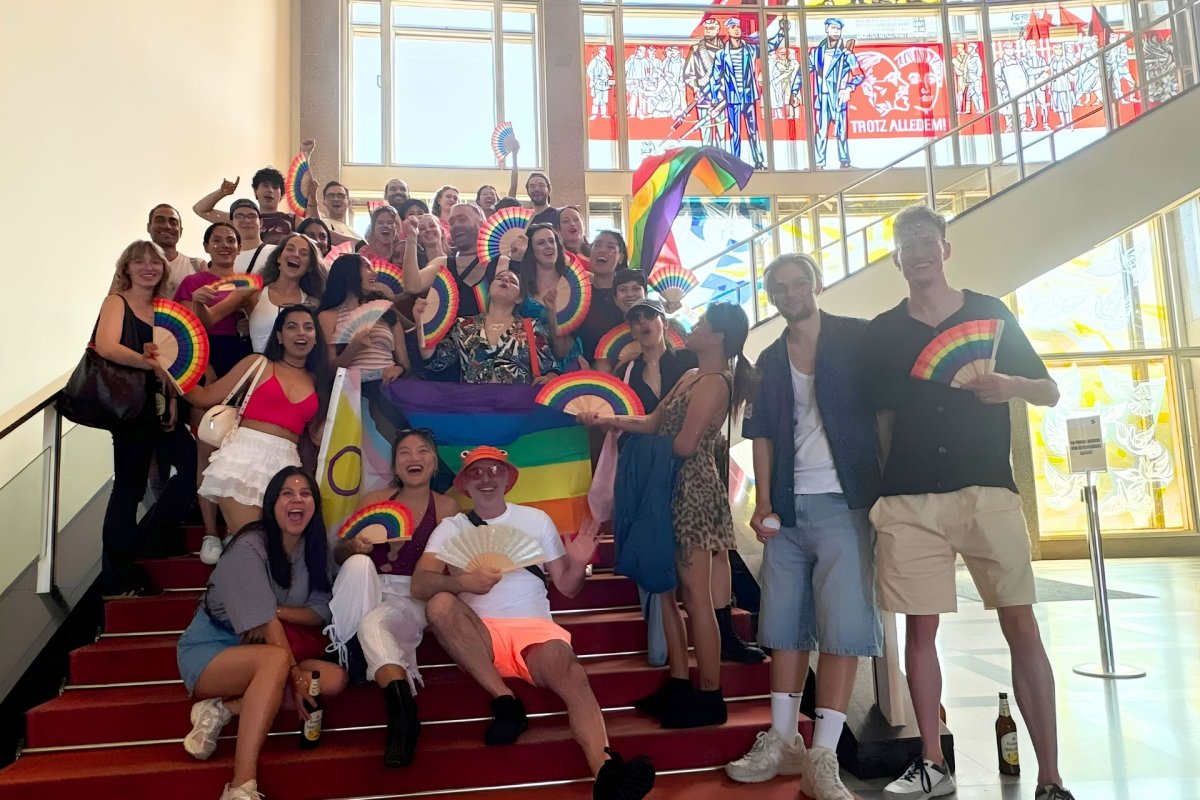
Yet it is important to remember that this event does not define the LGBTQIA+ community; in Berlin, or at ESMT. In this blog, Christopher Gerbino, Full-time MBA (Class of 2027) and Laura Ruiz, Master in Innovation and Entrepreneurship (Class of 2027) – the co-leads of the Pride Impact Club – offer a heartfelt reminder of this fact. They explain why they volunteered to lead the club, which bonding activities the students have shared, and why embracing diversity can give businesses enormous benefits.
And they explain how they demonstrate the Pride Impact Club's values of Fun, Empowerment, Authenticity, and Belonging, even in the face of tragedy. The result is a beautiful testament to queer resilience, peer support, and the strength of community.
Hi Christopher and Laura, could please introduce yourselves?
CRG: Hello! I’m Christopher. I’m originally from the United States and currently pursuing my Full-time MBA (FTMBA) here at ESMT Berlin, with a focus on operations and supply chain. Outside the classroom, I co-lead the Pride Impact Club, serve as a Class Representative, and on the weekends love to explore all that Berlin has to offer. I’m a huge history nerd and love just walking through the city and pausing to learn about whatever neighborhood I’m in and street I’m on.
LR: I'm Laura, originally from Nicaragua, a Master in Innovation and Entrepreneurship (MIE) student and co-lead of the Pride Impact Club. My passion for health led me to study nutrition and become a registered nutritionist, and it's grown into a broader interest in the intersection of technology, business, and health. I also have a strong sense of social responsibility – coming from a minority group myself, I care deeply about creating diverse and inclusive environments.
What programs are you completing at ESMT? What initially drew you to the school?
CRG: I’m completing my Full-time MBA and will be graduating in April 2027. What drew me to ESMT was the strong reputation within Europe, international cohort, and the opportunity to build a career here in Germany after graduation. I also really wanted a smaller class – as an undergrad in the United States, I was one of 10,000, while at ESMT my current class is 35 people. Here I feel like I can have a real impact and voice to actively shape this experience.
LR: I'm in the MIE program. I came to ESMT with a clear goal: I'd been working as a nutritionist in digital health, and I wanted to master the business frameworks to co-found a successful digital health company. The Summer Entrepreneurship Program (now called Incubation I), an incubator built into the curriculum, gave me the direct opportunity to do exactly that: build a team and create my own venture, Lunara, in the digital health space.
Let’s talk extracurriculars. You are both the co-leaders of the Pride Impact Club at ESMT. Can you tell us about the club?
CRG: The Pride Impact Club has had some recent ups and downs, it was pretty dormant through COVID, until an MBA student revitalized the club in 2024. So, we’re continuing that work and focused on growing the club with regular events throughout the year. We’re led by four strong values: Fun, Authenticity, Empowerment, and Belonging, and these values affect how we operate and view the club internally. We want this to be a safe space for self-expression, fun, and some occasional networking for the ESMT queer community and its allies.
LR: With the Pride Impact Club, we want to create a safe space for queer students and alumni to find community and connection, but also a place for education on Diversity, Equity, and Inclusion (DEI) topics, helping members become more conscious, effective leaders in their careers. Since most ESMT students come from abroad, we especially wanted to build a space for queer students to find one another. There's something really important about having a queer community – people you can talk to about the things that only our community truly understands.
Is the club entirely student-run and are all the members students? Do you get any help or support from ESMT or the wider community?
CRG: Yes – the club is entirely student run! Laura and I are researching, planning, coordinating any and all events that you may have seen or heard about on and off campus. We’re of course supported by the amazing Student Services team, Marketing team, some incredible alumni, and we're especially grateful for a swell of support after the recent attack on the Berlin CSD Parade.
LR: The club is entirely student and alumni run. ESMT supports us in making events possible, and we've also partnered with external companies such as DocMorris.
You both cohosted a webinar for DocMorris' Lunch & Learn session on the topic LGBTQIA+: History, Language, & Active Allyship. What did that involve?
CRG: This was such a cool event. DocMorris is an amazing corporate partner that last year helped us fund our very own truck in the CSD Parade, and we were thrilled to work with them again this year. I focused on the history of the queer rights movement and paid special attention to Berlin, which has been a trailblazer for well over 100 years in this space.
LR: We prepared and delivered a short presentation for DocMorris employees as part of their Pride Month initiatives. We focused on LGBTQIA+ history, the meaning behind the acronym, and active allyship in the workplace. Employees engaged with the content, which was great to see, and we believe initiatives like these can have a real impact in helping queer employees feel safe and seen.
What other events did the Pride Impact Club take part in during Berlin Pride?
CRG: We organized a karaoke kick off in mid-July, where a group of students met at Monster Ronson’s for an exciting night of dancing, singing, and celebrating. We also went to the 32nd Stadtfest in Schonenberg which was amazing to see: the community came together with shops, demonstrations, performances, food, and drinks. The Stadtfest is the largest queer event of its kind in Europe, and also the largest anti-violence project in Europe.
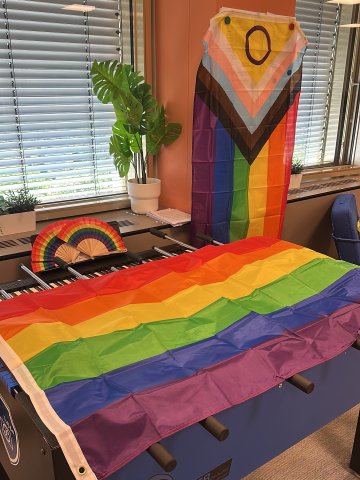
LR: We hosted a pre-CSD meetup for ESMT's queer community and allies – a glitter station, music, and a chance to connect before marching to the parade together. This year was of course marked by the attack at CSD. Thankfully, everyone from our community was safe, but it was a painful reminder of why visibility and solidarity still matter so much. Beyond Pride, we've hosted several meetups for queer students that create space for fun, connection, and friendship-building – which is really at the heart of what the club is about.


Is it important for ESMT students to take part in extracurriculars like Pride Impact Club (or other clubs)? How can it enrich their degree experience?
CRG: I honestly think that extracurriculars are just as important as classwork. School clubs allow you to explore what interests you in a more real-world setting, where you can learn what you’re passionate about, develop leadership skills, and build a stronger network that will hopefully support you throughout your career post-graduation. I think the Pride Impact Club is especially important for a school like ESMT with such an international student body – having a space for LGBTQIA+ students can make a huge difference in how connected and supported they feel throughout their programs.
LR: Absolutely. You connect with students you might not otherwise meet, and you can build meaningful relationships with corporate partners through sponsorship or co-created initiatives. You also develop leadership, budgeting, and project management skills. There are so many clubs where you can gain hands-on experience in the field you want to specialize in: operations, marketing, leadership. At the end of the day, a club is a small organization with performance goals, a team, processes, and structure.
ESMT deliberately tries to build diverse, inclusive cohorts. How do you think this shapes classroom interactions?
CRG: I love the diversity, not just in my cohort, but the entire school. My class of 35 people is from 22 different countries, and we all have such diverse backgrounds which directly contribute to engaging conversations that have often challenged my point of view in the best way possible. As an American, I know that I’m quite sheltered and I’m so grateful in the past seven months to have learned so much more about the world and to have been exposed to new ways of thinking and problem solving. This diversity also builds empathy and adaptability that I think is essential for anyone working and living globally.
LR: ESMT is a very diverse environment – both faculty and classrooms are multicultural. To understand each other across different backgrounds and cultures, we have to be open and empathetic towards one another's perspectives, which has helped me develop real intercultural competence. Also, 50% of my cohort are women – it's genuinely nice to feel represented, rather than being the only international woman in the room.
Is diversity an important part of business? How can the wider business world benefit from amplifying LGBTQIA+ voices?
CRG: Diversity is absolutely an important aspect of business and also a major advantage. Companies with diverse teams tend to make better decisions, understand a wider range of customers, and avoid certain blind spots that a less diverse team may miss. Amplifying LGBTQIA+ voices specifically means businesses get perspectives that are often overlooked in product design, marketing, HR policy, and beyond.
LR: Diversity is essential – first, to attract talent, and second, to drive performance. Research shows diverse teams make better decisions and tend to outperform homogeneous ones. And as Gen-Z grows older and gains more spending power, doubling down on social responsibility matters even more: it's a key criterion for how that generation chooses which companies to engage with.
Christopher: you are from the United States. Did you move to Germany for your MBA? Why Berlin, and what is it like to build a life here?
CRG: Yes, I moved to Berlin from the United States for my MBA. I chose Berlin partly for ESMT's program, but also because Berlin is one of the most open and diverse cities in the world and this was a major factor for me. Building a life here has been exciting, terrifying, rewarding... there are so many adjectives I could throw in here, but I think the most important part has been learning to adapt to a very different way of living.
Europe and America are so culturally close in so many ways, but also so far apart in others. Establishing myself here is an ongoing adventure: some days feel great when I can order a sandwich in German, and others I still feel like an out of place American tourist. But I absolutely love this city and I’m so thrilled to be making this my home.
Laura: although you were also born in the USA, and raised in Nicaragua, you have called Berlin home for nearly a decade. What makes it a home for you?
LR: Berlin is a city where you can express yourself completely authentically – that's what drew me here, and it's what has kept me here for so long. It's also very international, queer-friendly, and open-minded. There's a real sense of acceptance for diverse perspectives, expressions, and opinions.
For both of you: do you see Berlin as an LGBTQIA+ friendly city where people can be themselves?
CRG: Berlin has long been one of the most queer-friendly cities in the world. I did a lot of research on queer Berlin for the DocMorris Lunch & Learn and was fascinated by all the organizational developments and (relative) freedom of early 1900s Berlin. I love that the city has recaptured that sense of openness and freedom in recent history.
With that said, the recent attack on the Christopher Street Day parade is a reminder that with visibility often comes vulnerability. But if anything, the response from the city, the school, the community, has reaffirmed why Berlin’s spirit matters so much. I still firmly believe Berlin is the place where people can authentically be themselves, and this belief has only gotten stronger, not weaker, in the face of this recent tragedy.
LR: Generally, yes – though I'll be honest that I've experienced micro-aggressions myself in public spaces. They happen rarely, but they're still a reality. That said, Berlin has so many wonderful queer-friendly spaces where people can feel completely safe.
Do you have any tips for future students (particularly LGBTQIA+ students) who are thinking about applying to ESMT?
CRG: I love talking to prospective students considering ESMT! I’d recommend that you think about your application as a marathon, and in a similar way that you train for a marathon, you also need to prepare for your application. Set yourself a schedule to follow, connect with as many people within ESMT as you can (current students, alumni, admissions team), and think what your story is because ESMT is interested in what you can bring to the table and how you can contribute to this amazing community.
I think specifically for queer students I would say: don’t hide yourself, you can be whoever you want at ESMT and in Berlin – and reach out to Pride Impact Club members early to start learning about our events and how you can get involved!
LR: My tip is to be yourself throughout the interview process. ESMT actively looks for diverse people – it's what makes classroom interactions richer and deepens everyone's understanding of different realities and perspectives. So don't feel you have to hide any part of who you are; it's genuinely an asset here. And reach out – to me or to other classmates – start building your network early.
Thank you, Christopher and Laura
If you would like to learn more about the Pride Impact Club, you can connect with the club on LinkedIn. You can also connect with Christopher and Laura: follow Christopher on LinkedIn here and follow Laura on LinkedIn here.
Talking about CSD 2026
On Saturday, July 25, 2026, there was a deliberate attack on the CSD, in which a woman lost her life, and many were injured. There is no way to lessen this; it was a deadly act targeted at a loving, minority community.
And yet. It also came at the end of a day of encouragement and self-expression where hundreds of thousands of people came to march in support of queer rights and dance in celebration of love in all its forms. This included many students, alumni, and supporters from ESMT Berlin's Pride Impact Club.
It is vital that, despite how it ended, we don't lose sight of that part of the day. It is important to remember Berlin is still a city of queer defiance and joy, where all members of the LGBTQIA+ community can find their home.
Messages from students and alumni regarding the CSD attack
To that end, Christopher and Laura agreed to write this blog to let LGBTQIA+ students, alumni, and prospective students know that there is a welcoming community at ESMT and in Berlin. The Pride Impact Club values are Fun, Authenticity, Empowerment, and Belonging. Christopher and Laura embody these values every day and invite others to join them; to be heard, to support each other, and to show that love wins.
They also invited ESMT students and alumni to express their feelings about the attack. While not every club member felt like they were ready to share their thoughts publicly, both Christopher and Alan Wang, the Pride Impact Club lead from 2025, offered their words:
"I don't speak German well, but this year's CSD slogan touched me: "Haltung is hot, deine Stimme steht dir gut" (Taking a stand is hot, your voice suits you well). It reminds me why Alejandro and I founded the ESMT Pride Impact Club, because we often need to recharge ourselves with the courage to speak up and speak out. What is an ocean, but a multitude of drops?"
- Alan Wang, FTMBA, Class of 2025
"In the last few days, I've felt sad, angry, and honestly, I'm still working through all the emotions. I don't want to give the attacker any more of my time or energy, but I'll be honest – he stole some of my sense of safety I used to feel here in Berlin. Even so, I’m not going anywhere, the queer community is not going anywhere. We'll keep showing up, keep being seen, and keep holding our place in this world, together."
- Christopher Gerbino, FTMBA, Class of 2027
Where to find further support
If any part of this article or this news in general have raised feelings for you, please know you are not alone. ESMT and the wider Berlin community have support networks in place for anyone who needs a safe place to talk.
ESMT support networks
- Students at ESMT are encouraged to reach out to Christopher or Laura – or any member of the Pride Impact Club – to join the community and find mutual support.
- The ESMT Student Services team can help current ESMT students find counselling with our external partner, as well as other support offers.
- You can also contact our ESMT Mental Health First Aiders (MHFA), members of staff who have been trained to recognize different types of mental health crises, provide initial support, help individuals reach safety when needed, and guide them toward appropriate professional resources and services. An MHFA list is available on the school intranet.
- All conversations at ESMT Berlin will be treated with confidentiality, respect, and compassion. Current students can find more information about mental health support on our school intranet server.
Berlin support networks
- If you are in crisis, you can contact the Berliner Krisendienst (Berlin Crisis Service). They offer phone support 365 days a year, 24 hours a day, and free drop-in services during specific hours. Please note, while they strive to offer support in languages other than German, this may take a bit more organization. German-language support is immediately available.
- Hilfe in Berlin is a victim support portal that collects information for those who have been affected by crime and need legal, psychological, medical, or general help. They have dedicated resources explaining how you can find help if you have been affected by extremist violence.
- Schwulen Beratung Berlin is a non-profit, psychological support network for members of the LGBTQIA+ community. They are offering special, short-notice appointments for anyone affected by the attack: Schwulen Beratung Belin and CSD.
- For longer term care, it may be helpful to speak with your health insurance or Hausarzt (primary care doctor/GP) to discuss your options.


Get a firsthand look at ESMT student life

Christopher Gerbino
