Venture building in the Master of Innovation & Entrepreneurship: meet Lunara
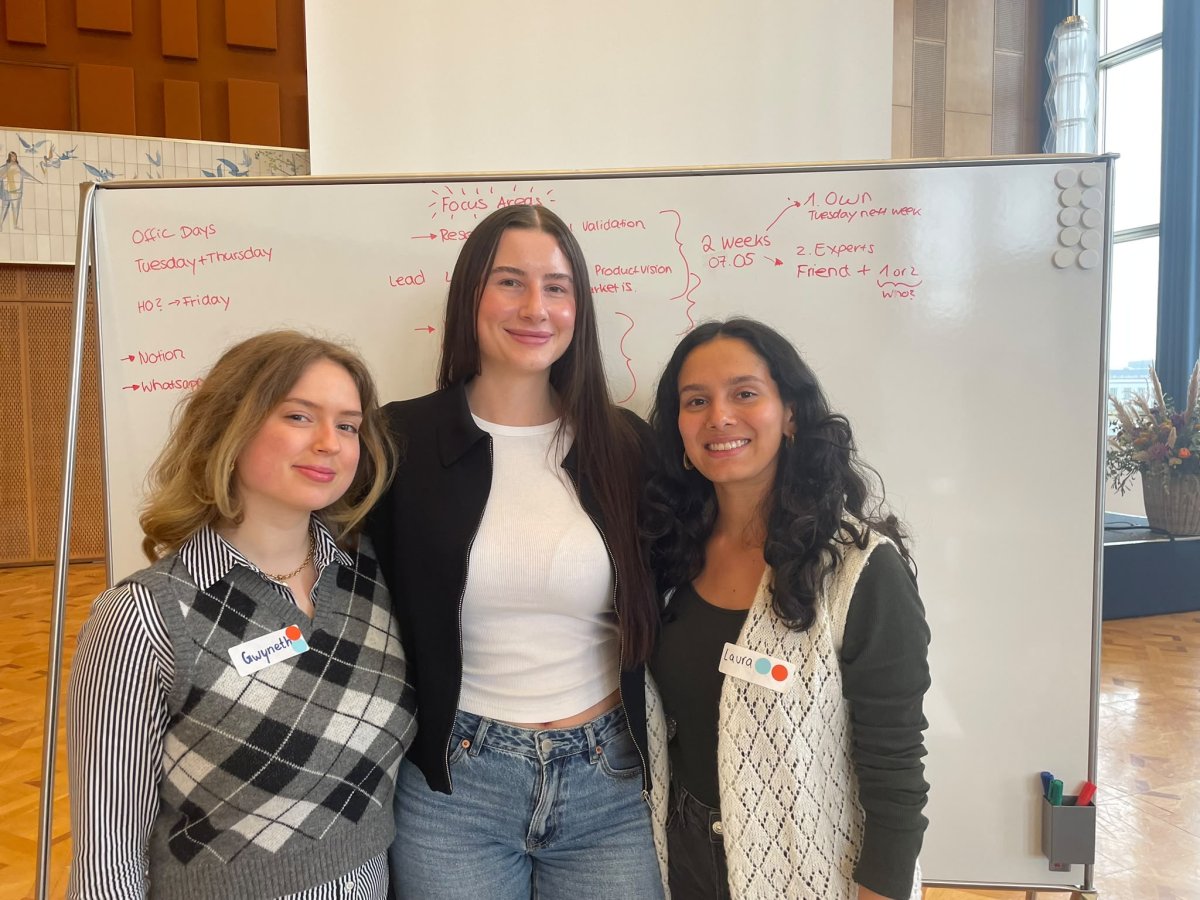
From idea to innovation: Jasmin, Laura, and Gwyneth-Tyger's story
To treat adult acne properly, we need to destigmatize it. That’s the thoughtful position of Lunara, a new venture that is aiming to build an app to help women treat hormonal acne through a combination of information, expert help, and understanding.
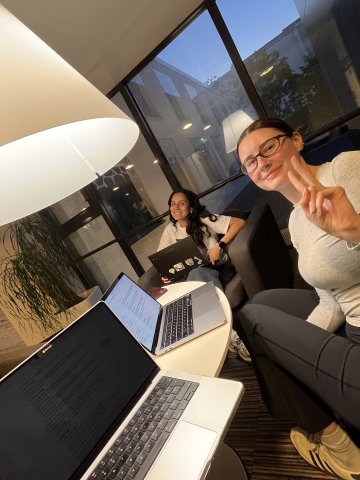
Lunara is the brainchild of three ESMT Berlin Master in Innovation and Entrepreneurship (MIE) students: Jasmin Mantwill, Laura Ruiz, and Gwyneth-Tyger Carys Neumann. The three students, all from the Class of 2027, met at ESMT, and have developed the app through the various bootcamps and initiatives that form a core part of the MIE program.
In this blog, Jasmin, Laura, and Gwyneth-Tyger outline their founder journey so far. They explain how they came up with the idea, what has gone into validating and testing their hypothesis, and how ESMT has supported them along the way. They also give us a look at what’s next for Lunara, and how the MIE has helped them grow as a team.
Hi Jasmin, Laura, and Gwyneth-Tyger. Could you please introduce yourselves?
JM: I'm Jasmin, I'm 26 years old and a master's student in the MIE program at ESMT. In my free time I love to bake and do sports like going to the gym and running, and I also love to read thrillers.
LR: I’m Laura, registered nutritionist and now a master's student in the MIE program, alongside working in product management in digital health. I care about solving big problems in the healthcare system in a way that actually puts patients first.
GTN: My name is Gwyneth-Tyger but as Jasmin and Laura do, you can call me Gwyneth or Gwyn. Not only do I study in the MIE program at ESMT but I am also part of the Connected Choir here since I am passionate about singing. I have been doing karate for years, but I also like to do other sports every now and then. Recently I have started working as a Creative Assistant for a biotech company focusing on female health.
What drew you all to the Master of Innovation and Entrepreneurship (MIE) at ESMT?
“I had ideas I wanted to validate and potentially turn into a venture. MIE stood out because it was welcoming to people without a business background, which mattered coming from nutrition science”
- Laura Ruiz
JM: I've always been interested in startups – either founding one, or working at one. Working in an environment where not everything is predefined, where you can actually shape the business, is exciting. Of coursethe Summer Entrepreneurship Program, (now called Incubation I) stood out to me in the application, but I honestly didn't know if I was going to be part of it.
LR: The Summer Entrepreneurship Program (Incubation I) drew me to the program. I had ideas I wanted to validate and potentially turn into a venture. MIE stood out because it was welcoming to people without a business background, which mattered coming from nutrition science. It gave me the chance to build an academic foundation in finance, economics, marketing, and organizational design. I'd already joined startups as one of the first employees and loved the dynamic environment, but I wanted to understand how to contribute even better.
GTN: Having been an intern at a startup during my bachelor’s confirmed my wish to become a founder myself. Although you do not necessarily need to study Entrepreneurship to become a founder, the MIE seemed like the perfect compromise of continuing my studies in business while already getting hands-on experience within a support system during the Summer Entrepreneurship Program (Incubation I).
Were you all based in Berlin already, or did you move here for the program? Have you been able to become part of the ESMT community?
JM: I'm new to Berlin, I've lived here for two years now, but I didn't move because of ESMT. It was my wish to stay in Berlin and go to ESMT. I think from day one I could already feel a sense of community. Especially in our MIE cohort, we get along very well, and I'd say we have a great cohort. In general, I felt ESMT's community strongly while we were working on our project Lunara, so many people all over ESMT were there to support us and always willing to help us wherever we needed it.
LR: I was already based in Berlin. I've been living and working here for four years. I had a good personal foundation in Berlin already, but ESMT has helped me broaden that community further.
GTN: I am the “Berliner” of Lunara having spent most of my life here except for a year in France. Since I love the city, I didn’t mind staying to study at ESMT. I really get the community feeling in our cohort that you can sometimes miss in this anonymous city. I would say especially the MIE cohort is a quite tight-knit group and, as Jasmin mentioned, we can really feel that our classmates have our backs since we have been working on Lunara.
Did you all meet for the first time in the MIE? What is it like being part of such a close-knit, global cohort?
“We like to share our traditions and festivities with each other, e.g. we celebrated Diwali together, or our Polish classmates brought doughnuts on Fat Thursday.”
- Gwyneth-Tyger Carys Neumann
JM: Yes, we all met for the first time in the MIE, but we became close when we did the Sustainability Bootcamp (now called The Ideation Bootcamp) together, completely by chance. Our cohort is amazing; it's hard to describe, but there are so many kind and smart people from different backgrounds. It's amazing sitting in class with these people and hearing their ideas and perspectives. I also think people in our cohort are supportive of each other and genuinely interested in being friends, not just classmates.
LR: We met for the first time in the MIE program, meeting Jasmin and Gwyneth, but also the rest of the cohort, has been an enriching experience. Everyone is so international, kind, and smart and it's great being surrounded by people with similar ambitions.
GTN: I truly enjoy being part of such a global cohort, I was happy to learn in the orientation week that we are only five Germans in our program. We like to share our traditions and festivities with each other, e.g. we celebrated Diwali together, or our Polish classmates brought doughnuts on Fat Thursday. Being part of this cohort has been really enriching so far.
You are working together on an innovation called Lunara. Can you tell us about this venture?
JM: Lunara is an app for women with hormonal acne that helps them understand and view acne holistically to understand what can trigger their breakouts, and helps them find the right products and get more personalized treatment.
LR: Many women in Germany struggle with acne, but finding a doctor is hard, and even when they do, they only get 6 minutes to talk. Lunara helps women understand the multiple factors that influence their skin, from nutrition, to products, to lifestyle, and connects them to experts who already have that full picture before the consultation even starts.
GTN: And beyond the app itself, we want it to help destigmatize adult acne. It is incredibly common, but women often feel isolated dealing with it, so part of our mission is making that conversation more open.
How did Lunara begin? Was it a co-founder story, or did some of you come on board later?
“Lunara began during the Bootcamp at ESMT... Ever since that day, we've been working and iterating."
- Jasmin Mantwill
JM: Lunara began during the Sustainability Bootcamp (now the Ideation Bootcamp) at ESMT. Gwyn and I are both former acne patients and we were both very unhappy with how we were treated for our skin and breakouts caused by hormones; we felt misinformed and frustrated and thought there should be something better for women.
Laura, too, was frustrated by the lack of medical expertise across fields and the missing holistic view; as a registered nutritionist who studied nutritional sciences, she understood our perspective and could see the pieces we were missing, especially around how important nutrition is for acne as well. Ever since that day, we've been working and iterating. For the longest time it was the three of us, but recently a technical co-founder, Fabiana, joined our team to fully own the technical side.
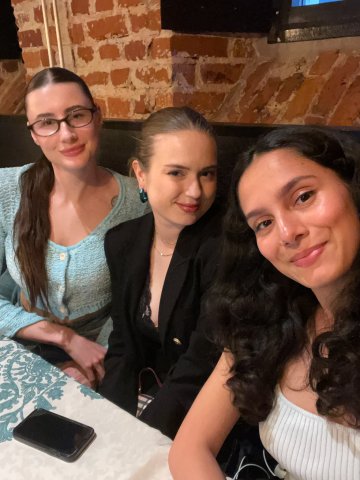

How well did you know each other before you started working together on Lunara? Has it brought you closer together?
JM: We didn't know each other well at all. I'd worked with Laura in a study group before, but with Gwyn I had no touchpoints whatsoever. Funny enough, Gwyn and I actually live pretty close to each other. Before working with her, I used to see her randomly in the mornings on my commute (though, honestly, I was trying to avoid her), and I once told her how scared I was about the Summer Entrepreneurship Program (SEP; now called Incubation I) because I didn't have an idea. Never would I have thought that, about two months later, I'd be working with her during the SEP.
LR: I met Jasmin on the very first day of the master's, when we were placed in the same study group, meaning we worked together on every group assignment that first term. It turned out to be the best group work I've ever been part of, because we shared the same work ethic and values, and I knew right then that if I ever built a venture, it would be with someone like Jasmin. Gwyn and I hadn't worked together before, and I didn't know her well, but building Lunara together has genuinely brought us closer.
GTN: I believe it was an advantage that we did not know each other well before the Sustainability Bootcamp (Ideation Bootcamp). When you are too close, it can be difficult to work together, so especially during the Bootcamp and the time leading up to Innova where we had to act extremely fast, it was helpful that we could speak our mind without worrying too much.
Of course, spending so much time together made us a close group by now, and I am grateful that we were brought together, more or less, by chance. It is funny thinking back to my conversation with Jasmin about us being scared about the SEP, sharing similar fields of interest (me telling my mom later that day that Jasmin could be a potential co-founder), and then actually ending up together. Jasmin was lucky with trying to avoid me in the mornings, since I usually have a tunnel vision when moving around in the city, but this also means I am ignoring her unintentionally sometimes now.
You won the Bootcamp with Lunara. What did the Bootcamp involve, what did it feel like to win, and how did it help you develop Lunara?
“I think it was the first door that opened many other doors for us to further develop Lunara.”
- Gwyneth-Tyger Carys Neumann
JM: The Bootcamp was only two days, plus a presentation on the Monday after the weekend. It involved an idea-finding stage and a product-building stage, where we vibe-coded our product prototype, and on Monday we had to pitch our ideas. I remember we worked a lot that weekend to get the pitch ready. I'm really proud of us, and I think we did well. I believed in us, but honestly, I didn't think we'd win – not because we weren't good, but because, like I said, we have an amazing cohort full of smart people alongside us. That day was truly amazing and unbelievable – I was on top of the world. But even better was the support from our cohort, who were genuinely so happy for us too.
LR: The Bootcamp involved forming a team, identifying a problem space, vibe-coding a prototype, and pitching the solution to a jury. Winning felt great – we put in a lot of hard work, even working through the full weekend to prepare the pitch deck. It gave us some validation that we were on the right path.
GTN: Mostly a lot of work. To be honest, at the start of the bootcamp I was mainly focused on getting an idea and potentially a team for the SEP (Incubation I). We turned out to be a great match and the more work we put into it, the more I thought “Hey, we can actually win this.” So, on pitch day when the jury finally came back and they actually said that team Lunara had won, I was over the moon. I remember the rest of the day felt like walking on clouds. I think it really gave us a motivational boost and even though consistency is what wins the race in the end, a little motivation does not hurt. I think it was the first door that opened many other doors for us to further develop Lunara.
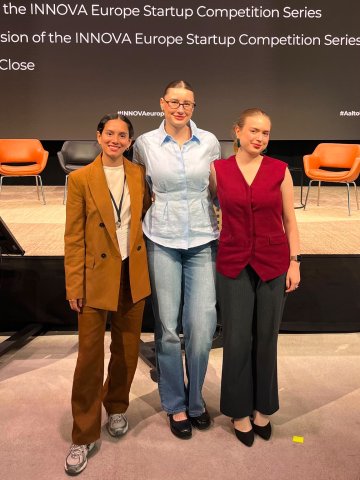
You took Lunara to INNOVA Europe 2026 at Aalto University in Espoo. What is INNOVA Europe and what was this experience like?
JM: INNOVA (an academic competition for student startups) brought us even closer together – three girls sharing one tiny hotel room for two nights will do that. The university was amazing, but the day and a half leading up to INNOVA was truly stressful, since we had to prepare our pitch and everything else. We stayed up practicing in the hotel hallway until someone literally came out of their room to tell us to stop – that's when we realized it was already the middle of the night.
Pitching at INNOVA in front of such a big audience, knowing our fellow students were watching, made me nervous but also felt amazing. It was a great experience, and there were so many impressive ideas. We were disappointed to walk out empty-handed, but we got a lot of good feedback and knew our competition had won fair and square.
LR: INNOVA is an academic startup competition dedicated to responsible, impact-driven entrepreneurship aligned with the UN Sustainable Development Goals. Pitching on a professional stage in front of such a strong jury was a great experience; it pushed my public speaking skills and confidence further than I expected. It also challenged us as a team to sharpen our storytelling skills, build a more impactful pitch deck, size the market properly, and practice pitching to investors and mentors.
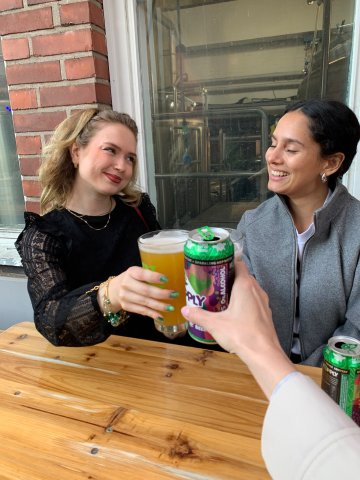
GTN: Although we did not take home the win, I would not want to change the rest of the experience for something else. We put our all into this competition and I think that is reflected in our pitch. It was a strange but exciting feeling pitching in front of so many people, and I hope this was only the beginning. We had the chance to explore the truly amazing Aalto University campus and connect with bright people. Our personal win was the positive feedback we received afterwards from some audience members. That was thoroughly celebrated by spending some more time together in Helsinki after INNOVA.


You were able to develop Lunara further during the Summer Entrepreneurship Program (SEP; now called Incubation I). What did this involve?
“It's also meant building the team further, bringing on a technical co-founder, and preparing for the next step, which is testing an actual MVP with real users.”
- Laura Ruiz
JM: It involved rethinking everything from scratch – coming up with new ideas, abandoning others, and generally a huge time commitment. We talked to experts from different fields and to potential users and got a lot of help along the way from people in our cohort's network and contacts.
LR: We did deep customer research to understand what women were really struggling with, developed a prototype and gathered feedback, refined our business model and market sizing, and connected with health tech experts in Germany. It's also meant building the team further, bringing on a technical co-founder, and preparing for the next step, which is testing an actual MVP with real users.
GTN: This was also where our mentor relationships really took shape. Sitting down regularly with people who had built and scaled companies before pushed us to think more critically about our assumptions, not just about validating them. Also, future participants should be prepared to overthink and change everything repeatedly.
How are you able to leverage your MIE learnings in the development of Lunara? Do any faculty members or seminars particularly stand out?
JM: The person we worked closest with was an alum, Baris Efe – he always believed in us and connected us with a lot of people, while also being honest with us about his opinion on things.
LR: Yes, so many lessons from the first two terms have been carried directly into the program, especially Strategy and Foundations of Entrepreneurship. Those courses taught us how to work systematically when everything is still unclear, using the scientific method to define hypotheses, and then actually validate them, rather than just assuming we know what users need.
GTN: I think for me it is not so much about specific courses translating into the development but more so that the professors in general train your critical thinking further. Although some frameworks from the Foundations of Entrepreneurship class and some skill seminars like Design Thinking popped up in my mind while working on Lunara. I agree with Baris being one of our biggest fans and critics, but I also wanted to mention how willingly other ESMT staff members like Elisabetta Mori and Qiao Zhang wanted to help us out.
What's next for Lunara?
JM: Our next step is to participate in the Incubation II program and launch our MVP web app to test with users.
LR: In the short term, we're focused on testing the MVP, validating our key hypotheses and iterating until we're genuinely solving a real problem for women.
GTN: Since the MVP can only be properly tested with first users, we are working on growing our social media presence to gather them. So, if you would like to support us or even know someone who would love to test Lunara, give us a follow on TikTok and Instagram (both @lunara_community), and LinkedIn.

What is your best piece of advice for any future founders – particularly female founders? Should they join the MIE?
“Don't be afraid to make mistakes; you will make them, and that's okay. Whatever you do, whether you fail or not, you never really lose, you only gain knowledge and experience.”
- Jasmin Mantwill
JM: Definitely join the MIE. Don't limit yourself in any way, and don't be scared, believe me, it will somehow work out in the end. Don't be afraid to make mistakes; you will make them, and that's okay. Whatever you do, whether you fail or not, you never really lose, you only gain knowledge and experience.
LR: You'll be scared to do things, but do them scared. Your confidence grows over time. Don't be afraid to ask for help either: don't underestimate the contacts the people around you already have and how willing everyone is to actually help.
GTN: You will have to force yourself to your own luck sometimes, especially when you are introverted like me. You will have to talk to A LOT of strangers, but the beauty in it is that you are reminded of how many people out there are willing to help you. Of course, you also get some rejection therapy but with the right co-founder(s) by your side you will persevere.
One thing I know is whether Lunara will be a roaring success or not, the time we spent working on it helped me grow as a person and meet great people and that was already worth joining the MIE.
Thank you Jasmin, Laura, and Gwyneth-Tyger!
If you would like to hear more of the Lunara team’s insights into entrepreneurship and master’s life at ESMT, you can follow them on LinkedIn: Jasmin Mantwill, Laura Ruiz, and Gwyneth-Tyger Carys Neumann.


See more from the ESMT Berlin community

Jasmin Mantwill

Laura Ruiz
