Hands-on, international impact during the Master in Global Management
Making things happen: Sophie's story
Master in Global Management (MGM) alum Sophie von Rohr is making things happen, in Berlin – and far beyond.
In this blog, recent graduate Sophie (Class of 2026) reflects on a degree shaped by curiosity and a hands-on drive to turn ideas into action. She also talks about her career path at a Swiss bank in Frankfurt – from an internship to her upcoming Graduate Talent Program – and how she has put MGM learnings directly into practice along the way.
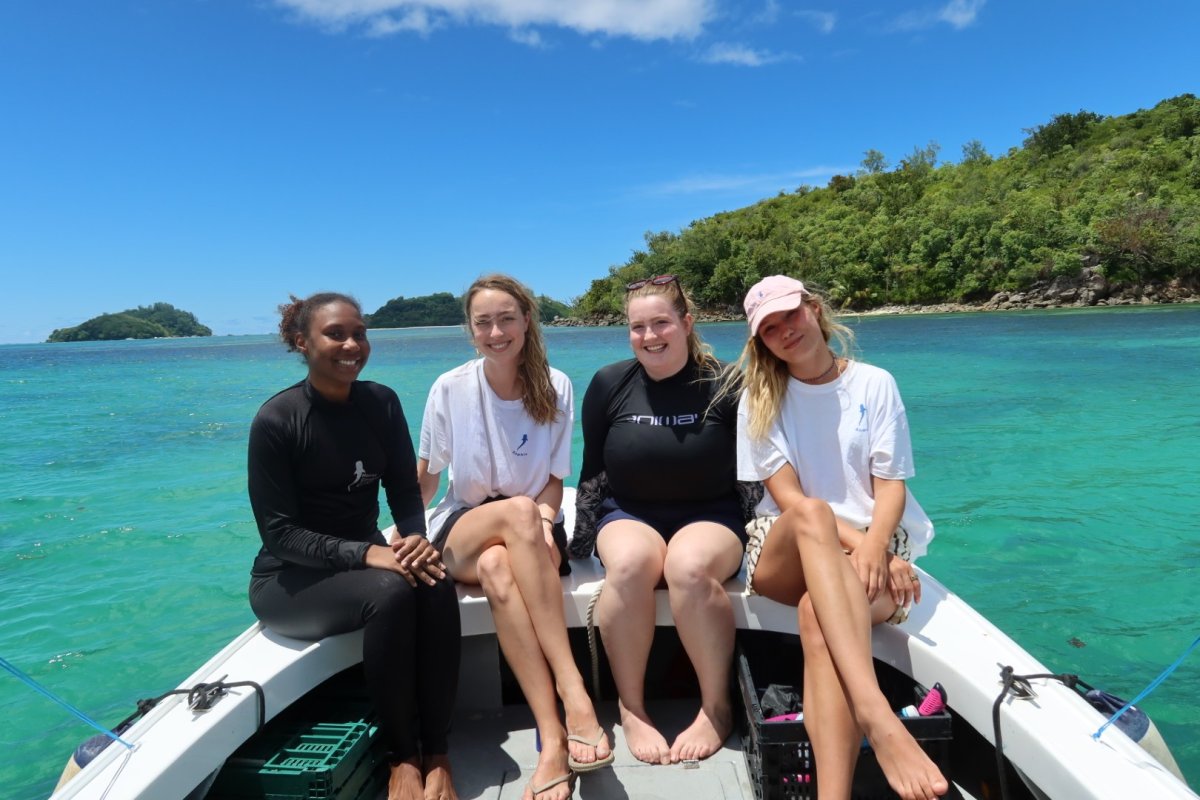
Additionally, Sophie shares what it was like to spend a month in the Seychelles for her Social Impact Project, in a country that established the first marine national park in the Indian Ocean, and has since gone on to protect 30 percent of its national waters (one of the largest marine conservation efforts in the world).
And she explains why bringing people and generations together matters so much to her, from founding ESMT's Generations Talk to representing the school as a Young Voice at Berlin Global Dialogue.
Hi Sophie, can you please introduce yourself?
I'm 26, born in Brussels, though I was only five years old when my family relocated to Frankfurt, which is where I really grew up: European School, three siblings, and me right in the middle of it all, trying to get a word in edgewise.
I think that's where the curiosity comes from too. Growing up in a big, lively family teaches you to spot the gap, the thing nobody's tackled yet. I've always loved a good challenge, and I'm still the person who can't walk past something without wondering how it could work better.
Why did you choose the Master in Global Management (MGM) at ESMT?
"What convinced me most was how closely ESMT works with real business cases, and how direct the exchange with professors is – you're treated as a thinking partner."
My undergrad at LMU Munich gave me a strong theoretical grounding, but I always had a job alongside my studies and knew I wanted a master's program that pushed further into practice.
The MGM felt like exactly the right balance: building on that academic foundation with a program that is hands-on, international, and genuinely opens doors. What convinced me most was how closely ESMT works with real business cases, and how direct the exchange with professors is – you're treated as a thinking partner.
As someone from Frankfurt, what drew you to an English-language master's program in Germany?
Germany is home to academically excellent universities, and LMU gave me a strong foundation to build on. But English is essential in a business context, and what really drew me in was being part of a business school built with the backing of major German companies and the people who shaped the German economy – figures like Gerhard Cromme. That network, and the chance to actually make things happen yourself alongside your studies, made the decision an easy one.
What has it been like to study with a highly global cohort where women are a majority? Do diverse classrooms enhance the business school experience?
It's been a great experience – I won't pretend constant group work was always my favorite, but it taught me a lot. There were very few Germans in my cohort, so studying alongside so many cultures was a real learning curve: understanding how people think differently, handle deadlines, and resolve conflict. My teams included classmates from China, Korea, the US, India, and across Europe.
As a woman, I felt genuinely well supported, and it was inspiring to meet women with drive who understood that collaboration is the best way forward and that you can shine without dimming anyone else's light.

You did your internship at UBS in Frankfurt and have continued working there while you study. What was the application process like, and are you able to apply what you're learning in the MGM to the role?
"A lot of what I'm learning in the MGM feeds directly back into my role, especially since, in the Chief of Staff team of UBS Europe, I work across so many functions and nationalities."
The internship process included assessments and interview rounds – one being a culture-fit assessment built around realistic on-the-job situations, which I think captures UBS's culture accurately. Honestly, I was nervous going in: I had never worked in finance, and my image of banks had always been one of rather strict and conservative organizations – almost "dusty." It turned out to be the complete opposite.
Especially in a time with so much geopolitical and economic uncertainty, I got to see up close just how much weight banks carry in keeping things stable and helping clients to risk manage their financial situation, and the role gave me insight into many different areas of the business. What stood out most was the culture: you are challenged, but just as much supported and developed, and given real responsibility early on – a big part of why I'm happy to be staying on.
A lot of what I'm learning in the MGM feeds directly back into my role, especially since, in the Chief of Staff team of UBS Europe, I work across so many functions and nationalities, and ESMT's emphasis on understanding other cultures and prioritizing pragmatically has proven invaluable there.
Agile leadership and our final project on failure culture really stayed with me, since at UBS I've seen first-hand how differently leadership can be practiced, not only from senior leaders but from young colleagues too.
Negotiation was another highlight: growing up in a big family, I learned early to assert myself, but the seminar taught me to state my position clearly, to never undersell myself as a woman, and to still approach negotiations in a cooperative way.
You completed a Social Impact Project (SIP) with the Marine Conservation Society Seychelles. What was it about and who was on your team?
As a team, we split the work by what each of us cared about most. I was drawn to communities and schools, so I dedicated myself to those areas: the community engagement, the funding work, and the school visits and beach cleanups, together with Ann-Sophie Seeburger, while Kevin Godratschke, Melina Lange, and Georg Schmitz-Dörner, alongside Lucas Wall, focused more on the website and the climate side. Together, we relaunched the MCSS website with 16 new subpages, mapped 21 funding and award opportunities, and ran our cleanups.
I think social impact is a hugely important part of business: companies have the ability to support society not only financially, but with resources and expertise, and it's so important to understand that everyone has or can have an impact. It's also why I noticed, during the SIP, how often NGOs are missing that business mindset, and that's precisely where students and companies can add real value.
What was it like living in the Seychelles?
"We spent a month living with a local family on Mahé, the main island, and quickly learned that the Seychelles are so much more than the luxury destination most people picture."
We spent a month living with a local family on Mahé, the main island, and quickly learned that the Seychelles are so much more than the luxury destination most people picture. St. Anne Marine National Park, right off Mahé, was the first marine national park established in the Indian Ocean, and today the country protects more than 400,000 square kilometers of its waters – about 30 percent of its entire territory – one of the largest marine conservation efforts anywhere in the world.
The community welcomed us from day one: a wonderful, young population with diverse backgrounds, many holding two or three nationalities, a reflection of the islands' colonial history. They took us on hikes, into their homes, into their everyday lives, and I completely fell in love with the country and especially its people.


You were one of the Berlin Global Dialogue (BGD) Young Voices in 2025. What are the Young Voices, and what was it like to take part?
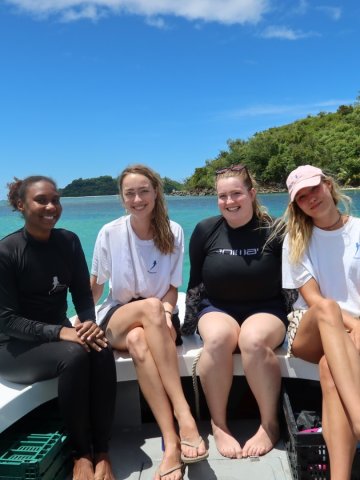
Attending Berlin Global Dialogue was one of the greatest opportunities I've had. I had always wanted to sit at the table, share opinions, and engage with the big questions of our time: where we stand, and how we can do better.
As a Young Voice representing ESMT, I joined around 30 participants from 20 countries, all from schools within the Global Network for Advanced Management. We were able to join as full participants, in talks with world leaders. Being able to engage in discussions at the table with such influential figures, on topics ranging from European security to the importance of middle powers and the trade agreements shaping Europe's relationship with them, to the digital euro, was an experience I'm genuinely grateful for.
It reminded me how much progress depends on real dialogue and international partnership. That's exactly why I'm returning again this year.


You were also the founding advisor for the Generations Talk event on campus. What is it, and what was it like to bring it to life?
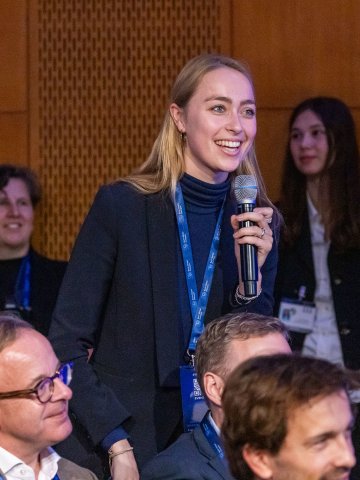
"For our first edition, I hosted a fireside chat with Alexander Mayer, Head of Germany & Austria at J.P. Morgan. I was nervous beforehand, but it was so much fun, and the conversation itself was genuinely exciting."
I have always liked engaging with every generation. I believe the future is shaped by everyone who wants to take part, not just one generation. That's why building bridges felt so important to me, and why I wanted to create Generations Talk: a space where people from different generations come to the table instead of pointing fingers at each other.
Turning that idea into something real with Generations Talk took a driving team of different students who believed in it, something I'm very grateful I got the chance to develop. Lucas Wall and Daniele Dell'Acqua, together with their team, were the ones who then made it happen.
For our first edition, I hosted a fireside chat with Alexander Mayer, Head of Germany & Austria at J.P. Morgan. I was nervous beforehand, but it was so much fun, and the conversation itself was genuinely exciting. Thanks to ESMT Chief of Staff Judith Kühn-Gerres and ESMT President Jörg Rocholl, I had the opportunity and the support from the ESMT side to develop this idea in the first place. My hope is that the students who come next keep growing it, and that ESMT stays a place where different generations can genuinely exchange ideas.

Do you have a favorite place on the ESMT campus? How about in Berlin?
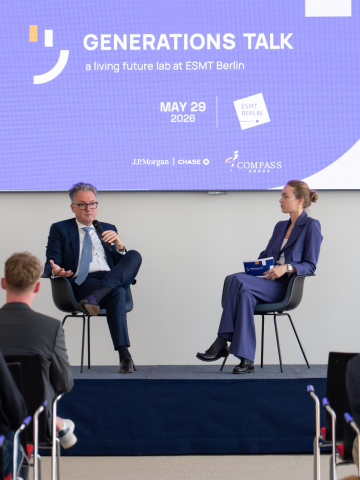
ESMT's campus carries so much history, and I love history, so honestly the whole building feels special to me – but if I have to pick one spot, it's the Palace View auditorium, with its view over the Humboldt Forum.
In Berlin, I love Kollwitzmarkt and Bar Tabac in Prenzlauer Berg, and if you're into art, Sammlung Hoffmann is a must.
What is your best advice for any potential students thinking about the MGM at ESMT?
"You get such good learning on both sides: the theory gives you the foundation, and the practical experience is where it really clicks."
You will learn how to work in real life, and internationally. It really is a hands-on program. Combined with an internship alongside it, you get such good learning on both sides: the theory gives you the foundation, and the practical experience is where it really clicks.
You are nearly at graduation - if you could sum up your whole ESMT experience in three words, what would you say?
Inspiring, transformative, connecting.
Thank you, Sophie
If you would like to hear more of Sophie's insights on leadership, teamwork, and intergenerational collaboration, you can follow her on LinkedIn.


What is it like to study at ESMT?
