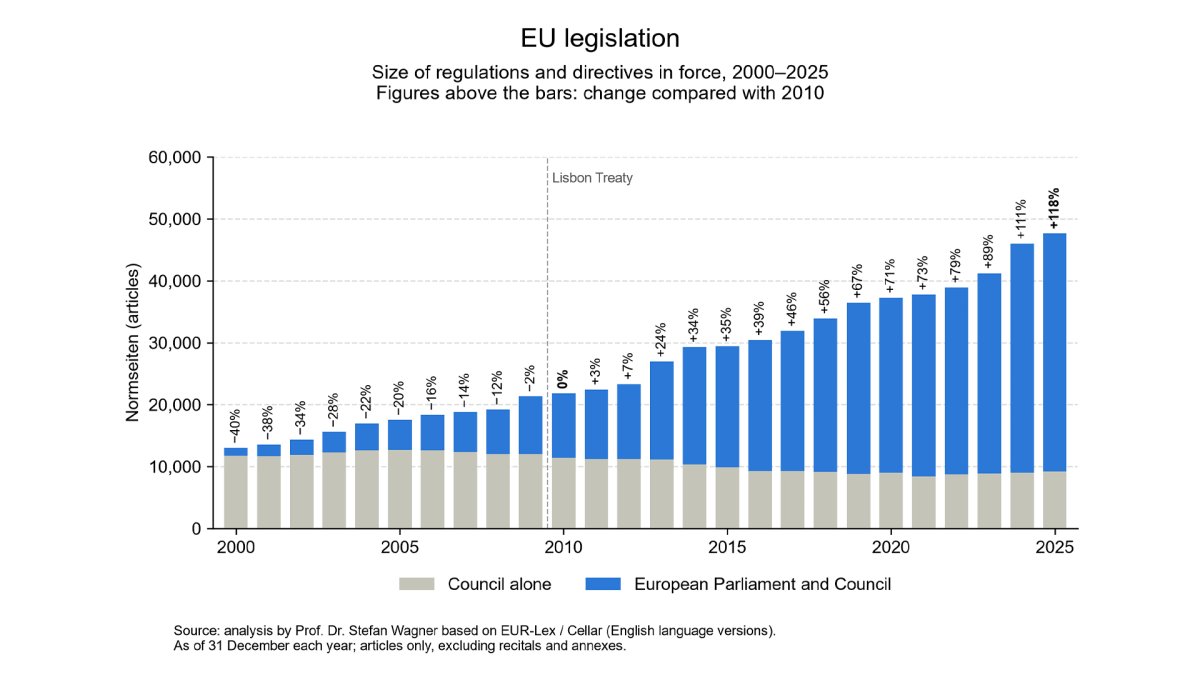
New EU Bureaucracy Index: EU law has more than doubled since 2010

The EU Bureaucracy Index is compiled by Professor Stefan Wagner, University of Vienna, in collaboration with ESMT Berlin. It adds the European level to the Bureaucracy Index for German federal law, which ESMT published in March 2026. The index covers all regulations and directives in force on December 31 of a given year that were adopted jointly by the European Parliament and the Council or by the Council alone, each in its consolidated version. Legal acts of the European Commission are not included. As with the German index, volume is measured in standard pages of 1,500 characters each. The data comes from Cellar, the database of the Publications Office of the European Union that underlies EUR-Lex.
The principle: The index does not count the number of legal acts. It measures their actual volume, that is, how much regulatory text applies at EU level and ultimately affects companies, public administrations, and citizens. Because EU law and federal law are measured in the same unit, developments at both levels can be compared.
If annexes such as lists, limit values, and technical specifications are added to the articles, EU law in force even comprises around 90,800 standard pages (+85 percent since 2010). At the same time, there has been a shift in who makes the law: in 2000, 10 percent of the articles came from legal acts adopted jointly by Parliament and the Council; in 2025, the figure was 81 percent.
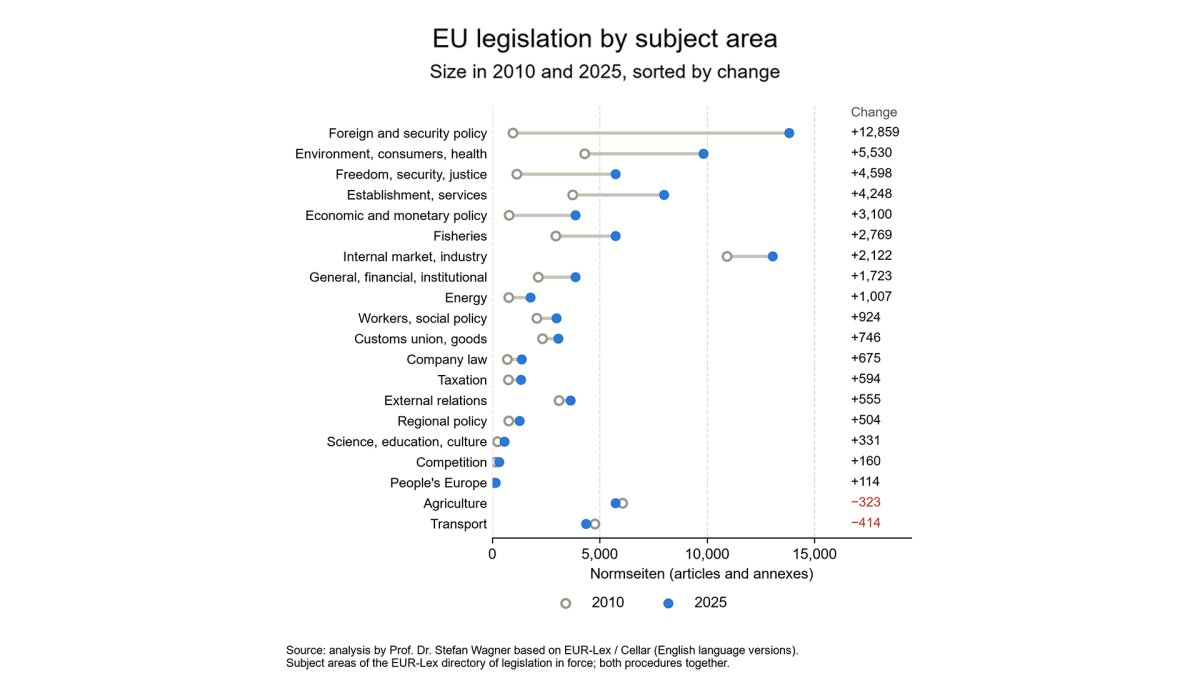
Eighteen of 20 policy areas have grown since 2010. Foreign and security policy saw the largest increase, with almost 12,900 additional standard pages. These are almost exclusively Council sanctions regulations with their lists of persons, companies, and goods. In second place is law on the environment, consumer protection, and health: it has more than doubled, from around 4,300 to 9,800 standard pages. Outside of sanctions law, no other area has added as many standard pages. This is driven above all by new sets of rules, for example on medical devices, renewable energy, and industrial emissions. The Environmental Noise Directive alone grew by around 700 standard pages due to new calculation methods. Even sanctions law is excluded, EU law has grown by 60 percent since 2010.
“EU law is growing almost twice as fast as German federal law,” says Stefan Wagner. “Anyone who wants to reduce bureaucracy must also take the European level into account. Many of the obligations that companies in Germany complain about originate in Brussels. A national relief program alone will not solve the problem.”
For companies in Germany, EU law and federal law add up. The Bureaucracy Index for federal law, which ESMT published this year, had already reached a new record high. The volume of federal statutes in force rose from 24,765 standard pages in 2010 to 40,270 in 2025. Commercial law grew the most: 1,542 standard pages were added between 2022 and 2026 (+16.5 percent), more than ever before since the analysis began. The articles of the EU regulations and directives in force alone now comprise roughly as many standard pages as all federal statutes combined. Including annexes, EU law is more than twice as extensive, and it is growing significantly faster.
The index does not assess whether individual regulations make sense. It measures the volume of the law in force. Sanctions law in particular is politically intended, and its extensive lists drive the figures up. However, the index shows where regulation has increased particularly sharply over the past 15 years, providing a basis for a targeted debate on reducing the bureaucracy burden at the European level.
About ESMT Berlin
