The male blueprint: Why women leave the top of German companies
In 2005, as Angela Merkel first ran for chancellor, a respected journalist asked Eva Christiansen, then a spokesperson for the CDU and later media advisor for the chancellor, how a woman would walk the red carpet past a Bundeswehr honor guard.
“I didn’t understand this question, but it was a real question,” Christiansen recalled at a recent ESMT Insight Hour. Her answer was simple: “I said she will walk, right? It’s not a problem.” The question showed her how far there was to go.
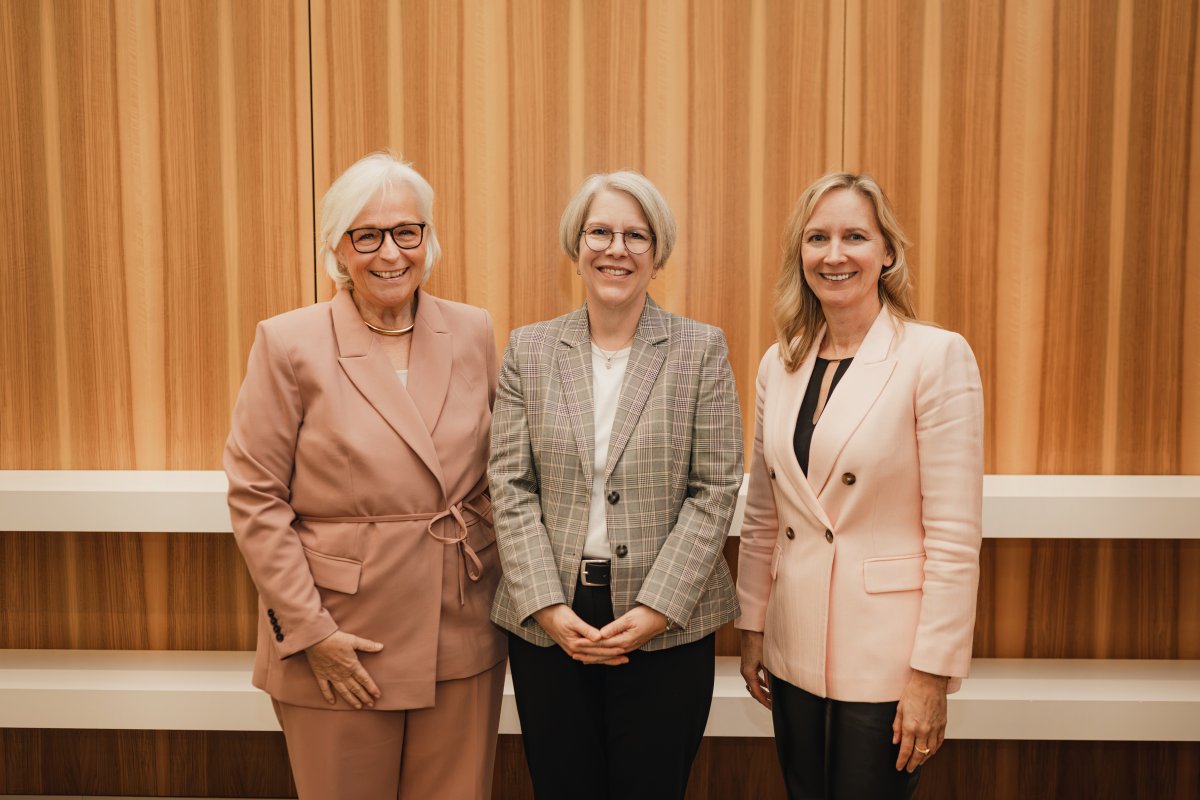
More than two decades later, Christiansen doubts anyone would ask this question. But executive suites have proved harder to change. That was the subject of the October 5 Insight Hour, “Who gets to lead? Rethinking women, men, and power,” moderated by Molly Ihlbrock, ESMT’s director of corporate communications. Christiansen, now a partner at FGS Global, and Brigitte Lammers, a partner at Egon Zehnder, discussed their joint study, “A question of culture: More women in leadership – a change in perspective.” The study draws on interviews with CEOs, board members, and senior executives from Germany’s largest companies. They locate the barrier to more women at the top in leadership culture: the governance and organizational norms that decide who succeeds and who stays.
What a study of women in German leadership found
Both authors set out hopeful. Lammers, who has spent nearly 30 years in executive search and co-founded FidAR, an initiative for more women on German supervisory boards, expected their 2024 interviews to show real progress. “I actually got out of this exercise super frustrated,” she said. What the women described was not “a fundamental kind of movement that stands on its own.”
The authors also wanted to hear from men, especially the supervisory board chairs who choose CEOs. Despite a promise of anonymity, only one agreed. “It’s not a debate between women,” Christiansen said. “It’s a debate between all of us.”
What is the male blueprint in corporate leadership?
At the center of the study is what the authors call the male blueprint. A woman joins the management board, often from outside, Lammers said, and finds a group of men led by an unquestioned alpha CEO and governed by unwritten rules. The group tends to share the same education, age, and upbringing. According to the study, Christiansen noted, the average German executive board member was born in Germany, raised in West Germany, trained in business administration, and in their fifties.
The newcomer is expected to adapt. “The overall pattern is that you need to get used to what the boys are used to,” Lammers said, whether that means a confrontational style of debate or, in her experience, 15 minutes of soccer talk to open every Monday meeting. “It sounds a bit stupid,” she said, but such patterns decide who is seen as part of the team.
Lammers described a further challenge when companies recruit women externally to meet quotas: Senior managers who spent years preparing for the seat are passed over, and the newcomer meets “silent opposition.” Such women, she said, often try to prove they deserve the role instead of building the internal networks that board members rely on.
Why do women leave executive boards in Germany?
“It is not true that they fail,” Christiansen said of the women in the study. “They decide to go because they say, no, that’s not my kind.” They want to work by their own rules in a culture where they can grow, and successful women now have alternatives, such as supervisory board mandates. Executive boards then lose them, which Christiansen described as a “vicious circle.”
The pipeline, Christiansen said, is “much better than it was a decade or two decades ago.” But culture and the lack of diversity on German executive boards, she said, remain “really a problem.”
Gender quotas and the agents of change
Christiansen opposed quotas early in her career and has since changed her mind, as have many of the women they interviewed. Without some pressure, she said, little will move. Lammers dismissed the idea that quotas lower the bar as “nuts.” Instead, she said, they force companies to search more creatively and read CVs differently.
The real leverage, both argued, lies with CEOs and supervisory board chairs, whom the study calls the “agents of change.” One interviewee proposed pairing a male CEO with a female supervisory board chair, and vice versa, an idea Christiansen called “very progressive.” Women on supervisory boards also have “enormous leverage” to help younger women, Lammers said, but in her experience, they use it “rarely.”
How uncertainty is changing leadership and power
Christiansen warned that progress has stalled and may be sliding back. In times of crisis, she said, diversity starts to look like a “nice to have,” and organizations reach for an old pattern: “the time for a strong man.”
Lammers, answering a later question, saw uncertainty differently. “Times are over where CEOs are standing up and saying that’s the course we are taking,” she said. With artificial intelligence and geopolitical upheaval, there is often no precedent to rely on. “I’m waiting for the first big CEO of a DAX 40 company saying I don’t know the answer.” Power at the top now means being a “superb coordinator, moderator,” someone who can “orchestrate a tribe around a certain topic.” And that, she added, is “fantastic news.”
Christiansen added that such leadership needs values. In the early COVID-19 pandemic, no one had a playbook, she said, but a value-based goal, saving as many human lives as possible, could still guide how power was used.
What real diversity on a board requires
Diversity also has to mean more than counting women. Asked whether gender diversity at the top brings different leadership styles, Lammers described a deeper kind of difference: who on a team is the moderator, who asks the provocative questions, who brings the customer’s view. “That is true diversity, but it requires trust among a team and an open exchange about what makes us different around this table beyond gender.”
That kind of diversity has a price. One woman they interviewed said colleagues always asked her, “Why do you ask those crazy questions?” Christiansen noted that women, like men, tend to promote people like themselves because it is more comfortable. In her view, homogeneous teams decide faster at first, “but this then leads to standstill and a lack of innovation.”
Who is responsible for more women at the top?
The red-carpet question, Christiansen believes, would not be asked today. Inside companies, however, she and Lammers argue that familiar expectations still shape who receives support and whose leadership is accepted. Changing them falls to CEOs and supervisory board chairs. For Lammers, uncertainty makes that more urgent: Leaders who cannot know every answer need colleagues who ask different questions.
Eva Christiansen and Brigitte Lammers spoke on October 5, 2026, as part of the ESMT Insight Hour series. The conversation was moderated by Martha Ihlbrock, director of corporate communications.
Join our mailing list to participate in upcoming events.
Event photos
View event photos from ESMT Insight Hour with Eva Christiansen and Brigitte Lammers on Flickr. Photos by Ana Torres.
