How companies weigh the costs of stakeholder commitments
A fictional brewery had promised investors a 10 percent return. Tariffs and a gas price shock had left it barely meeting that commitment. Now its CEO faced an offer to cut transport emissions by 80 percent. The price was €32 million over two years, reducing its expected return on equity to about 7 percent in 2027.
Every student team chose to invest. When they presented their decision at ESMT Berlin, Stefan Grosch, a member of the board of management at Robert Bosch GmbH, praised their consultation with stakeholders. But he pressed them on competitiveness, which their explanation had not addressed. What if accepting higher costs meant the brewery could no longer sell its products?
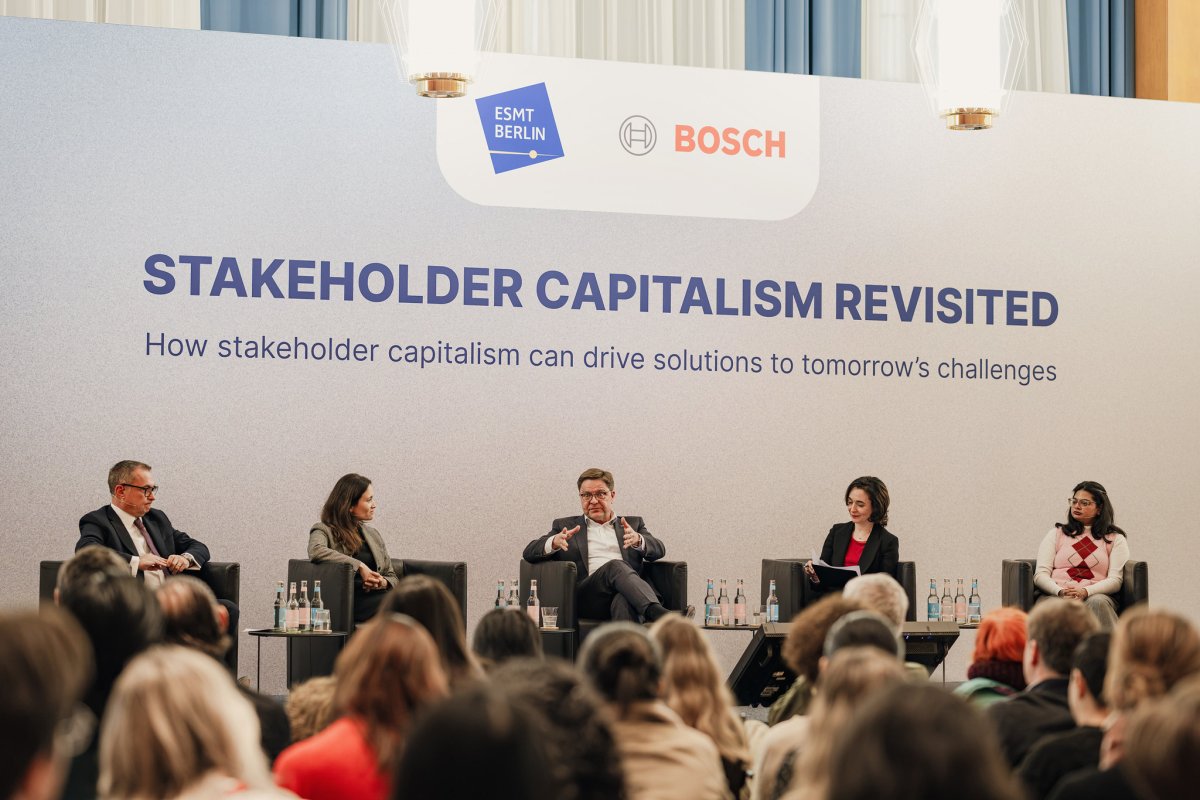
At “Stakeholder capitalism revisited” on November 5, 2026, the panel examined how much financial pressure a company can accept to meet its longer-term responsibilities, and what determines whether that choice is viable.
Catalina Stefanescu-Cuntze, professor of management science at ESMT, moderated the panel with Grosch, Joachim Nagel, president of the Deutsche Bundesbank, Miki Yokoyama, managing director and partner at Aurum Impact Invest GmbH, and Roshni Dutta, a Full-time MBA student and co-president of Net Impact ESMT Berlin.
Nagel described the economic and geopolitical upheaval as lasting: “This is not just a short-term disruption.” In his assessment, structural changes would alter business models and needed to inform management decisions.
Why students chose lower-carbon logistics
The students had worked through the brewery case in a workshop led by Hanna Setterberg, affiliated researcher at the ESMT Institute for Sustainable Transformation. Each team assigned a CEO and stakeholder roles. The company’s immediate financial pressures competed with its commitment to net zero by 2040.
The exercise also varied how heavily CEOs’ bonuses depended on short-term returns or emissions reductions. All teams accepted the offer, including those whose pay formula favored declining it. One student CEO explained that the investors in the role play had agreed to lower initial returns. The student said that listening to stakeholders and protecting the company’s reputation had led them to invest despite receiving a lower bonus.
Dutta said the students had entered the exercise wanting lower emissions. Responding to Grosch, she said the brewery’s competitors faced similar geopolitical pressures. Most also operated in the EU and faced comparable environmental targets. She added that further costs could have made her reconsider.
Stefanescu-Cuntze noted that the expected average return on equity over five years was the same under either choice. She described the investment as accepting lower short-term returns to build resilience and reduce the risk of a painful transition.
Why Bosch moved toward local-for-local production
Grosch offered Bosch’s manufacturing strategy as an example of how the value of an investment could change over time. Producing in a few locations for global markets had offered economies of scale. Increasing logistics costs and local content requirements, together with different customer needs across markets, had encouraged Bosch to move partly toward a “local for local” approach.
That meant maintaining capabilities within the regions the company served, including manufacturing and development. Grosch acknowledged that the approach could initially cost more. He considered it a successful strategy in the changed environment because Bosch could supply customers region by region. “We are extremely resilient,” he said.
Financing sustainable technologies through commercialization
For Yokoyama, the difficulty was often sustaining investment long enough for a technology to reach the market. Europe had strong research and promising early-stage innovations, she said, but investors were harder to find when businesses needed capital to commercialize and scale.
She called for more European investors to support that stage of development. Her assessment of a company began with its founders’ expertise and capacity to adapt. She also examined how the proposed solution addressed a sector’s problems and whether it could succeed against competing technologies. Regulation and market conditions formed part of that judgment.
Who should bear the cost of sustainable transformation?
The panelists differed over how broadly the costs should be shared. “The company owns the business risk,” Nagel said. Public institutions, he argued, should provide the rules and a reliable framework; companies should bear the risk and costs of their decisions.
Grosch partly agreed, while emphasizing the conditions businesses needed to compete. Competitiveness could come from innovation or flexibility, rather than the lowest costs. Nevertheless, he wanted policy certainty and financing directed toward future technologies. Companies had to take risks, he said, without waiting for a fully secure environment.
Yokoyama argued for distributing costs along the value chain. She described an investment in a lower-emission cement technology whose early projects required customers and construction partners to accept additional costs and risk. Some technologies also needed subsidies to reach scale, she argued. “All of us have to bear some part of the cost.”
In the brewery exercise, one team’s investors accepted lower initial returns. Dutta also described competitors facing comparable pressures. A company without that support, or facing competitors with lower costs, would have to weigh a different decision. It would still have to establish whether it could afford the investment and remain competitive.
Stefan Grosch, Joachim Nagel, Miki Yokoyama, and Roshni Dutta spoke at ESMT Berlin on November 5, 2026, as part of the joint stakeholder capitalism series organized with Robert Bosch GmbH. The conversation was moderated by Catalina Stefanescu-Cuntze, professor of management science at ESMT Berlin.
Join our events mailing list to hear about upcoming events.
Event photos Stakeholder capitalism revisited | Flickr. Photos: Ana Torres.
