Built to outlast any one person
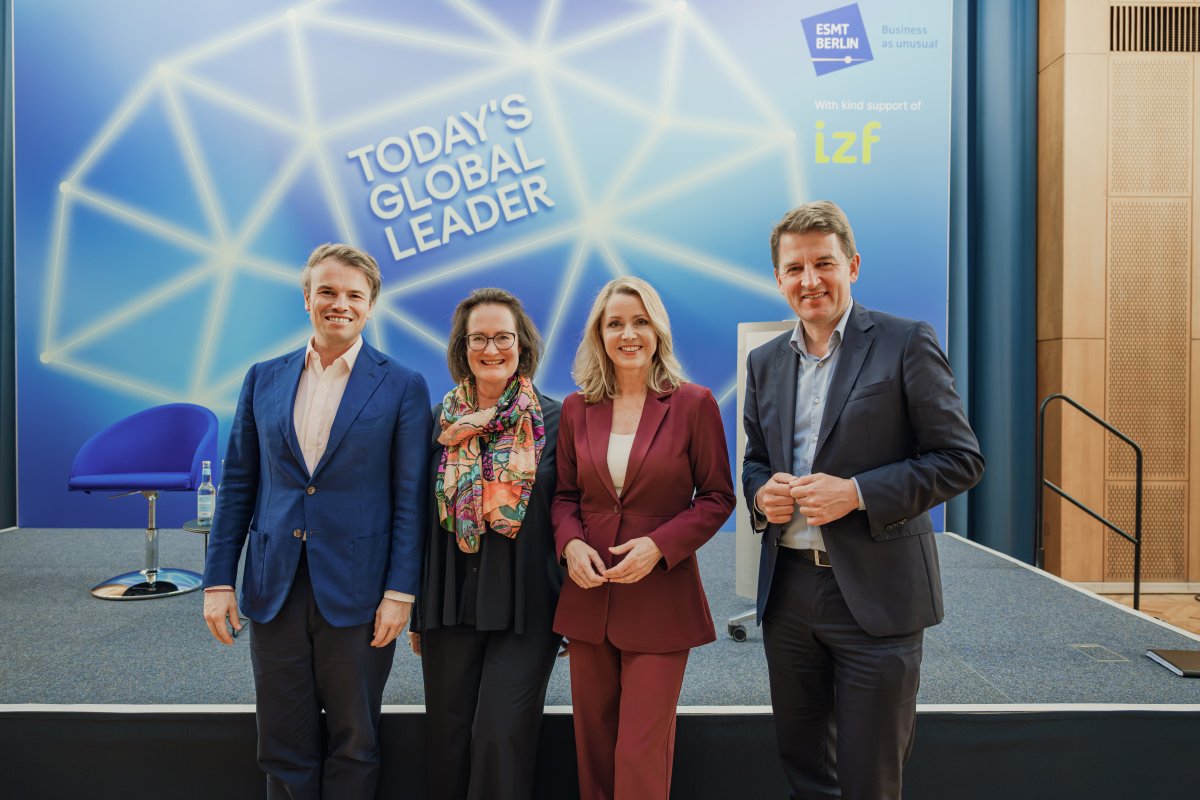
Some supervisory board meetings at Bankhaus Metzler are hard on Franz von Metzler. Sometimes as a member of the executive board he has to take the criticism. “Deep inside me I’m happy about this,” he said, “because I know that as a shareholder this bank is organized in a good way.”
The board that holds him to account includes his younger sister, Elena von Metzler, and is chaired by an outsider, Wolfgang Kirsch, who in von Metzler’s words “speaks the language of the family” but is “quite tough when it comes to strategic decisions.”
Von Metzler, member of the executive board of B. Metzler seel. Sohn & Co. AG with responsibility for asset management, spoke with journalist Astrid Frohloff at ESMT Berlin’s Today’s Global Leader series on October 13, 2026. The bank has been owned by the same family since 1674, and he is part of its twelfth generation.
Joining the family bank by choice
Von Metzler did not set out to join the family bank. He first spent nearly three years in mergers and acquisitions at HSBC in London, where he learned to take responsibility early. Working late, he recalled having to resolve questions himself rather than call his supervisor at midnight.
He joined Metzler in 2014, at almost 30, planning to get to know the bank and its people and then leave again. A year later, he had grown so attached to the company that he spent a summer wrestling with the decision. After talks with his family and the management board, he stayed. His parents never put any obligation on him or his sister to join.
The bank has also always had management board members from outside the family, and he wants a structure that could run without any family member in management. “We always make sure that the leadership of the company is not dependent on the fate of the family,” he said.
A family charter and an independent board
Family ownership, in his view, “can be a huge asset, but it also can be a huge liability if you don’t handle things right.” The Metzlers have always paid out relatives with no interest in the business, which is why the twelfth generation has only three shareholders. When a conflict arises, he said, the three shareholders message each other on WhatsApp or meet at short notice.
Five or six years ago, the three shareholders spent around six months with a mediator writing a family charter that formalized rules followed informally for centuries. In 2021, the bank also changed its legal form from a partnership limited by shares (KGaA) to a stock corporation (AG). The family still owns the bank outright. Von Metzler described these arrangements as a way to strengthen professional oversight.
Early responsibility and room for mistakes
He joined the executive board in 2023 thinking he was well prepared. In hindsight, he said, he could have prepared much better. Suddenly there was no one to his right or left to ask for advice: “All of a sudden I had to give the advice.” His conclusion: “You can only learn this by doing.”
Younger employees at Metzler also get responsibility early. In a bank of 800 people, he argued, talented people can develop much faster than in a large organization, and he looks above all for people who think independently and want that responsibility. His approach is “setting a goal but leaving the path open,” which includes room for mistakes. If a promising employee gets something wrong and a client is unhappy, the bank’s job is to win the client back and let the employee learn.
Pension reform and the cost of long-term thinking
Von Metzler traced the bank’s independence to a cycle: focus on businesses where it can compete, plan over decades rather than the next quarter, grow profitably, and use the independence that growth secures to keep that focus. Long-term thinking still works, he said, if leaders separate structural developments from tactical ones. Pensions, the subject of the evening’s opening remarks, were his example of a structural one.
ESMT President Jörg Rocholl, a member of the federal pension commission, explained the problem. Germany’s statutory pension works on a pay-as-you-go basis: today’s contributions pay today’s pensions. With people living longer, the baby boomers retiring, and birth rates low, he argued, that system alone cannot secure a high pension level. It needs capital-funded provision alongside it, in which savings are invested over many years to help pay for retirement.
Retirement provision in Germany rests on three pillars: statutory pensions, occupational pensions, and private retirement savings. Rocholl argued that all three need stronger capital-funded elements. He would personally have started with occupational pensions, he said, but their many models, guarantees, and levels of complexity led the commission to concentrate on the statutory pillar. He also called broader participation in capital markets a social project, because too many savers miss out on long-term returns.
Von Metzler sees occupational pensions as a growth area for the bank: by his account, only about half of workers in Germany receive a pension from their employer. Of the commission’s work, he said: “We should have done that 30 years ago.” He criticized attempts to reopen parts of the negotiated compromise. Reforms hurt in the short term and pay off in the medium to long term, he argued. “If we can’t sustain the worst times in the short term, then we’re not able to do reforms in Germany.”
AI, concentration risk, and staying invested
A member of ESMT’s student investment club asked whether AI is linking sectors once seen as unrelated, from semiconductors to energy and private credit, so that a diversified-looking portfolio in fact depends on a single investment cycle. Von Metzler did not call AI a bubble. Unlike many internet companies 25 years ago, he observed, many of today’s leading AI companies already generate considerable profits. Concentration is still a risk, and he argued for diversification and for staying invested: “Time in the market is always better than timing the market.”
He extended that argument to capital-funded pensions. With a 30-year investment horizon, he said, the decisive condition is that no one, politicians included, can intervene and start trying to time the market.
AI and a retiring workforce
Within the next five to ten years, von Metzler estimated, almost a third of the bank’s own employees will retire. “We have baby boomers as clients, but we also have baby boomers as employees,” he said. Not every position will be refilled, so the bank needs AI to maintain productivity. A team of about ten people, Metzler DX, develops uses for AI and blockchain. Digitalization, he said, is a prerequisite for the business model; what distinguishes the bank is how it works with clients.
Frohloff ended by asking what his late father, Friedrich von Metzler, who shaped the bank for more than five decades, would be most proud of. He would be proud that the company keeps developing, von Metzler said. Above all, though, he thought his father would see that he does the work with a sense of ownership and entrepreneurship, “with a bit of a twinkle in the eye,” because he wakes up in the morning knowing it is what he wants to do. His father, he said, “would not see me as a successor of the business but rather as a happy son.”
Today’s Global Leader is supported by izf–Initiative Zukunftsfähige Führung. Claudia Horner, who leads the initiative’s Berlin-Brandenburg region, gave welcoming remarks. Join our events mailing list to hear about the next event in the series.
